Monday, November 2, 2026
B2B Cold Email Reply Rates: Fix the Decision System Before You Rewrite the Copy

The real reason prospects stay silent
What if your cold emails are not being ignored because the copy is weak, but because your outreach process gives the wrong people the wrong reason to care at the wrong moment?
Many B2B sales teams are stuck right there. They keep rewriting subject lines, adding “personalization,” and increasing follow-up volume while the underlying problem stays the same: low-confidence targeting and generic relevance. Higher reply rates rarely come from a single clever sentence. They come from a disciplined system that combines accurate targeting, timely buying signals, credible personalized messaging, deliverability controls, and follow-up across the channels buyers actually use.
A strong cold email only has to convince one specific, relevant recipient that replying is worth a small amount of time.
Start with fit, not volume
The most common mistake in B2B outbound is treating a large contact database as a pipeline strategy. A contact is not necessarily a qualified prospect, and a company that matches an industry filter is not necessarily a viable account.
Before an SDR writes a message, define the account and persona criteria that correlate with successful opportunities. Typical criteria include:
- Company size, geography, and vertical
- Technology environment or operational maturity
- Trigger events, such as hiring, expansion, product launches, or leadership changes
- Existing process gaps that your product can realistically address
- Seniority and functional ownership of the relevant problem
- Disqualifiers, including customer overlap, incompatible business models, or insufficient scale
This is where lead sourcing and qualification have a direct effect on reply rates. Even the most polished email is an interruption to a poor-fit prospect, while a strong fit with a timely problem makes a reply more likely.
Automated account scoring can help teams apply those criteria consistently. For example, Strama’s Scorecards grade each company and contact from A to F against plain-language fit criteria, which can reduce the time SDRs spend deciding whether a prospect belongs in the sequence at all. The point is to save human attention for the accounts where judgment matters most.
Replace superficial personalization with proof of relevance
Mentioning a prospect’s recent funding round, job title, or LinkedIn post is not automatically personalized messaging. In many cases, it signals that the sender found public information without explaining why it matters.
A useful personalization has three parts:
- An observable fact: Something true about the account, role, initiative, or market position.
- A plausible implication: A specific business challenge that may follow from that fact.
- A relevant hypothesis: A concise reason your offer could be worth discussing.
For example, “Congratulations on your funding” is an observation, not a reason to respond. A stronger approach would connect growth to a likely operating challenge, then invite correction:
“Noticed your team is expanding enterprise sales coverage. At that stage, SDR teams often face a choice between increasing activity volume and protecting message quality. Is improving outbound consistency a priority this quarter?”
That message is still a hypothesis, not a claim. It leaves room for the buyer to say “no,” “not now,” or “tell me more.” That is valuable, because a reply that is not a meeting still gives you new information that improves sales pipeline optimization.
For more detail on why generic trigger-event outreach falls flat, see why “congrats on your funding” emails do not work, and what does.
Write for a reply, not a conversion
Cold emails often try to compress an entire sales presentation into 120 words. They explain the product, list capabilities, name customers, request 30 minutes, and include a calendar link. That is too much work for a person who did not ask to hear from you.
The first email has one job: earn a low-friction response.
A practical structure is:
- Opening: Name a relevant observation or business context.
- Problem hypothesis: Identify one likely consequence or inefficiency.
- Credibility: Briefly state how you help similar teams or what outcome you address.
- Question: Ask an easy, specific question that can be answered quickly.
Match the call to action to the relationship. “Would it be useful to compare notes?” or “Is this owned by your team?” often creates less resistance than asking for a 30-minute meeting immediately.
Avoid inflated claims, dense paragraphs, and feature lists. Buyers can explore a product later. First, they need to see why the conversation applies to them.
Protect deliverability before measuring engagement
A low reply rate can be an inbox-placement problem disguised as a messaging problem. If emails land in spam or promotions tabs, changing the copy will not help much.
Protect sender reputation through operational basics:
- Use properly configured sending domains and mailboxes.
- Warm new inboxes gradually rather than sending at full volume immediately.
- Validate email addresses and promptly remove hard bounces.
- Keep sending volume predictable and appropriate to inbox health.
- Limit duplicate sends to the same contacts.
- Include a clear opt-out path and respect suppression requests.
- Monitor bounce rates, spam complaints, and inbox placement, not just opens.
Dedicated sending infrastructure and continuous reputation monitoring are useful because deliverability is ongoing operational work, not a one-time setup task. Treat it as a prerequisite for AI sales outreach, not a separate technical concern.
Use AI to scale research standards, not generic output
AI can increase outreach capacity, but only if it works within clear inputs and quality controls. Unsupervised AI-generated messages often sound polished but generic because they rely on shallow company descriptions and broad value propositions.
A better model: use AI for repeatable research and drafting while keeping a defined sales voice:
- Summarize account-level context from trusted data sources.
- Identify possible fit signals and disqualifiers.
- Generate first-draft messages based on approved positioning.
- Adapt the message by persona, industry, and account situation.
- Flag weak evidence, unsupported claims, or missing context.
- Route high-value accounts for human review.
A team-specific writing framework matters most here. When AI follows approved language, proof points, boundaries, and examples, personalized outreach still reads like your team wrote it. Strama’s AI Style Guide for authentic emails shows why voice standards matter as you send more.
Do AI SDR tools reduce administrative work while increasing outreach capacity? They can, but only when teams use them to improve account selection and message relevance rather than to send more emails faster.
Build a coordinated follow-up path
Cold email works better when it is one touchpoint in a coherent multi-channel engagement plan. Each touch should add a distinct piece of value or context. Contacting prospects everywhere at once does not count.
A simple sequence might include:
- A concise first email built around a business hypothesis.
- A follow-up that clarifies the problem or shares a useful observation.
- A LinkedIn touch that reinforces recognition without copying the email.
- A phone call for high-fit accounts, with a focused reason for calling.
- A final permission-based close-out email.
Each follow-up should answer: “Why is this worth reopening?” Never send “just bumping this” without adding new information.
For LinkedIn, timing and cadence matter as much as the message itself. The guidance in this analysis of LinkedIn cadence and reply rates helps you avoid repetitive touches that create fatigue rather than familiarity. For calling, use the same relevance standard: a strong opener identifies the reason for the call and earns permission to continue, as covered in the science of the cold-call script.
Measure the right parts of the funnel
Reply rate matters, but it is not enough on its own. A vague email can generate replies such as “remove me,” while a highly targeted campaign may generate fewer replies but more qualified conversations.
Track performance by segment, persona, message angle, and sequence stage:
- Delivered rate
- Bounce rate
- Positive reply rate
- Total reply rate
- Meetings booked per delivered email
- Opportunity creation rate
- Unsubscribe and complaint rates
- Time spent per qualified meeting
Do not declare a winner based on a handful of sends. Test one major variable at a time (such as target segment, problem hypothesis, or call to action) and keep the sample large enough to avoid overreacting to noise. Most of all, check whether replies turn into qualified opportunities. That is the outcome that matters.
What consistently lifts B2B response quality
- Better reply rates begin with account fit and timely relevance, not more aggressive email volume.
- Personalized messaging should connect a real account fact to a credible business implication and a focused question.
- The first cold email should earn a small response, not attempt to complete the sales process.
- Deliverability discipline is foundational; messages cannot generate replies if they do not reach the inbox.
- AI sales outreach works best when it enforces research, targeting, and voice standards instead of producing generic copy at scale.
- Multi-channel engagement works when each touch advances the conversation rather than repeating the same request.
- Evaluate campaigns by positive replies, meetings, and opportunities, not opens or total sends alone.
Common questions from sales development teams
What is a good B2B cold email reply rate?
There is no universal benchmark because reply rates vary by market, seniority, offer, sender reputation, and list quality. A campaign should be judged against its own historical baseline and, more importantly, by positive replies and qualified meetings. If total replies rise but qualified conversations do not, the campaign has not necessarily improved.
How long should a cold email be?
Most first-touch cold emails work best when they are concise enough to scan quickly and specific enough to establish relevance. Aim for one clear idea, short paragraphs, and a single low-friction question. Length is less important than clarity: a 70-word relevant message will usually outperform a 200-word generic one.
Should SDRs use AI to write every cold email?
AI is useful for research synthesis, account prioritization, draft creation, and personalization at scale. It should not be trusted to invent facts, make unverified claims, or operate without approved messaging standards. High-value accounts still benefit from human review, especially where business context is complex.
Why are personalized emails still getting ignored?
The personalization may be cosmetic rather than relevant. Referencing a company announcement does not prove the sender understands the recipient’s priorities. Reassess the target account, the business hypothesis, the strength of the trigger, and whether the call to action is too demanding.
How many follow-ups should an SDR send?
There is no fixed number that suits every audience. Use a sequence long enough to account for busy buyers, but stop before repetition becomes nuisance. Every follow-up should introduce a new angle, insight, or question. If you cannot add value, it is usually time to pause the sequence.
Are AI sales outreach tools for small B2B teams worthwhile?
They can be, especially when a small team spends too much time finding contacts, assessing fit, moving data between systems, and producing first drafts. The best outcome is a more consistent process for focusing limited SDR time on qualified accounts and real conversations. More volume is a side effect at most.
Put the approach into practice this week
Start with one segment rather than rebuilding your entire outbound motion at once.
- Choose a narrow account group. Define the company profile, relevant persona, and disqualifiers.
- Create a scorecard. Rank accounts based on fit and signals instead of working a flat lead list.
- Write one message hypothesis. Connect a real operational condition to a specific problem your team can address.
- Build a five-touch sequence. Use email, LinkedIn, and calls selectively, with a different purpose for each touch.
- Audit deliverability. Check sending reputation, bounce handling, mailbox configuration, and suppression processes.
- Review results weekly. Compare positive replies and meetings by account segment and message angle, then improve one variable at a time.
Teams that want to combine lead research, qualification, tailored messaging, and coordinated outreach can explore how Strama’s integrated SDR workflow supports that operating model. The practical test is simple: does the system help reps spend more time on qualified conversations and less time assembling outreach manually?
How the Decision System Works in Strama
In Strama, the fit decision happens before anything is written. Every campaign carries a scorecard: Strama researches each company and contact against your plain-language criteria and grades them from A to F, and a criterion the research cannot confirm counts as a fail. The report behind each grade sits on the lead’s Intelligence tab, and it is the same research the sequence is written from, which is why a lead has to be scored before its sequence can generate (how scorecards work).
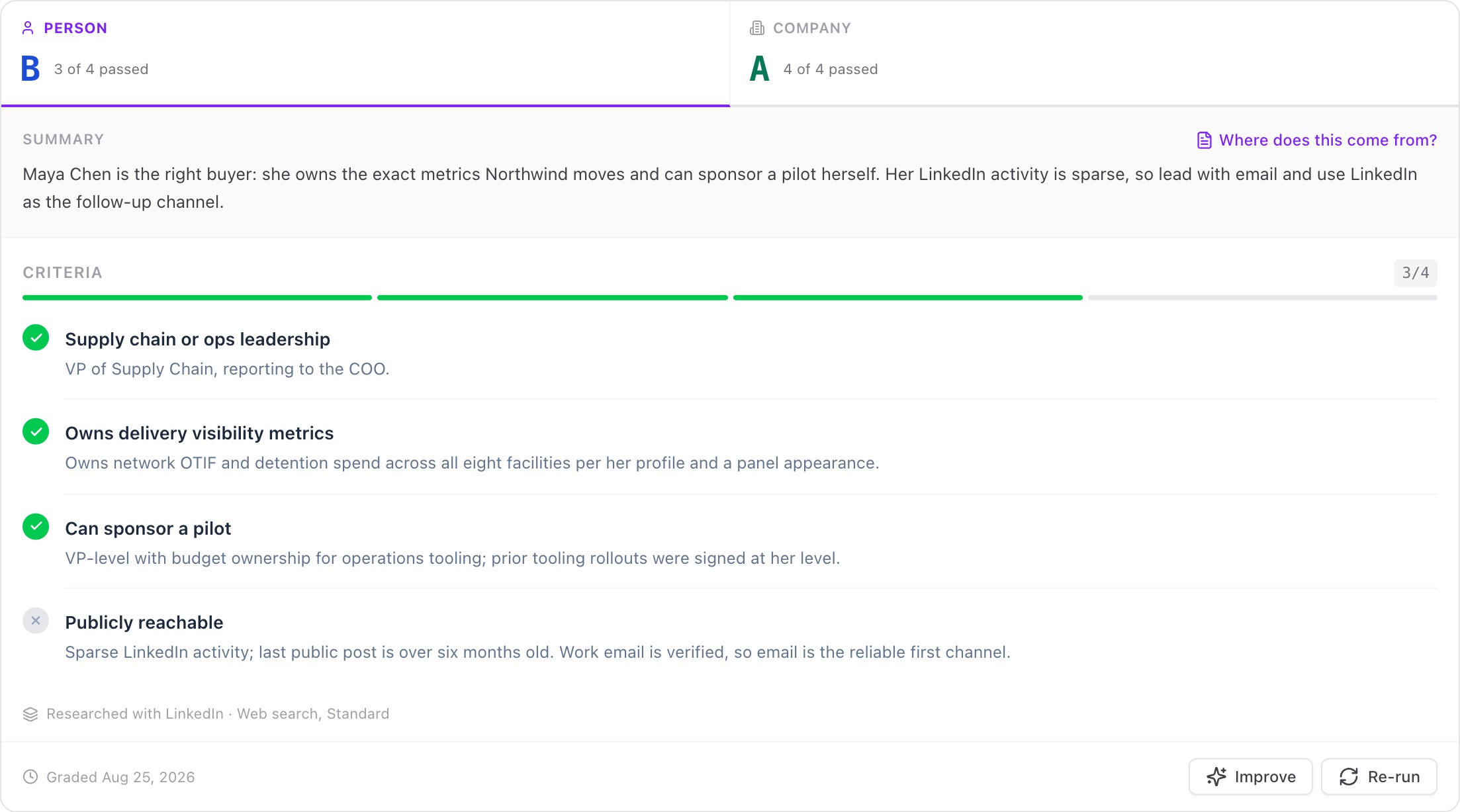
Generation then draws on that research, your content library and your style guide, and claims are checked against their sources. Every sequence is a draft that sends nothing until a rep starts it. Email and LinkedIn run as independent tracks that never reference each other, call steps go to a Call Sheet, and a reply stops the sequence and lands in one Inbox. Sending goes through your own Google or Microsoft inbox, or through Strama-managed warmed inboxes with health monitoring. Speck Design grew pipeline about 50% in its first month on Strama (the Speck Design story).
Better replies are earned before the email is sent
The fastest way to improve B2B cold email reply rates is to make stronger decisions upstream instead of hunting for a magic subject line or automating higher volume: target accounts that fit, use evidence to form a relevant hypothesis, protect deliverability, and ask for an easy next step. When sales development automation supports those disciplines, it can make outbound more efficient and more human, because every message has a clearer reason to exist.