Friday, October 23, 2026
Beyond Sequences: What AI Changes in the Sales Outreach Operating Model

The Real Difference Is Not Faster Email
Are your SDRs using modern sales tools to execute the same manual process faster, or are they operating a smarter outbound motion? That question gets to the heart of how AI-driven sales outreach compares with traditional sales engagement tools.
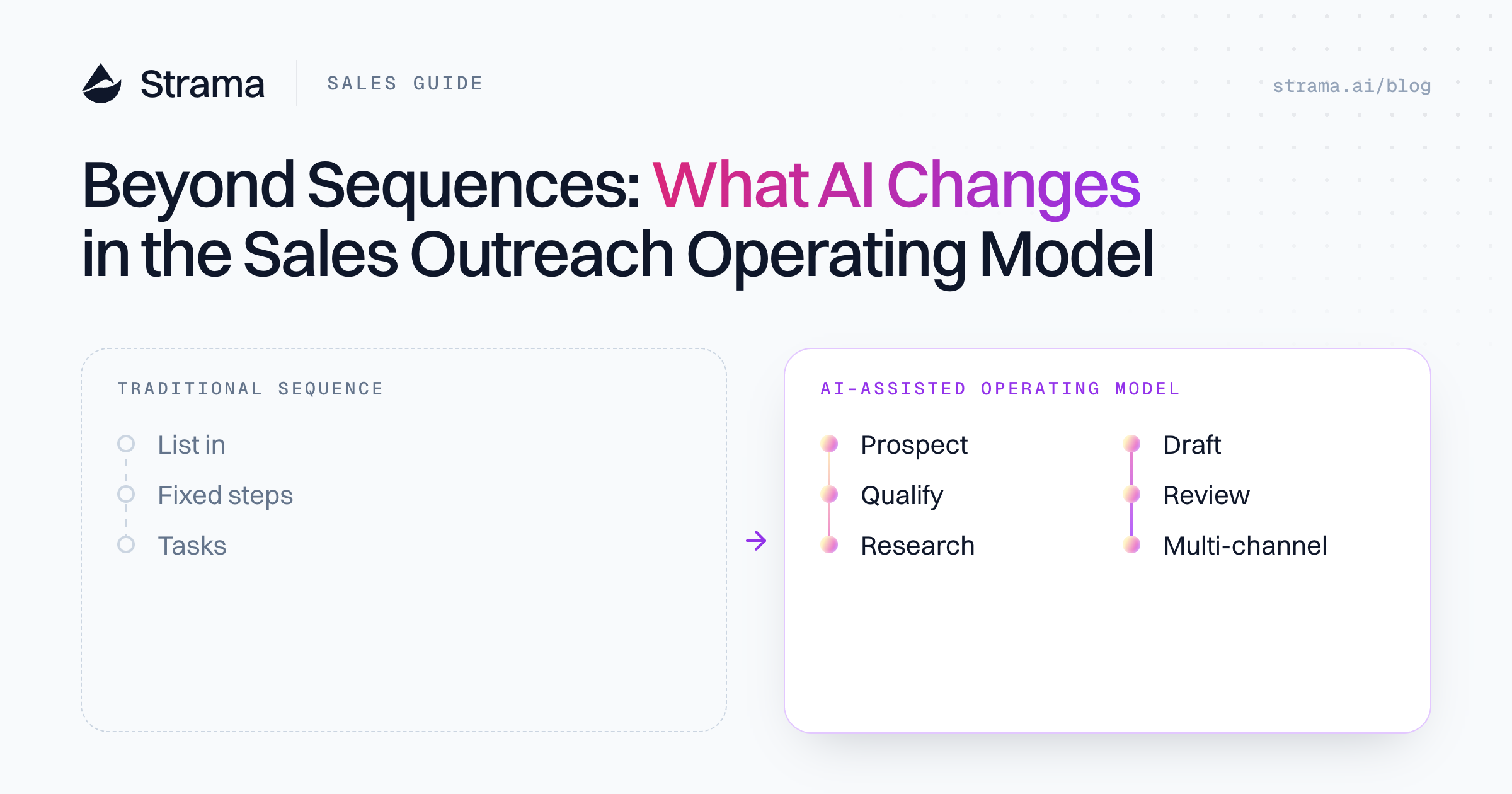
Traditional platforms are built mainly to organize execution: upload a list, place contacts in a sequence, schedule tasks, and measure activities. They can improve consistency, but they generally depend on people to supply the inputs: the target accounts, research, segmentation, messaging angles, and decisions about when to follow up.
AI-driven sales outreach changes the operating model. Instead of just helping an SDR send more touches, it can help with the full decision chain: finding relevant prospects, qualifying accounts against fit criteria, interpreting buying signals, drafting outreach in the team’s voice, and coordinating email, LinkedIn, and phone activity. The goal is to save human judgment for the moments where it creates the most value, not to automate everything.
Traditional engagement tools: structured execution
A conventional sales engagement tool is valuable when the team already has a well-defined outbound process. It typically provides:
- Sequencing and scheduled email sends
- Task queues for calls and LinkedIn activity
- Templates and snippets
- CRM synchronization
- Activity reporting and basic A/B testing
These capabilities solve operational inconsistency. An SDR can follow a repeatable cadence, managers can monitor activity, and teams can reduce administrative overhead.
But the platform often starts after the hard work is done. Someone must still build the list, validate contacts, research accounts, decide which trigger matters, tailor the message, and adapt the cadence when circumstances change. That is why many teams find that high activity volume does not turn into better pipeline on its own.
AI-driven outreach: decisions plus execution
AI sales outreach goes past cadence management: it uses data and context to decide what should happen next. A capable system can connect account research, qualification logic, signal monitoring, messaging, and multi-channel execution in one workflow.
For example, an SDR manager may define an ideal-customer profile using firmographic factors, technology environment, hiring patterns, geography, or account-specific criteria. AI can then help prioritize accounts that meet those requirements, surface relevant changes, and turn the resulting context into an outreach angle.
This is the practical answer to how can sales teams personalize outbound without manual research? Don’t try to research every detail of every prospect. Set a clear relevance standard, use automation to collect and organize qualifying context, and ask SDRs to review the highest-value insights before initiating a conversation.
Strama’s approach reflects this workflow. Its Lead Scout finds people who match a persona and adds them straight into a campaign or scorecard, with no exports or CSV management, while Scorecards grade each company and contact from A to F against fit criteria written in plain language. That combination matters because personalization is only useful when it begins with the right accounts.
For a closer look at the sourcing side of the process, see this guide to AI for sales prospecting.
The comparison across the outbound workflow
The difference is clearest when sales leaders compare the tools stage by stage.
| Workflow stage | Traditional sales engagement tools | AI-driven sales outreach |
|---|---|---|
| Prospecting | Relies on imported lists or separate data tools | Helps identify and surface relevant prospects |
| Qualification | Usually manual or based on static segments | Scores accounts against configurable fit criteria |
| Research | SDR-led, time-intensive, inconsistent | Aggregates context and prioritizes useful signals |
| Messaging | Templates with limited merge fields | Generates tailored drafts based on account context and team voice |
| Sequencing | Automates fixed steps and task reminders | Coordinates adaptive multi-channel actions informed by context |
| Follow-up | Often relies on rep discipline and preset rules | Can flag missed follow-up opportunities and recommend next actions |
| Learning | Reports activity and outcome metrics | Supports pattern recognition across signals, messaging, and outcomes |
Traditional tools are not obsolete. A disciplined sequencing platform is still useful for governance and execution. Its limit is that it rarely removes the upstream research and decisions that eat SDR capacity.
Personalization: templates versus relevant context
Traditional tools often define personalization narrowly: first-name tokens, company-name fields, or a manual custom line at the top of a template. Those additions can make an email look individualized without making it relevant.
AI-driven systems can support deeper personalization by connecting outreach to an account’s business situation. The strongest messages usually combine three elements:
- A credible observation: a meaningful change, priority, or constraint at the account.
- A plausible implication: why that development may create a challenge or opportunity.
- A restrained point of view: a concise reason to discuss the issue now.
A funding announcement alone, for instance, is rarely enough to justify an email. It is public, overused, and often disconnected from the recipient’s actual responsibilities. This analysis of why “congrats on your funding” emails do not work explains why relevance must go beyond a visible event.
An outreach tool that doesn't sound like ai wrote it needs more than access to account data. It needs a messaging framework, clear constraints, and examples of the team’s actual voice. AI should create a high-quality first draft, not introduce inflated claims, generic flattery, or synthetic phrasing.
A style guide that learns from the feedback reps leave on drafted messages can make automated drafts more consistent with the way experienced reps already communicate. The SDR should still review high-value messages, especially when a claim, insight, or executive audience requires precision.
Signals and timing: where AI can outperform static cadences
A traditional cadence assumes you should contact every prospect on a set schedule. This creates consistency, but not necessarily good timing.
AI-driven outreach can monitor changes that suggest a prospect may be more receptive: leadership changes, hiring activity, new initiatives, technology shifts, job postings, or other defined account events. The best trigger depends on the offer and buyer, so teams should configure monitoring around signals that have historically correlated with meaningful conversations.
For sales leaders asking, what is the best way to set up web monitoring for sales signals? start with three steps:
- Identify the two to four events that reliably create urgency for your buyers.
- Define the accounts and personas for whom those events matter.
- Create a distinct outreach play for each signal, with a specific hypothesis rather than a generic reference.
Signal monitoring should narrow focus, not create noise. A new executive hire may matter for one product category, while aggressive hiring in a particular function may be more relevant for another. Learn more about signal-based monitoring for sales prospecting.
Multi-channel engagement: coordinated, not duplicated
Prospects do not live in one channel. Traditional tools can still encourage disconnected activity: an email sequence in one place, LinkedIn tasks elsewhere, and call notes in a separate system.
An integrated AI-driven workflow can coordinate email, LinkedIn, and phone touches around one account narrative. An email may introduce a relevant observation; a LinkedIn action can reinforce credibility; a call can test whether the problem is timely. The message should evolve by channel rather than repeat verbatim.
Phone is especially important when nuance matters. AI can summarize call transcripts, identify recurring objections, and preserve context for future outreach. But it cannot replace the rep’s ability to listen, ask a thoughtful follow-up question, or handle an unexpected business concern.
This is also the answer to can AI sales agents handle complex objections reliably? Not without guardrails. AI can prepare objection frameworks, retrieve relevant context, and help reps review calls. Complex objections involving procurement, competitive positioning, legal risk, organizational politics, or strategic priorities still require a trained human seller.
Where legacy platforms often create friction
When leaders ask, where do leading sales tools often fall short in user experience? the answer is often workflow fragmentation. SDRs may switch between a data provider, spreadsheet, CRM, sequencer, LinkedIn, dialer, inbox, and note-taking tool just to run one prospecting motion.
The cost is more than inconvenience. Context gets lost, follow-up becomes uneven, and reps spend time maintaining systems instead of starting conversations. Research from McKinsey’s 2024 State of AI report found that 71% of respondents said their organizations regularly use generative AI in at least one business function. For sales teams, the opportunity is removing disconnected work from the SDR day, not adopting another AI feature.
List creation is a common bottleneck. Teams can explore how integrated sourcing reduces that delay in this breakdown of moving from campaign idea to outreach.
Deliverability remains a non-negotiable foundation
AI-generated messaging cannot create pipeline if it never reaches the inbox. Dedicated sending infrastructure, warmed inboxes, domain management, and ongoing reputation monitoring remain essential components of a scalable outbound program.
This is one area where teams can be misled by polished user interfaces. An AI workflow may generate strong copy, but poor sending practices will undermine it. Review the operational risks in this guide to the outreach infrastructure that can quietly damage results.
What Sales Leaders Should Carry Forward
- Traditional engagement tools improve consistency in sequencing and task execution, but they generally rely on SDRs to provide research, qualification, and messaging decisions.
- AI-driven sales outreach can connect prospecting, account scoring, signal monitoring, personalized drafting, and multi-channel follow-up into a more complete workflow.
- The best personalization is not a token or a generic custom line; it is a credible account-specific observation tied to a relevant business implication.
- AI is most effective when it prioritizes information and produces reviewable drafts, while SDRs retain ownership of judgment, relationship-building, and complex objections.
- Static cadences should be supplemented with meaningful buying signals so outreach is triggered by relevance, not just by the calendar.
- Deliverability, data quality, and workflow integration determine whether AI-driven efficiency becomes pipeline or simply more outbound volume.
Questions Teams Ask Before Making the Shift
Is AI-driven sales outreach just automated email writing?
No. Email generation is only one capability. A more complete AI-driven model supports sourcing, qualification, account context, signal detection, personalized messaging, and coordinated actions across email, LinkedIn, and phone. Copy generation without accurate data, clear targeting, and deliverability controls will not solve the underlying outbound problem.
Should SDRs still research accounts when using AI?
Yes, but their research role changes. Instead of spending hours collecting basic facts, SDRs should validate the most important context, decide whether an insight is truly relevant, and refine the message for high-value accounts. This produces stronger judgment with less repetitive work.
Will AI outreach reduce personalization quality?
It can, if teams use generic prompts, weak account data, or unreviewed content. Quality improves when AI has defined fit criteria, reliable context, a clear messaging strategy, and a documented team voice. Managers should routinely review samples for accuracy, tone, relevance, and unsupported claims.
How should managers measure success?
Track leading and lagging indicators together. Leading indicators include time from target selection to first touch, percentage of accounts meeting fit criteria, signal-to-outreach conversion, and follow-up completion. Lagging indicators include positive reply rate, meetings held, qualified opportunities created, pipeline value, and conversion by segment.
Can a team adopt AI without replacing its CRM or sales engagement platform?
Usually, yes. The question is whether the AI layer fits into the existing sales workflow and reduces tool switching rather than adding another isolated destination. Start with one constrained use case (such as qualification, signal-led outreach, or personalized first drafts) and measure the result before expanding.
Put the Comparison Into Practice
Start with an audit of the current SDR workflow. Ask where reps spend time before they ever send a first message: sourcing prospects, checking fit, researching accounts, locating triggers, writing drafts, logging activity, or chasing overdue tasks.
Then run a focused 30-day test:
- Select one defined segment and one buyer persona.
- Document the account-fit criteria and the signals that should trigger outreach.
- Create a messaging standard that specifies tone, proof points, and prohibited generic language.
- Use AI to prioritize accounts and create drafts, while requiring SDR review before sending.
- Compare effort, positive replies, meeting quality, and pipeline conversion against the existing process.
A platform such as Strama is most useful when applied to this full workflow: use Lead Scout to bring prospects into the working environment, Scorecards to focus effort, a Style Guide to preserve the team’s voice, and multi-channel outreach with calling capabilities to sustain relevant follow-up.
How This Operating Model Runs in Strama
In Strama, the stages in this article run as one pipeline. Lead Scout finds people who match a persona, a scorecard grades each company and contact from A to F against your criteria, and the research behind each grade feeds generation. Each sequence draws on that research, your content library and your style guide, and generated claims are checked against their sources before a rep sees the draft.
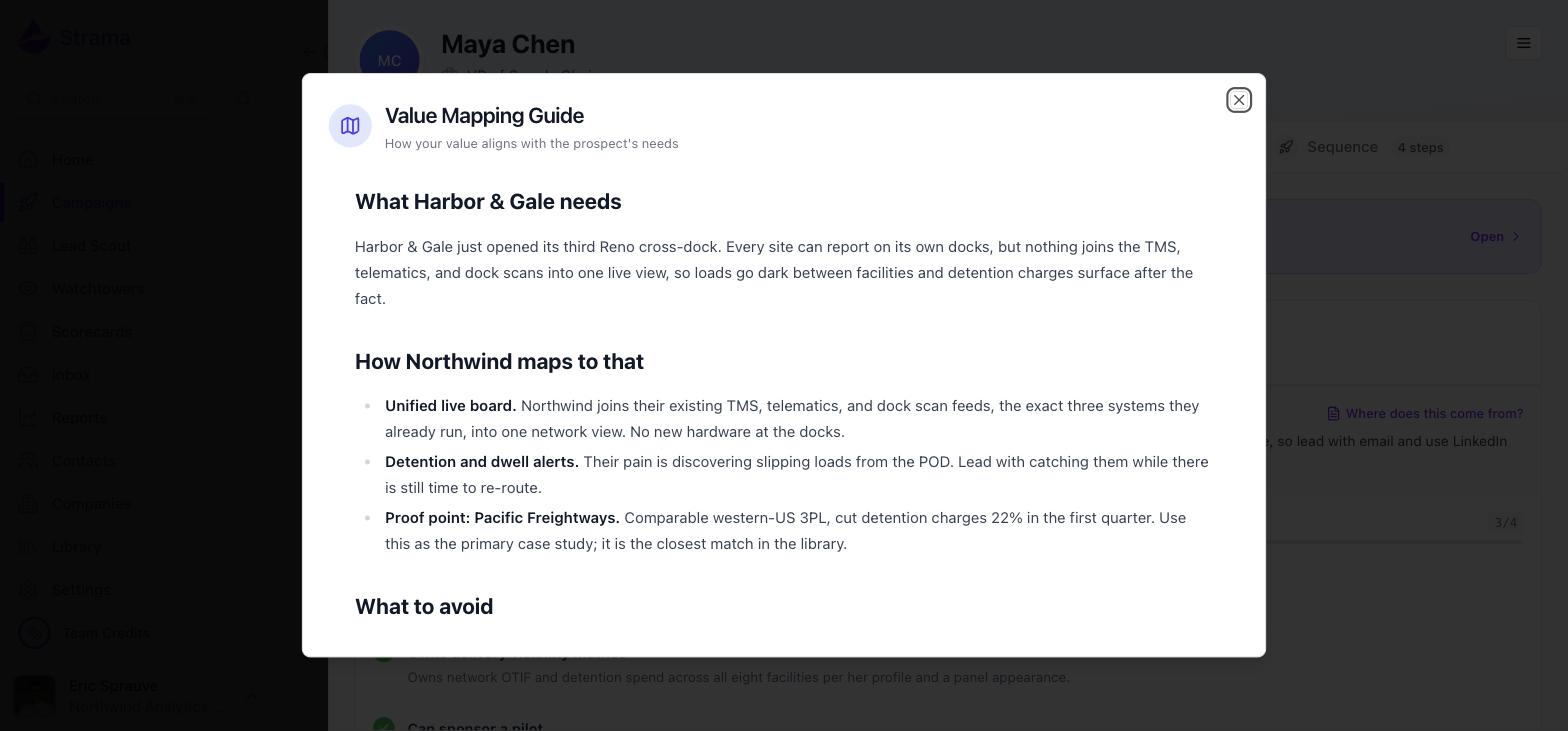
Every sequence lands as a draft and sends nothing until a rep starts it. Email and LinkedIn run as independent tracks, call steps queue prospects onto a Call Sheet, and a reply stops the sequence and lands in one Inbox (how Strama works, end to end).
Judge the model on pipeline. TCS Basys opened roughly $16M in qualified pipeline, with its first meeting in under 30 days (the TCS Basys story).
The Better Question Is What Work Your SDRs Should Still Do
AI-driven sales outreach does not replace thoughtful selling. It removes the repetitive research, list handling, coordination, and drafting work that keeps SDRs from selling thoughtfully at scale. Traditional engagement tools help teams execute a process; AI-driven systems can help teams improve the decisions that shape that process. The strongest outbound teams will use that advantage to become more relevant, more timely, and more human, not just more automated.