Friday, October 30, 2026
From Prospecting Chaos to a Qualified SDR Queue: A Practical Automation Framework

The Productivity Problem Starts Before the First Touch
What would change if your SDRs began each day with a prioritized queue of accounts that already matched your ideal customer profile, showed evidence of need, and came with useful context for the first message? For many teams, the fix sits in lead sourcing and qualification, not outreach.
Research frequently cited by Harvard Business Review found that companies contacting a web lead within an hour were nearly seven times more likely to qualify that lead than companies that waited longer. That figure is about inbound response, but the lesson applies to outbound: timing and relevance deteriorate when teams rely on manual research, spreadsheet exports, and inconsistent handoffs.
Sales development automation fixes this bottleneck. The goal is to automate the repeatable work around lead discovery, data enrichment, account evaluation, prioritization, and workflow routing, so SDRs spend more time opening informed conversations. It should not remove SDR judgment or flood the market with generic messages.
A high-performing system turns a broad market into a smaller, explainable set of accounts worth engaging. It connects lead sourcing and qualification to personalized messaging and multi-channel engagement rather than treating each activity as a separate task.
What an Automated Qualification System Should Deliver
- Define qualification rules before selecting data sources or automation tools; automation only accelerates the process you design.
- Build a repeatable account score from firmographic fit, buying signals, technical or operational context, and disqualifying criteria.
- Use AI to research and summarize evidence, but require transparent sources and clear scoring logic so SDRs can verify recommendations.
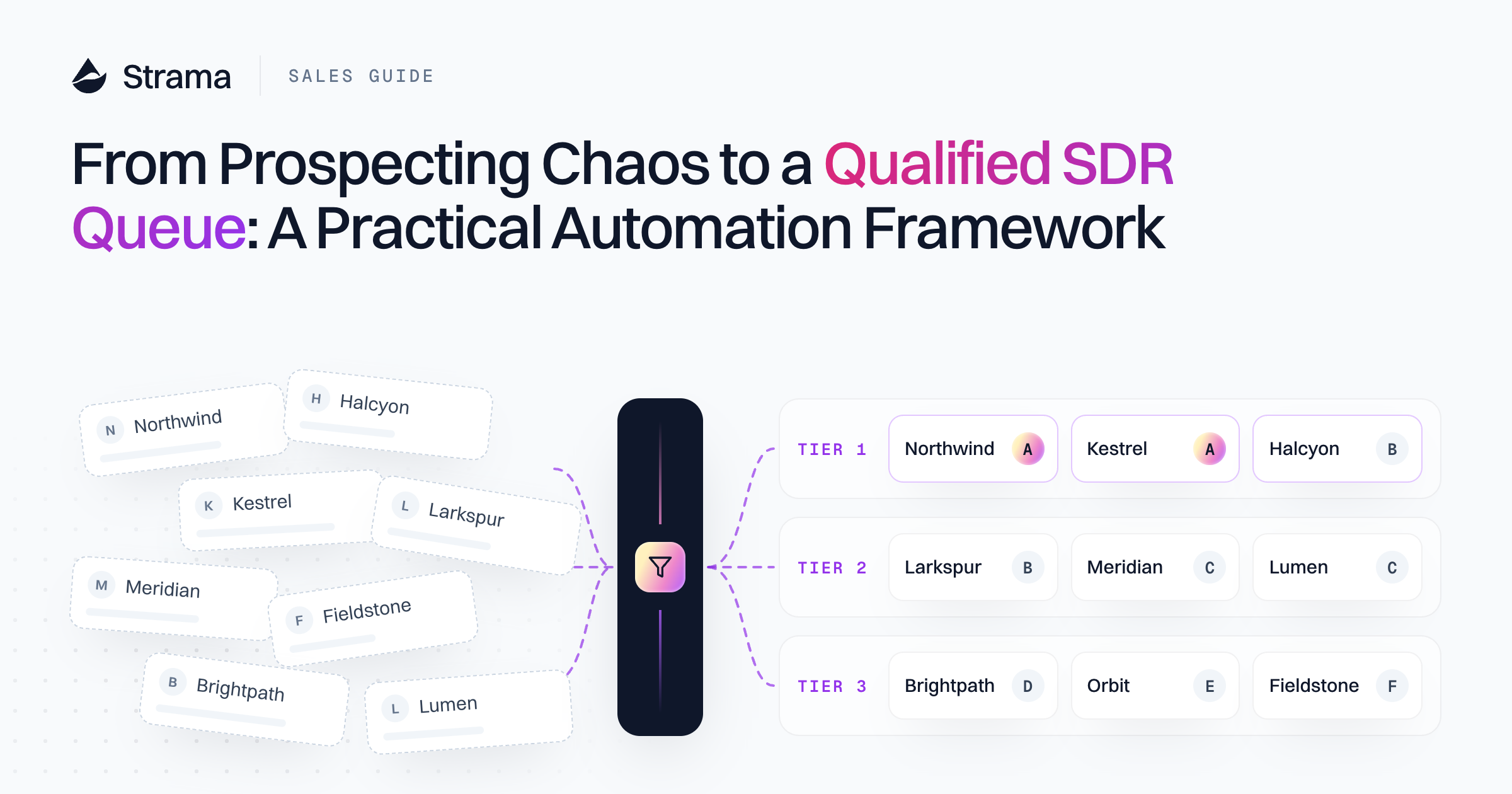
- Route accounts into priority tiers with different service levels, cadences, and human-review requirements.
- Preserve personalization by automating research and first-draft creation, not by sending identical copy at greater volume.
- Measure the workflow from sourced account to qualified opportunity, including data quality, speed to first touch, meetings, and pipeline contribution.
- Review rejected leads, unsubscribes, bounce rates, and CRM outcomes regularly; these are feedback signals for improving your ideal customer profile.
Common Questions SDR Leaders Ask
What does lead scout mean in sales?
The lead scout meaning is simple: it is the process or role that finds prospective accounts and contacts that may fit a company’s ideal customer profile. A person who performs this work may scout lead lists manually through databases, websites, social networks, events, job postings, and intent signals.
In an automated workflow, a lead sourcing tool can do much of the initial discovery. For example, Strama’s Lead Scout finds people who match a persona in the Strama Lead DB or your own Sales Navigator seat and adds them straight into a campaign or scorecard, with no CSV export in between. Discovery alone is not qualification. A useful system identifies candidates, then tests them against defined fit and timing criteria.
Which parts of lead sourcing and qualification should be automated?
Automate high-volume, repeatable activities where rules or structured research can produce a reliable first pass:
- Finding companies that match industry, size, geography, growth stage, or technology criteria
- Enriching accounts with publicly available company and role information
- Identifying likely buying roles and mapping buying committees
- Detecting qualifying or disqualifying signals, such as expansion, hiring, funding, product changes, or territory restrictions
- Applying account scores and sorting accounts into prioritized work queues
- Logging activities and outcomes in the appropriate systems
- Generating research summaries and messaging drafts for SDR review
- Triggering follow-up tasks when an account meets a defined threshold
Keep humans responsible for strategy, nuanced account judgment, relationship context, final message approval for high-value accounts, and learning from objections. AI sales outreach works best when it removes administrative friction while leaving commercial judgment with the team.
How should we build an account scoring model?
Start with the conditions that have historically produced qualified opportunities, not the fields that are easiest to obtain. Review closed-won, closed-lost, disqualified, and stalled accounts from the past six to 12 months. Look for patterns in company type, buyer role, use case, urgency, and sales-cycle quality.
A practical scorecard can use four categories:
- Firmographic fit: Industry, employee range, geography, revenue band, and business model.
- Operational fit: Technology environment, process complexity, sales motion, or other factors directly tied to what you sell.
- Buying signals: Hiring, expansion, leadership changes, relevant initiatives, engagement, or identifiable pain indicators.
- Risk and exclusions: Existing customer status, direct competitor status, inadequate market coverage, poor data quality, or a known mismatch.
Assign weighted points based on evidence, then define clear tiers. For instance, Tier 1 accounts may need strong fit plus at least one credible trigger, while Tier 2 accounts meet fit requirements but lack urgency. Automated tools should explain why a score was assigned. Strama’s advanced prospect research and qualification guidance shows why account context needs to feed a practical qualification decision, not just get collected.
Why do companies lose sales without lead follow-up automation statistics?
The phrase “why companies lose sales without lead follow-up automation statistics” points to a real measurement gap: many teams can report activity volume but cannot show how delayed or missed follow-up affects qualification, conversion, and pipeline. Leads and target accounts lose priority when no one owns the next action.
Track these indicators to quantify the problem:
- Median time from account qualification to first SDR touch
- Percentage of priority accounts receiving the planned number of touches
- Follow-up completion rate after a reply, call, or intent signal
- Meetings and opportunities by account tier
- Stage conversion rates by source, segment, and score
- Recycled or abandoned accounts with no documented next step
Automation should create tasks, reminders, and sequenced actions based on account status, not just schedule more email. If a prospect engages on LinkedIn, an SDR may need a call task; if an account is disqualified, the workflow should capture the reason and suppress future outreach until circumstances change.
Will automation make our outreach less personal?
It can, if teams automate the wrong thing. Generic templates, vague AI prompts, and unverified enrichment look like scale but carry no relevance. Personalization depends on accurate inputs, a clear point of view, and messaging that sounds like the sender.
Use automation to gather context and propose a concise message angle. Then control quality with approved positioning, account-specific evidence, and writing standards. A messaging system such as Strama’s Style Guide, which learns from the feedback notes reps leave on drafted messages, can help keep personalized messaging in the team’s established voice, but SDR managers should still sample messages routinely and review performance by segment.
For larger accounts, set a higher personalization threshold. Require an SDR to validate the research summary, choose the relevant pain hypothesis, and tailor the opening. For lower-priority accounts, use lighter personalization and carefully managed volume.
What is the best way to combine email, LinkedIn, and phone?
Treat channels as coordinated interactions, not duplicate broadcasts. Every channel should add context or create a logical next step.
A simple pattern might be:
- Email with a relevant business hypothesis or observation
- LinkedIn connection or engagement that reinforces recognition rather than repeats the email verbatim
- Phone call when the account score, seniority, signal strength, or engagement warrants a direct conversation
- Follow-up that references the previous interaction and provides a useful reason to respond
Centralize activity history so SDRs can see the full account narrative before acting. A multi-channel engagement workflow is especially valuable when it includes call recording and transcription, because coaching insights and objections can feed back into qualification criteria and messaging.
Put the Workflow Into Practice in 30 Days
Start with a narrow pilot: one segment, one ICP definition, and one SDR team. A focused pilot teaches you more than trying to automate every territory and persona at once.
Week 1: Establish the baseline
Measure current sourcing time, records researched per SDR, qualification rate, first-touch speed, meetings booked, and opportunity conversion. Audit 30 to 50 recently worked accounts to identify where data is missing, scoring is inconsistent, or follow-up breaks down.
Week 2: Define the scorecard and work queues
Document the positive criteria, exclusions, trigger signals, buyer roles, and evidence needed to move an account forward. Create three tiers with explicit actions for each. Teams using automated Scorecards should be able to adjust these criteria as the market and ICP evolve.
For a deeper view of the operational weaknesses that manual research creates, review Strama’s analysis of the lead qualification crisis and contextual research.
Week 3: Automate research, routing, and follow-up
Connect account discovery, enrichment, scoring, and outreach preparation into one workflow. Route high-scoring accounts to SDRs quickly, attach a concise research brief, and create the appropriate next action. Make sure CRM fields and suppression rules are respected before any sequence starts.
If your team is evaluating workflow design and feature adoption, Strama’s product tutorials are practical starting points for using its sales development workflow.
Week 4: Inspect quality and improve the model
Review a sample of scored accounts with SDRs and sales leadership. Ask three questions:
- Did the account actually match the ICP?
- Did the research surface a credible reason to engage?
- Did the assigned action and message fit the account’s priority?
Then compare Tier 1, Tier 2, and Tier 3 results. Refine scoring weights, exclusions, and messaging prompts using conversion data, not anecdotal preferences alone. As the program matures, look at Strama’s approach to AI-powered sales outreach in the context of your own operating model, data governance, and SDR capacity.
How Strama Handles Sourcing and Qualification
In Strama, sourcing and qualification happen in one place. Lead Scout finds people who match a persona in the Strama Lead DB or your own Sales Navigator seat, and it can build its filters from a plain-English description of who you sell to. Leads go straight into a campaign or scorecard with no export. One rule to know: adding acts only on the rows you loaded and selected, so load the full audience before you select it.
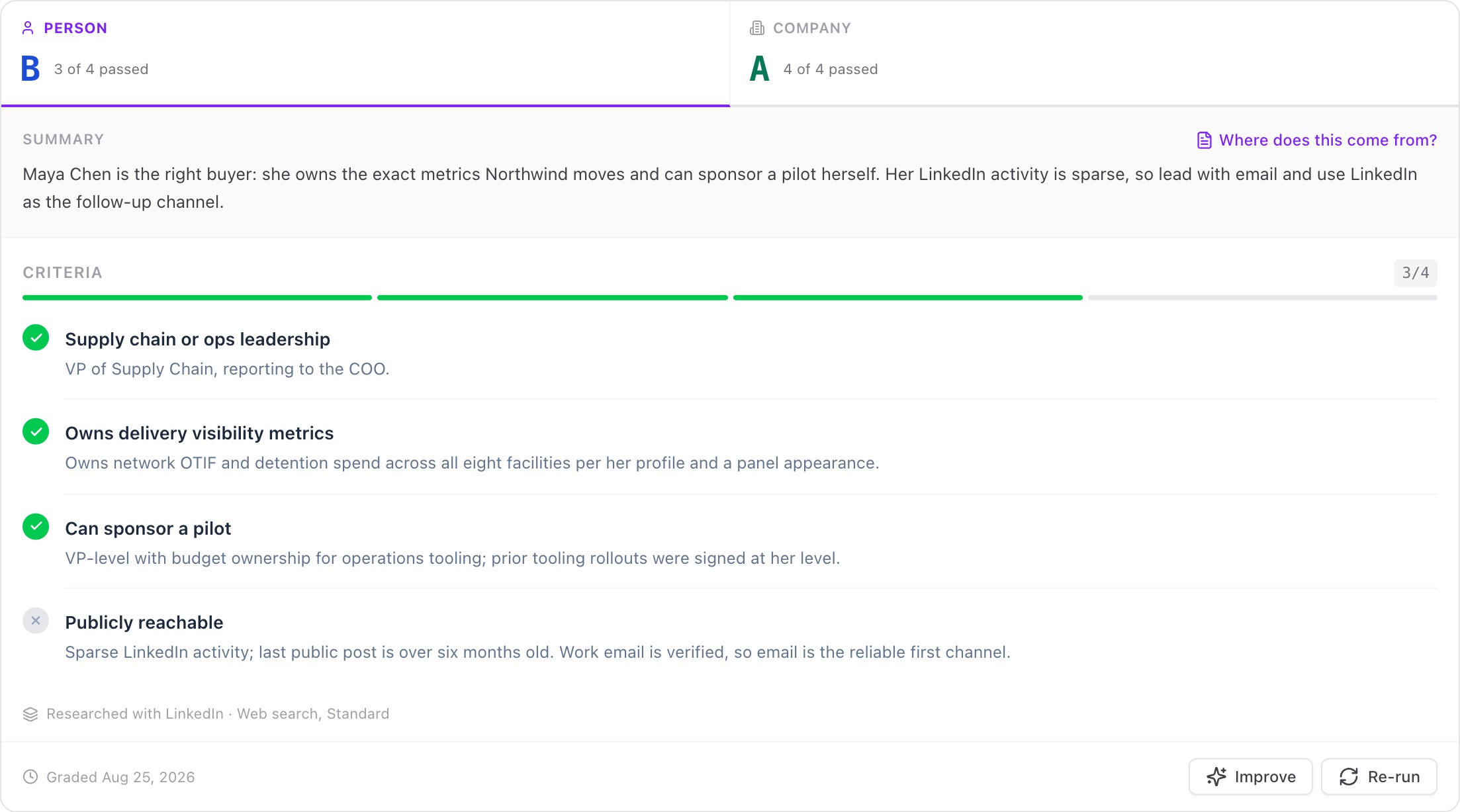
From there, a scorecard grades each company and contact from A to F against criteria written in plain language. Every grade shows a pass or fail and the reasoning for each criterion, and the research behind it is a cited report on the Intelligence tab. That same research is what Strama writes the outreach from, and every generated sequence is a draft that sends nothing until a rep starts it (how scorecards work).
Judge the setup on qualified pipeline, not activity counts. TCS Basys opened roughly $16M in qualified pipeline, with its first meeting in under 30 days (the TCS Basys story).
Make Automation a Better Decision System
The most productive SDR teams use automation to make faster, better decisions about where human attention belongs, not to source more names or send more touches. Effective lead sourcing and qualification combines a clear ICP, evidence-based scoring, timely routing, disciplined follow-up, and meaningful personalization across channels.
When your workflow can explain why an account is worth pursuing (and give the SDR the context to act), you get more than a fuller pipeline: a more focused team, more credible conversations, and a sales development process that scales without losing judgment.