Wednesday, November 4, 2026
The B2B AI Outreach Platform Decision: Match Automation to Your Sales Motion

The Platform Question Behind Every Scaled Outbound Program
What if the biggest reason your outbound program is underperforming is not the copy, the SDR team, or the number of prospects, but the technology stack forcing people to work in disconnected steps?
Consider a sales development leader managing a growing account list. Reps are expected to identify the right companies, find multiple stakeholders, research recent changes, write relevant messages, coordinate LinkedIn and phone follow-up, and keep CRM records current. Each task is manageable on its own. Together they make real personalization hard to sustain.
The best AI platforms for automating personalized sales outreach in B2B do more than generate email drafts. They reduce the handoffs between sourcing, qualification, research, messaging, sequencing, and follow-up, while leaving sales teams in control of the judgment that matters.
There is no universally best platform. The right choice depends on whether your largest constraint is prospecting volume, account prioritization, message quality, multichannel execution, or deliverability. Pick the platform category that removes your team’s current bottleneck without adding another disconnected tool.
What a capable AI outreach platform should automate
An AI-powered sales agent should help SDRs make better decisions and execute routine work faster. At minimum, check whether a platform can support five connected jobs:
- Lead discovery: Find accounts and contacts that match your ideal customer profile without relying on spreadsheet exports.
- Qualification and prioritization: Score accounts using the fit criteria that reflect your actual sales motion, such as firmographics, technology, geography, hiring, or business signals.
- Sales context: Gather the relevant details that give an outreach message a credible reason to exist.
- Personalized outbound messaging: Turn that context into concise, useful copy in the team’s established voice.
- Multichannel follow-through: Coordinate email, LinkedIn, and phone activities so the prospect receives a coherent experience rather than disconnected touches.
AI that only writes messages covers a narrow slice of this workflow. It may save minutes per email but still leaves reps deciding who to contact, assembling context, updating lists, and switching between tools. That is why the strongest platforms combine intelligence with execution.
For teams evaluating how AI changes sourcing and research, AI for sales prospecting offers a useful lens: better prospecting comes from a faster path from relevant data to an informed next action, not from more data.
The platform categories, and where each fits
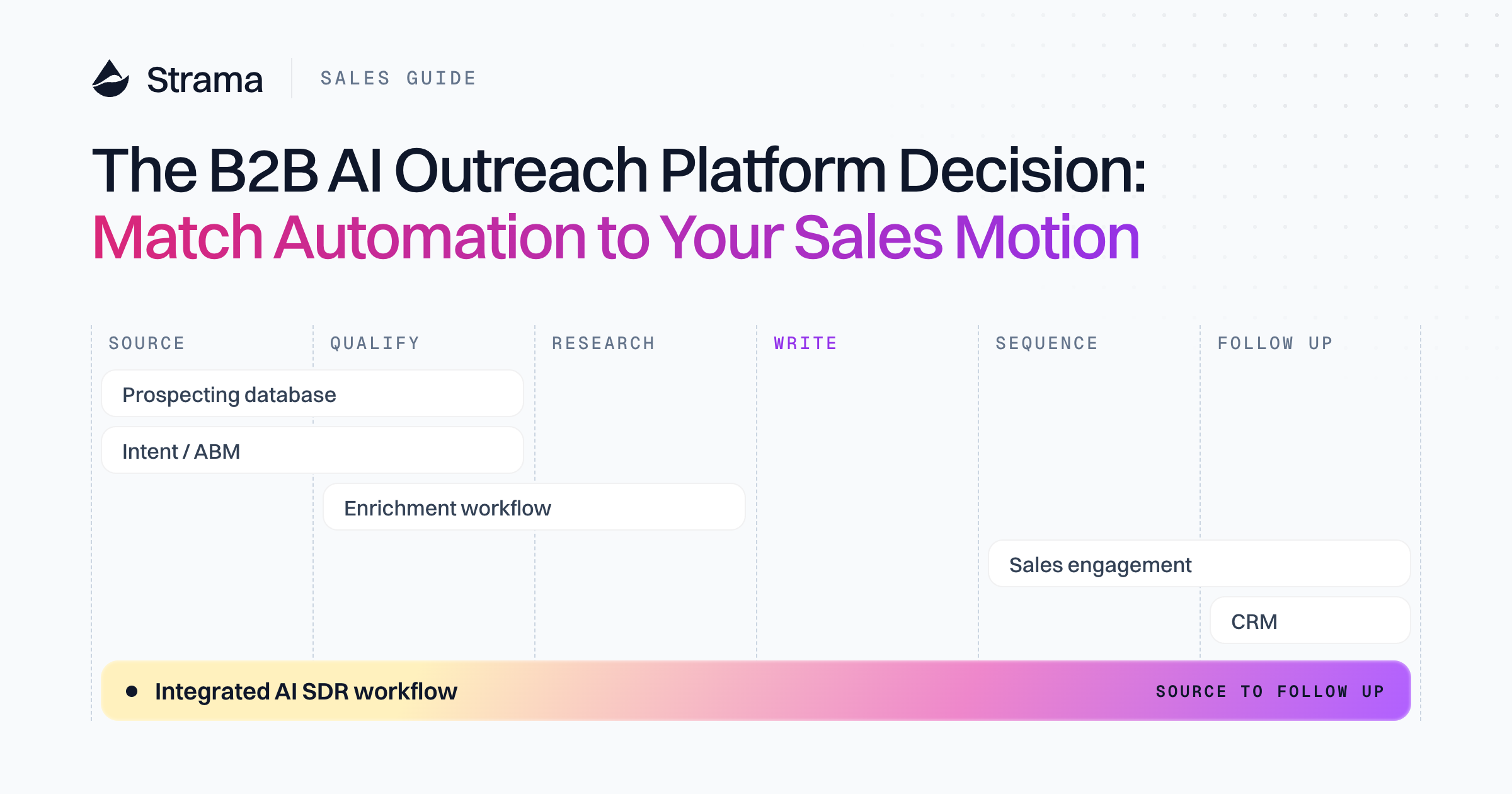
Most B2B teams compare platforms that solve related but different problems. Knowing these categories prevents a common buying mistake: picking a strong point tool and expecting it to run the entire SDR workflow.
| Platform category | Best for | Typical limitation to test |
|---|---|---|
| Sales engagement platforms | Managing cadences, tasks, coaching, and rep activity | AI sourcing, research, and personalization may require separate tools |
| Prospecting databases | Building contact lists and basic filters | Lists can become a manual handoff before outreach begins |
| Data-enrichment and workflow tools | Combining data sources and creating custom research workflows | Often require significant operational design and multiple downstream tools |
| ABM and intent platforms | Prioritizing target accounts based on fit and buying activity | Can identify interest without making daily SDR execution easier |
| CRM suites | Centralizing customer records and reporting | Usually need additional tools for high-volume, personalized outbound |
| Integrated AI SDR workflow platforms | Connecting sourcing, qualification, messaging, and multichannel execution | Buyers should validate data quality, controls, and adoption workflow |
Well-known sales engagement, CRM, enrichment, and ABM platforms can work well when they fit an existing stack. For example, an established sales engagement platform may be the right choice for a large team with a mature CRM process and a dedicated operations function. A data-enrichment workflow may be ideal for a technical team that wants to build custom research automations.
Many mid-sized and enterprise SDR teams need fewer handoffs, not more configurable layers. An integrated platform such as Strama is most relevant when the goal is to source leads, apply custom qualification, create messaging, and act across email, LinkedIn, and phone in one working environment.
A practical standard for personalization at scale
The question, “how can sales teams personalize outbound without manual research?” has a more disciplined answer than asking AI to write an opening line.
Personalization should connect a verified observation to a plausible business implication and a relevant reason to talk. It should not flatter, speculate, or repeat information the buyer already knows.
A highly personalized outbound statement example might read:
“Your team’s expansion of regional fulfillment operations suggests that keeping inventory visibility consistent across locations may become more complex. We help operations leaders reduce manual reconciliation when that transition begins.”
This works because it does three things:
- Refers to a concrete, relevant development.
- Avoids pretending to know the prospect’s internal problems.
- Connects the observation to a credible value hypothesis.
The same message becomes weak if it is sent to the wrong persona, based on outdated information, or followed by unrelated generic touches. So good AI outreach needs account scoring, context management, approved claims, and multichannel coordination, not just a text generator.
Strama’s Style Guide works this way: it learns from the feedback notes reps leave on drafted messages, so drafts pick up each sender’s voice instead of generic language. Teams looking for an outreach tool that doesn't sound like ai wrote it should evaluate whether they can define voice, approved proof points, tone, and message guardrails before content is generated.
How to evaluate the leading options fairly
A useful buying process starts with the problem, not a vendor scorecard. Ask what eats SDR time today and what limits pipeline creation.
If your team has plenty of leads but uneven execution, prioritize multichannel sequencing, call workflows, coaching visibility, and CRM reliability. If the pipeline problem starts earlier, prioritize lead sourcing, segmentation, account scoring, and buying-signal monitoring.
For the question, “how to choose b2b platforms with ai-enabled segmentation and targeting?”, test the platform using a real segment. Ask it to identify accounts that meet your ideal customer profile, exclude poor-fit companies, locate several relevant stakeholders, and explain why each account was prioritized. The quality of the output, and how easily a manager can adjust the criteria, will tell you more than a polished demo.
Strama’s Scorecards are built around this need: teams grade each company and contact from A to F against their own plain-language criteria instead of relying only on broad database filters. That matters because company size alone rarely defines the best prospect.
Also check whether the vendor supports real-time context. A funding announcement, leadership change, hiring pattern, technology adoption, or relevant company event can provide a timely reason for outreach. Signal-based monitoring for sales prospecting explains why signals are most valuable when they alter prioritization and action, not when they only create more alerts.
The non-negotiables: control, deliverability, and context
AI outreach creates risk when it scales weak targeting or unreviewed claims. Build controls into the evaluation process:
- Message governance: Can managers set voice, proof points, prohibited claims, and approval rules?
- Source transparency: Can reps inspect the information behind a personalized message?
- Account-level coordination: Does the system prevent multiple reps from contacting the same buying group incoherently?
- Data handling: Does the vendor provide clear security, permissions, and CRM integration practices?
- Deliverability: Does it support responsible sending limits, inbox health, and domain reputation monitoring?
- Call workflow: Can reps move naturally from digital outreach to phone, with recordings and transcriptions available for coaching?
Dedicated sending infrastructure needs close attention. Even the best message has no impact if it does not arrive. Teams should understand the operational factors behind inbox placement before increasing volume; this guide to hidden outreach infrastructure problems is a useful starting point.
Finally, do not confuse personalization with novelty. Buyers recognize generic AI patterns quickly. Relevant context, direct language, and a human point of view remain differentiators. As explored in the case for human likability in sales, automation should make human selling more consistent, not less human.
What the Best Choice Looks Like in Practice
- The best AI sales outreach platform is the one that resolves the team’s primary workflow constraint: sourcing, qualification, personalization, execution, or deliverability.
- Prioritize platforms that connect lead discovery, account scoring, message creation, and multichannel action. Fragmented workflows often recreate manual work elsewhere.
- Judge AI personalization by the quality of its reasoning: a verified observation, a defensible hypothesis, and a relevant next step.
- Run a real-segment pilot rather than relying on demonstrations. Measure account quality, time to first touch, reply quality, meetings created, and deliverability.
- Maintain manager controls over voice, claims, targeting, and account coordination. Scale amplifies both strong and weak outbound practices.
- Treat AI as an SDR force multiplier, not an autonomous replacement for qualification judgment and buyer empathy.
Common Questions Sales Leaders Ask Before Buying
Which AI sales rep is best for discovering and messaging key stakeholders for ABM outreach?
For account-based outreach, choose a platform that can identify multiple stakeholders, score the account against custom criteria, preserve account-level context, and coordinate messages across channels. A generic email-writing tool falls short because ABM depends on buying-group coverage and coordination.
An integrated workflow platform is often a strong fit when SDRs need to move directly from account discovery to qualified contacts and tailored outreach. Strama’s Lead Scout and Scorecards address this sequence by helping teams find prospects and prioritize accounts before messaging begins.
Can AI-generated outreach still feel personal?
Yes, but only when the AI gets meaningful inputs and works within clear guardrails. It needs current account context, persona-specific value propositions, a defined team voice, and limitations on unsupported claims.
Aim for a message that is accurate, concise, and credible enough to earn a reply, not one that tries to look clever.
Should we replace our sales engagement platform with an AI outreach platform?
Not automatically. If your current engagement platform is well adopted and your challenge is only research or enrichment, adding a specialized tool may make more sense. If SDRs constantly move among a database, spreadsheets, AI writer, sequencing tool, dialer, and CRM, consolidating may help more.
Map the workflow before deciding. The goal is fewer manual handoffs and better execution, not fewer vendors at any cost.
How should we measure an AI outreach platform pilot?
Use a controlled test lasting long enough to capture replies and booked meetings (often four to eight weeks, depending on your sales cycle). Compare the pilot group with a similar baseline on:
- Time spent per qualified account
- Percentage of accounts meeting your qualification standard
- Positive reply rate and reply quality
- Meetings held, not just meetings booked
- Opportunity creation and pipeline contribution
- Bounce rate, spam complaints, and inbox placement indicators
Don’t judge a platform only by email volume or open rates. Those metrics do not reliably indicate buyer interest or revenue impact.
Which B2B buyer experience platform offers the best personalized microsite generation?
Personalized microsites are a related but distinct category from sales outreach automation. They can strengthen account-based campaigns by giving a buying group a tailored destination after engagement begins. Judge those tools on content governance, analytics, CRM integration, and how easily SDRs can use the experience in follow-up.
For the initial outreach workflow, prioritize accurate targeting and relevant messaging first. A sophisticated microsite cannot compensate for contacting the wrong account or sending an unconvincing first message.
Build a Shortlist Around Your Actual SDR Workflow
Start by documenting one outbound motion from target-account selection through the first qualified conversation. Identify every system, handoff, and repetitive task involved. That exercise shows whether your team needs better data, stronger qualification, faster personalization, coordinated multichannel outreach, or all of the above.
Then create a shortlist of two or three platforms and have each vendor demo the same use case using your target persona and account criteria. Ask to see the full journey: source accounts, score fit, identify stakeholders, create messages in your voice, execute follow-up, and record outcomes.
If disconnected list building is slowing launch speed, this breakdown of the list-building bottleneck can help teams decide what to cut first. Use the pilot to validate operational fit, not just AI output quality.
How the Platform Decision Plays Out in Strama
In Strama, sourcing, qualification and writing happen in one place. Lead Scout finds people who match a persona in the Strama Lead DB or through your own Sales Navigator seat, and adds them straight into a campaign or scorecard with no export. A scorecard grades each company and contact from A to F against plain-language criteria, with a cited research report on the Intelligence tab. Generation draws on that research, your content library and your style guide, and every sequence is a draft that sends nothing until a rep starts it.
The voice problem gets handled on the drafts themselves. A rep highlights what reads wrong and leaves a note, and the notes they approve become rules in that sender's style guide, so later sequences start closer to how the rep writes (making the AI sound like you).
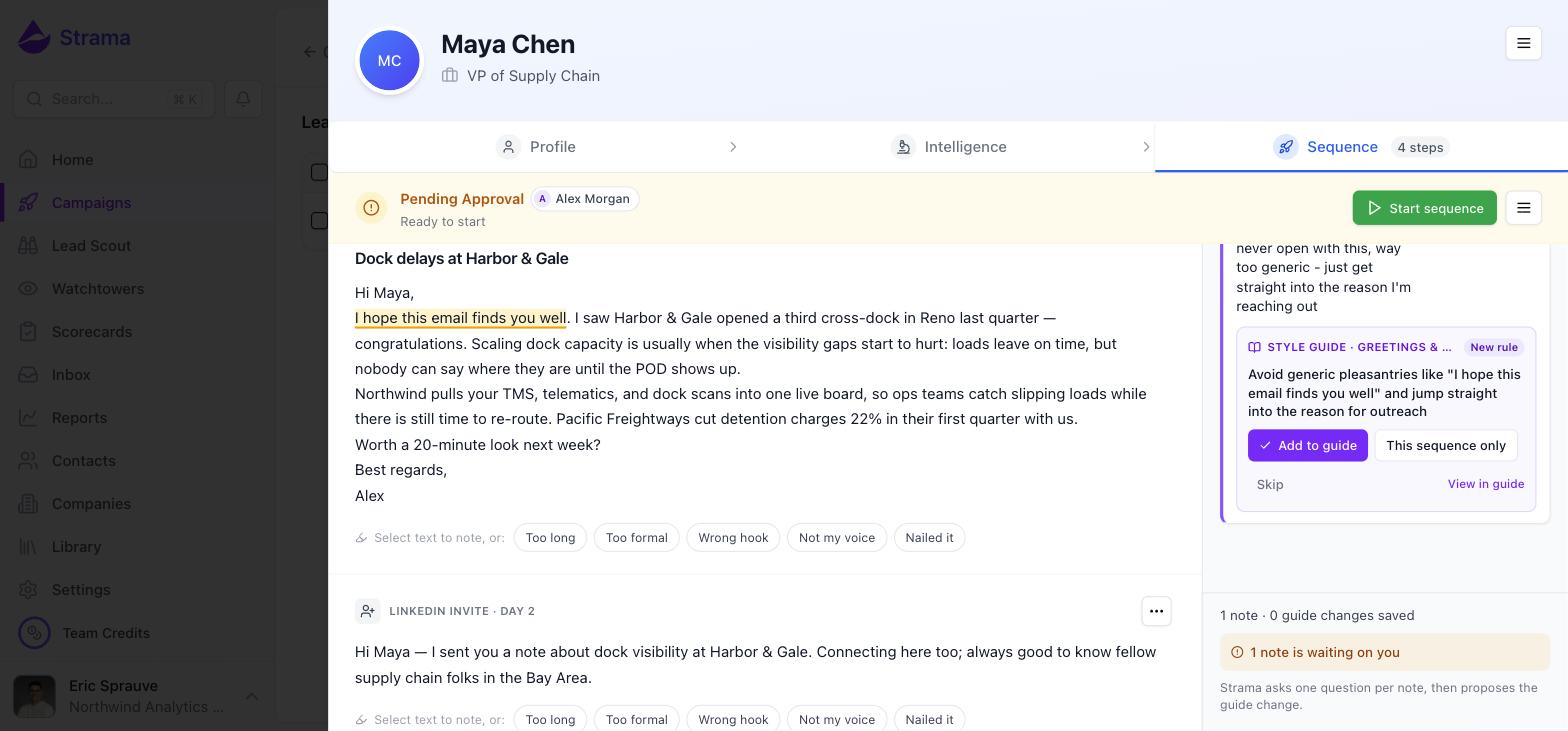
Sequences run email and LinkedIn as independent tracks, with call steps on a Call Sheet, and a reply stops the sequence and lands in one Inbox. TCS Basys opened roughly $16M in qualified pipeline, with its first meeting in under 30 days (the TCS Basys story).
Automation Should Create More Relevant Conversations
The best B2B AI outreach platforms win by helping SDR teams spend more time on qualified accounts, communicate with more relevance, and follow through consistently across the channels buyers use, not by sending the most messages.
Choose technology that makes the full sales development workflow simpler while keeping the judgment, voice, and accountability that buyers expect from a professional sales team. When AI is connected to sound qualification and real buyer context, personalization becomes scalable without becoming performative.