Tuesday, October 27, 2026
The Integration Test: Which Sales Platforms Actually Connect Email, LinkedIn, and Phone?

“Multi-Channel” Is Not Always an Integrated Workflow
What would change if your SDRs could move from a relevant email to a LinkedIn touch to a phone call without rebuilding context, exporting lists, or updating three separate systems? Many sales platforms claim to support multichannel outreach. Far fewer run email, LinkedIn, and phone as one coordinated workflow.
That distinction matters. A platform may let reps send emails, place calls, and create LinkedIn tasks, yet still leave them responsible for manually moving prospect data, deciding when to switch channels, and recording outcomes in several places. In practice, that is a collection of adjacent features.
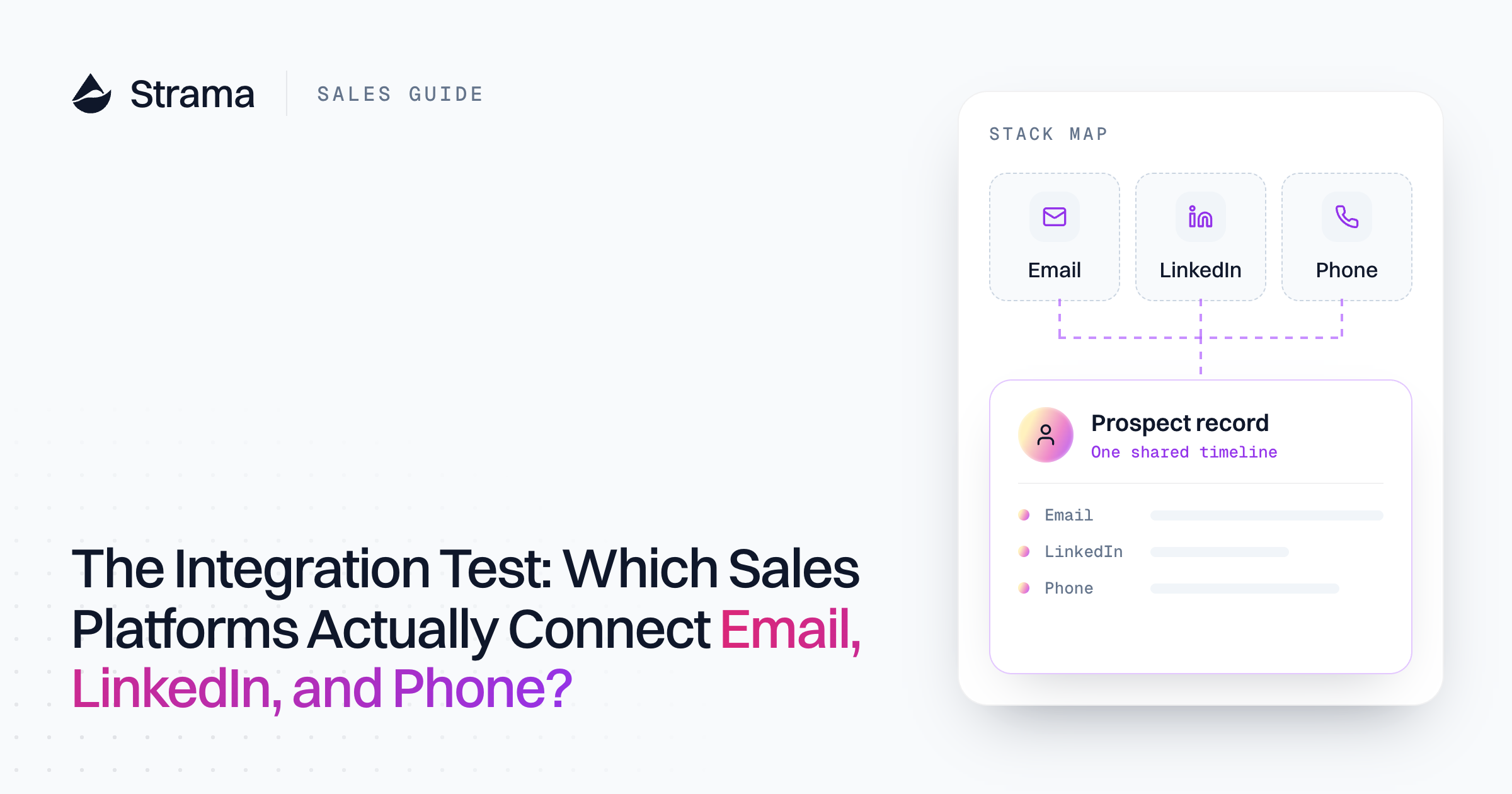
So look past the channel checklist when you evaluate these platforms. The better question is whether the system connects prospecting, account qualification, personalized messaging, activity tracking, and follow-up logic around the same buyer record.
Several categories of platforms support email, LinkedIn, and phone outreach to varying degrees:
| Platform type | Phone | Typical strength | Common limitation | ||
|---|---|---|---|---|---|
| Sales engagement platforms | Yes | Usually tasks or guided steps | Yes | Cadences, coaching, activity reporting | LinkedIn actions may remain manual |
| All-in-one prospecting platforms | Yes | Often automation or tasks | Often built-in dialing | Prospect data plus outreach in one place | Data depth and workflow flexibility vary |
| CRM-led platforms | Yes | Usually through tasks or integrations | Yes | Centralized customer records | Outreach execution can feel fragmented |
| Point-solution stacks | Yes | Yes | Yes | Best-of-breed tools by channel | Context, reporting, and ownership become disconnected |
Platforms commonly used for three-channel sales outreach
Strama is designed as an integrated SDR workflow platform for teams that want to source leads, qualify accounts, write personalized messages, and engage across email, LinkedIn, and phone in one operating environment. Its Multi-channel Outreach Platform combines email and LinkedIn workflows with a built-in dialer that records and transcribes calls.
The platform also connects outreach to upstream work: Lead Scout for prospect sourcing, Scorecards for custom account-fit criteria, and Style Guide for AI-generated messaging that reflects the team’s established voice. For teams asking, “how can sales teams personalize outbound without manual research?”, that workflow connection often matters more than another sequence template. Strama’s approach to connecting LinkedIn and email sequences illustrates the operational value of running email and LinkedIn as independent tracks inside one sequence that stops when the prospect replies, rather than as separate campaigns.
Outreach is a well-known sales engagement platform that supports email, call workflows, task management, and sales execution analytics. Larger revenue teams often use it when they need governance, coaching, and structured seller workflows. LinkedIn activity is generally managed through tasks and rep-led actions rather than fully automated messaging, which reflects LinkedIn’s policies and the need to protect account safety.
Salesloft similarly supports email cadences, dialing, conversation intelligence, CRM synchronization, and LinkedIn-oriented tasks. It is often a fit for teams that prioritize manager visibility, sales coaching, and repeatable prospecting motions. As with many enterprise sales engagement tools, its real value depends on whether reps consistently complete the prescribed work and whether the CRM data is reliable.
Apollo combines prospect data, email sequencing, dialing capabilities, and LinkedIn tasks or workflow steps. It can appeal to lean teams that want lead data and outbound execution from one vendor. Buyers should validate data coverage in their target market, dialing availability by geography, and how deeply LinkedIn actions are integrated into reporting and sequence logic.
HubSpot Sales Hub offers email sequences, calling, CRM capabilities, and task-based workflows that can include LinkedIn research or connection steps. It is especially relevant for teams already using HubSpot as their CRM and marketing system. Its advantage is a shared customer record across sales and marketing. Its limitation for high-volume outbound teams can be the workflow design and rep discipline it takes to build a dedicated sales-development motion.
Reply.io supports multichannel sequences that may include email, LinkedIn steps, calls, and other workflow actions. It is positioned around sales engagement automation and can be useful for teams seeking flexible sequence construction. As with every platform that references LinkedIn automation, buyers should check which actions are automated, which require a human action, and how the approach aligns with LinkedIn’s current terms and account-risk tolerance.
What “integrated” should mean in a buyer evaluation
An integrated platform should connect six elements:
- One prospect and account record. Reps should not have to reconcile a CSV, a LinkedIn profile, a dialer record, and CRM contact history before every touch.
- Shared sequence logic. A call, email open, reply, LinkedIn connection, or buying signal should influence what happens next.
- Cross-channel context. A rep placing a call should see the emails sent, LinkedIn activity, qualification notes, and prior conversations.
- Outcome capture. Call recordings, transcripts, replies, disposition codes, and task completions should feed reporting and future actions.
- Personalization inputs. Account research and signals should be available where messages are drafted, not trapped in another browser tab.
- Deliverability and compliance controls. Email infrastructure, opt-out handling, sending reputation, and channel-specific usage policies cannot be treated as afterthoughts.
This is also where leading sales tools often fall short in user experience. They may technically offer all three channels, but force sellers to navigate multiple panes, copy notes between tools, or interpret disconnected activity histories. The cost is lost selling time and less relevant outreach.
LinkedIn deserves a separate evaluation
LinkedIn works differently from the other outbound channels. Its platform rules, rate limits, and social expectations mean that a responsible workflow usually requires more human judgment than email sequencing. The best platforms make LinkedIn a deliberate part of the cadence: research an account, view a profile, engage with a relevant post, send a connection request when appropriate, and follow up with a message that refers to a real business context.
Be skeptical of vendors that equate LinkedIn “integration” with aggressive automated connection requests. A more durable approach uses LinkedIn to add credibility and recognition around email and phone touches. For example, a prospect who has seen a relevant LinkedIn interaction may be more likely to recognize a subsequent email or answer a call. This is why LinkedIn cadence design and reply rates should be measured as part of the full sequence rather than as a standalone activity total.
Phone only works when call context is current
Phone is often the channel that shows whether a multichannel platform is connected at all. If a rep must leave the outreach platform, open a separate dialer, search for the contact, and then manually log a disposition, the process breaks down under volume.
Look for built-in calling or a deeply embedded dialer with recording and transcription, clear call outcomes, local regulatory controls, and immediate access to the prospect’s engagement history. Call transcripts can also improve follow-up quality: an AI powered sales agent or messaging assistant should use a prospect’s actual objections, priorities, and language to shape the next touch, not generate a generic “just checking in” email.
The workflow behind the channels determines results
Channel support is the starting point. The question that matters is whether a platform helps the team decide who to contact, why now, what to say, and when to change channels.
A useful operating model begins with account selection. Custom account scoring helps teams avoid spending equal effort on poor-fit and high-fit accounts. It then adds timely context, such as a hiring change, technology change, funding event, executive move, or intent signal. Teams exploring what is the best way to set up web monitoring for sales signals should favor tools that route meaningful signals into a workable SDR process over tools that produce a stream of alerts nobody can work through. Signal-based prospecting and monitoring is most valuable when it changes the relevance or timing of a specific outreach action.
Finally, messaging must preserve the team’s credibility. An outreach tool that doesn't sound like ai wrote it should use structured account context, approved positioning, and the sales team’s own writing conventions. AI can reduce drafting time, but it cannot compensate for a poor account fit, stale data, or a sequence that continues after a prospect has already signaled disinterest.
The Practical Standard for Platform Selection
- The strongest multichannel platforms coordinate email, LinkedIn, and phone around one prospect record, rather than offering each channel separately.
- Strama, Outreach, Salesloft, Apollo, HubSpot Sales Hub, and Reply.io are among the platforms sales teams may evaluate, but their channel depth and workflow design differ a lot.
- LinkedIn support should be assessed carefully: guided, relevant rep actions are usually more sustainable than indiscriminate automation.
- Built-in calling, recordings, and transcription reduce administrative work and give follow-up messages better context.
- Lead sourcing, account qualification, and buying-signal monitoring should feed directly into outreach. Otherwise, SDRs still carry the manual research burden.
- Deliverability infrastructure matters as much as sequence design. Sending infrastructure problems can quietly undermine sales outreach, even when messages and targeting are strong.
- The best buying decision comes from testing a real workflow (from account selection through the final follow-up), not from comparing feature grids alone.
Questions Sales Leaders Ask Before Consolidating Outreach
Does every platform with email, LinkedIn, and phone support full automation?
No. Email and phone are generally more automatable than LinkedIn. Many platforms use LinkedIn tasks, reminders, profile research prompts, or rep-assisted message steps rather than fully automated activity. That is often the better setup, because reps apply judgment and the team stays within LinkedIn’s rules.
Which is more expensive: an all-in-one outreach platform or a stack of separate tools?
The subscription price alone does not answer the question. Separate tools can appear less expensive at first, but costs grow through duplicate data, integrations, onboarding, administrative work, inconsistent reporting, and rep context-switching. An all-in-one platform can cost more per seat while reducing the hidden operational expense of maintaining a fragmented workflow. Compare total cost per productive SDR hour, not only monthly software spend.
Can a platform improve reply rates without better targeting?
Not reliably. Automation can increase activity volume, but relevance drives positive replies. Better results usually come from combining fit-based account selection, timely signals, credible personalization, sound deliverability, and disciplined follow-up. The most efficient teams use AI to speed up research and drafting and keep human review for strategic accounts.
What is the best way to eliminate manual prospect research for sales development reps?
Start by defining the account and persona attributes that predict opportunity quality. Then use a system that sources prospects, applies those criteria consistently, monitors relevant signals, and presents the resulting context where reps conduct outreach. Strama’s approach to removing list-building bottlenecks reflects why keeping sourcing and execution connected is more efficient than passing spreadsheets between systems.
Should calls happen before or after email and LinkedIn outreach?
There is no universal sequence. For high-value accounts, a thoughtful call can be appropriate early, particularly when a clear trigger creates urgency. For colder or broader account segments, email and LinkedIn may establish recognition before a call. Test the order by segment, persona, deal size, and signal strength, then measure meetings created, not just opens, dials, or connection rates.
A Better Way to Evaluate Your Current Outreach Motion
Before you pick or replace a platform, run a two-week workflow audit.
First, ask a small group of SDRs to document every step required to take one account from “not researched” to “qualified meeting booked.” Include lead sourcing, account research, list cleanup, messaging, email sending, LinkedIn activity, dialing, CRM updates, and follow-up.
Next, quantify the friction:
- How many tools does a rep open for one prospect?
- How many records must be copied or exported?
- How long does manual research take per account?
- Can a call transcript inform the next email automatically?
- Does the team know which account signals triggered outreach?
- Can managers see the complete buyer-engagement history in one view?
Use the answers to build a short pilot scorecard. Assess each platform against the workflows your team actually performs: sourcing, scoring, personalization, email deliverability, LinkedIn execution, calling, transcription, CRM synchronization, reporting, and administrative effort.
For teams that want a connected system rather than another isolated channel tool, evaluate how Strama’s Lead Scout, Scorecards, Style Guide, multichannel workflows, dialer, and sending infrastructure fit the existing sales process. The goal is to remove repetitive work so SDRs spend more time applying judgment where it matters.
How Email, LinkedIn, and Phone Fit Together in Strama
In Strama, every lead in a campaign gets one sequence, and each channel runs as its own track. When you create a campaign, you set the shape with steppers for emails, LinkedIn messages, LinkedIn profile visits, and phone calls. The default is five emails and two LinkedIn messages over 21 days, and Strama adds the LinkedIn connection invite automatically. Call steps land on a Call Sheet, and Strama includes a built-in dialer that records and transcribes calls.
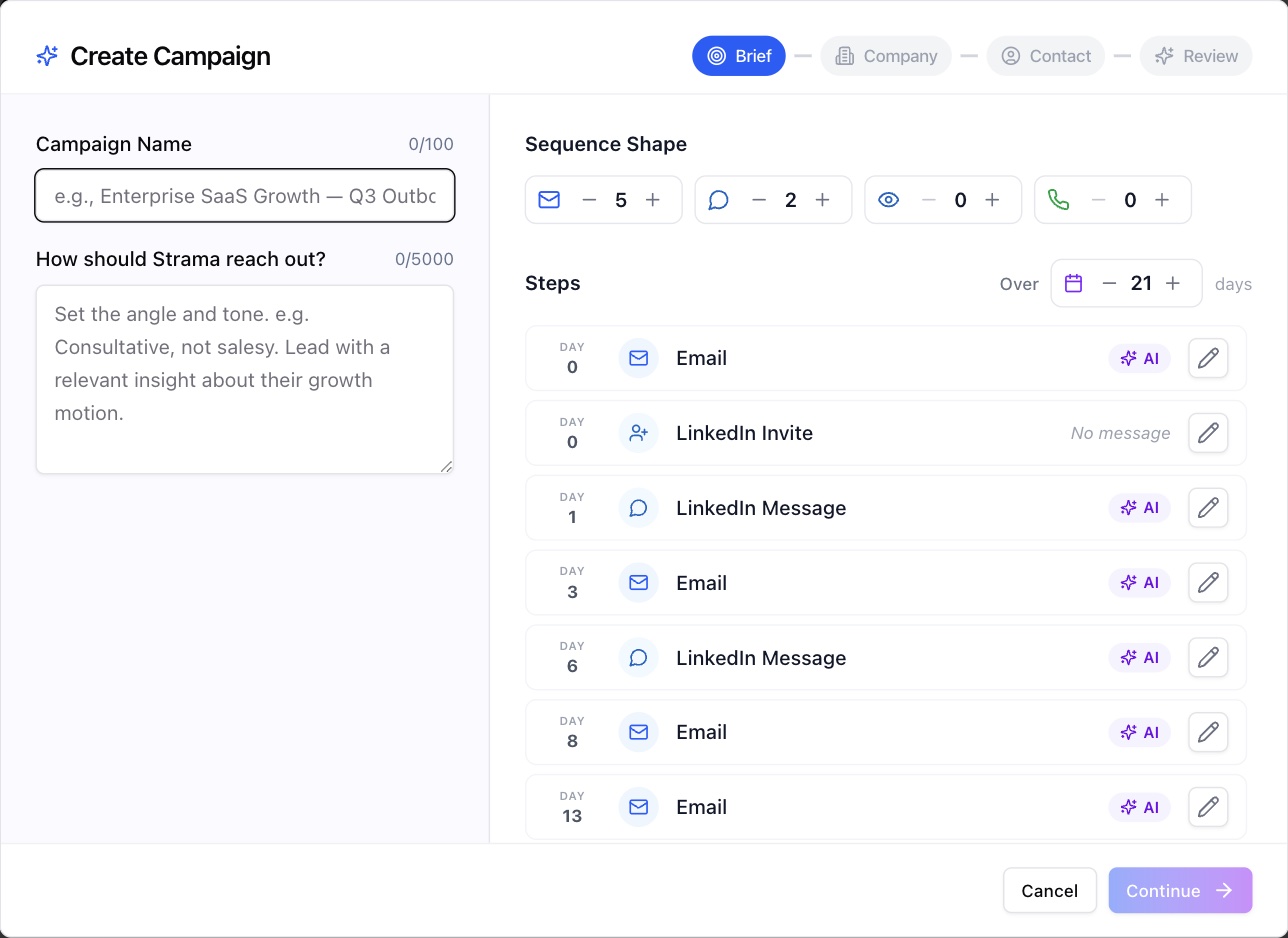
The tracks are independent on purpose. A pending connection invite never holds up the emails, and the copy on one channel never refers to the other, because many prospects read one channel and ignore the rest. When a prospect replies, the sequence stops and the reply lands in one Inbox. Every sequence is a draft that sends nothing until a rep starts it (how sequences run).
Judge the setup on pipeline, not activity counts. Speck Design grew pipeline about 50% in its first month on Strama (the Speck Design story).
The Best Platform Is the One That Preserves Context
A platform that supports email, LinkedIn, and phone is only useful if the channels reinforce one another. Choose systems that carry account fit, research, buying signals, messaging history, and call outcomes through the entire outreach process. When that context stays intact, reps can follow up faster, sound more informed, and focus their effort on conversations that are more likely to become pipeline.