Monday, November 9, 2026
The Reply-Rate System: How to Earn More Responses From B2B Cold Email

Why More Emails Rarely Create More Conversations
What if your declining cold email reply rate is not a copywriting problem at all, but evidence that your outbound system is asking prospects to do too much work?
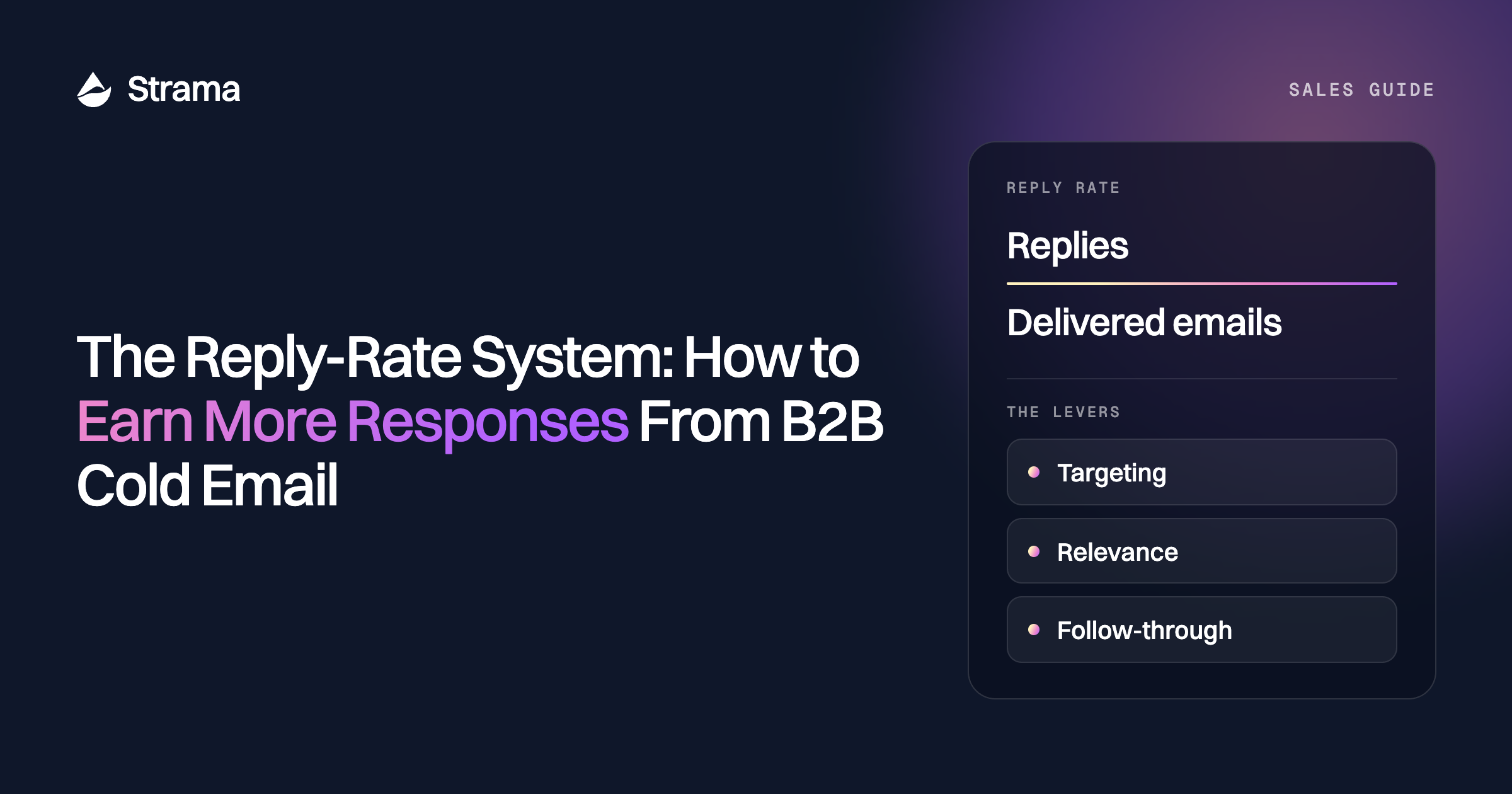
Many teams assume better cold email results come from sending more messages, adding more “personalization,” or finding a cleverer subject line. Those tactics help at the margins. Lasting reply-rate gains come from a disciplined system: choosing accounts with a credible reason to care, identifying the right people, translating a relevant signal into a specific hypothesis, and following up through channels prospects actually use.
That distinction matters because B2B buyers are busy and skeptical. They do not reply because an email uses their first name or references a recent funding announcement. They reply when the message makes a plausible, low-friction case for why a conversation could be worthwhile now. A generic trigger often performs poorly because every seller has access to it; this is why “congrats on your funding” emails frequently miss the mark.
The goal is more qualified conversations without sacrificing deliverability, brand credibility, or SDR time, not a better email metric.
Start with account relevance, not a contact database
Even excellent writing cannot rescue poor targeting. A large contact database may create the appearance of scale while producing messages with no clear connection to the recipient’s priorities. This is a central reason huge data sets can still lead to generic sales emails: data availability is not the same as commercial relevance.
Build a practical ideal customer profile around observable fit indicators, such as:
- Company size, geography, and industry
- Existing technology, operational maturity, or business model
- Hiring patterns that suggest a relevant initiative
- Growth, expansion, product, compliance, or leadership changes
- Evidence of a problem your offer can realistically address
Then define disqualifiers with equal care. An account that lacks budget potential, operates in an excluded market, or has no plausible use case should not enter the sequence merely to fill an activity target.
Effective lead sourcing and qualification is therefore a reply-rate lever. Tools such as Strama’s Lead Scout can find people who match a persona and add them straight into a campaign without a manual export-and-cleanup workflow, while Scorecards grade each company and contact from A to F against a team’s own fit criteria. Whatever the tool, the principle holds: only ask an SDR to personalize an account after the account has earned that effort.
Turn research into a useful point of view
Personalization explains why a fact may create a business implication. Inserting the fact alone does not do that.
Compare these approaches:
“I saw you are expanding your sales team. Congratulations.”
“Your recent hiring suggests the team may be balancing ramp speed with message consistency. We help sales development leaders reduce manual prospecting work while preserving the voice reps use in outbound.”
The second example is not guaranteed to be correct, and it should not pretend certainty. But it gives the recipient a reason to consider the message. It moves from observation to hypothesis.
Use a simple three-part structure for personalized messaging:
- Signal: Name a credible, relevant observation.
- Implication: Connect it to a likely operational challenge or opportunity.
- Question: Invite the prospect to confirm, reject, or explore the hypothesis.
For example: “Noticed your team is hiring enterprise AEs. When organizations add that motion, pipeline coverage often becomes harder to maintain without increasing SDR admin work. Is improving outbound capacity a priority this quarter?”
This approach keeps messages concise while making them specific. It also makes a “no” easier, which often improves response quality. A clear no is more valuable than silent non-engagement.
Write for recognition, not persuasion
Cold email is not the place to explain every feature, share a long company history, or make a broad claim such as “we can transform your revenue engine.” Its first job is to earn recognition: “This person may understand a problem I have.”
A high-performing first email usually includes:
- A direct subject line that does not overpromise
- One relevant observation or problem hypothesis
- One concrete outcome, without unsupported performance claims
- A short call to action that is easy to answer
- Plain, human language
Keep the body short enough to scan on a phone. Remove introductions that consume space without adding value, such as “My name is…” or “I hope this finds you well.” Avoid false urgency, excessive exclamation points, and vague superlatives.
For sales teams using AI sales outreach, voice consistency matters. If an email sounds unlike the rep who will handle the reply, trust erodes right when interest appears. A documented messaging framework, like an AI-informed Style Guide, helps automation retain the team’s vocabulary, level of directness, proof standards, and preferred calls to action.
Use a sequence that adds value instead of repeating itself
One email is rarely enough. Silence is ambiguous: the prospect may be busy, may not have seen the note, or may need more context before responding. But repetitive follow-ups such as “Just checking in” teach recipients that the next message is safe to ignore.
Each touch should change the angle. A practical sequence might include:
- Touch 1: A relevant observation and question
- Touch 2: A concise consequence of leaving the issue unresolved
- Touch 3: A proof point, customer pattern, or alternative perspective
- Touch 4: A direct “worth discussing or not a priority?” close
Instead of sending daily, match the cadence to deal complexity and audience seniority. Monitor positive replies, negative replies, meeting conversion, unsubscribes, and spam complaints, not just total response volume. A campaign with many “remove me” replies is not healthy performance.
Coordinate email with other channels
Email is strongest when it is part of multi-channel engagement, not an isolated sequence. A prospect may ignore an inbox but recognize a name after a thoughtful LinkedIn interaction or a relevant call. The objective is coherent familiarity, not channel saturation.
Before connecting on LinkedIn, engage selectively with a prospect’s public content if you have something useful to add. After an email, a connection request can briefly state the relevant reason for reaching out. For high-fit accounts, a phone call can surface context email cannot capture.
Cadence design should match the channel to the message. Research on LinkedIn cadence and reply rates reinforces the need to make each touch intentional rather than treating social outreach as a duplicate email channel. An integrated workflow that includes email, LinkedIn tasks, and calling reduces the risk that SDRs send conflicting messages or lose track of account activity.
Protect deliverability before optimizing copy
A perfectly targeted email cannot earn a reply if it lands in spam. Deliverability is part of reply-rate optimization, not a technical afterthought.
Protect it by:
- Sending from properly configured, warmed inboxes
- Keeping sending volumes consistent and proportionate to engagement
- Verifying addresses before launch
- Avoiding deceptive subject lines and spam-heavy language
- Removing hard bounces and uninterested contacts promptly
- Segmenting campaigns so one weak audience does not damage overall sender reputation
Dedicated sending infrastructure, continuous reputation monitoring, and domain management can reduce operational burden. They also make valid testing possible. If inbox placement fluctuates wildly, a copy test cannot tell you what actually caused a result.
Test the full outbound hypothesis
Reply rates improve fastest when teams test one meaningful variable at a time. Do not simultaneously change the audience, offer, message length, subject line, sending domain, and sequence timing. The result may look better or worse, but the team will not know why.
Run tests around strategic questions:
- Which account signal predicts the highest positive reply rate?
- Does a pain-led opening outperform an opportunity-led opening?
- Does a question-based CTA outperform a meeting request?
- Which persona has both reply potential and downstream conversion?
- Does calling high-scoring accounts after email improve meeting rates?
Use a large enough sample before drawing conclusions. For low-volume enterprise outreach, directional learning may take longer, so combine quantitative results with qualitative review of replies and call transcripts. This is where sales development automation should support judgment, not replace it.
Finally, evaluate the entire funnel. Reply rate matters, but the better measure is qualified meetings or pipeline created per account contacted. That is the connection between outbound execution and sales pipeline optimization.
The Practices That Compound Reply-Rate Gains
- Targeting quality comes before copy quality. Prioritize accounts with verified fit, a credible trigger, and a realistic business problem.
- Treat personalization as a hypothesis about the prospect’s situation, not as a collection of public facts.
- Make first emails concise, specific, and easy to answer. A low-friction question often outperforms a broad request for a meeting.
- Build follow-up sequences in which every touch adds a new reason to engage; do not rely on repeated “checking in” messages.
- Combine email with LinkedIn and phone thoughtfully, using one coordinated account narrative across channels.
- Protect deliverability through healthy sending practices, verified data, and reliable infrastructure before interpreting campaign results.
- Measure positive replies, meetings, opportunity quality, and pipeline, not reply rate in isolation.
- Use AI to scale research, qualification, drafting, and workflow execution, while maintaining human review for positioning, claims, and high-value accounts.
Common Questions From Sales Development Teams
What is a good B2B cold email reply rate?
There is no universal benchmark because results vary by audience, offer, sender reputation, market maturity, and how a team defines a reply. A campaign sent to highly qualified accounts may generate fewer total replies but a far higher proportion of positive responses and meetings.
Track at least three measures separately: total reply rate, positive reply rate, and meeting-booked rate. The last two tell you more about outbound quality.
How long should a cold email be?
Most first-touch cold emails should be brief enough to scan quickly (often around 75 to 150 words). The exact length matters less than clarity. If an email needs several paragraphs to establish relevance, the targeting or core proposition may need refinement.
Use the message to earn a response, not to complete the entire sales presentation.
Do subject lines increase reply rates?
Subject lines influence opens, but they cannot compensate for irrelevant content. Use plain, truthful subject lines that match the body of the email. Testing can help, but prioritize account selection, message relevance, and deliverability first.
Avoid clickbait or artificially urgent subject lines. Even when they increase opens, they can damage trust and lead to lower-quality engagement.
Should SDRs use AI to write every cold email?
AI is valuable for scaling research synthesis, first drafts, account summaries, and personalization at volume. It should not be allowed to invent facts, make unsupported claims, or send unreviewed messaging to strategically important accounts.
The best operating model gives AI clear inputs (ideal customer profile, approved claims, messaging style, disqualifiers, and account signals), then uses human oversight for quality control and learning.
How many follow-ups should a cold email sequence include?
A reasonable starting point is three to five touches, adjusted for your sales cycle, audience, and channel mix. Stop earlier when a prospect gives a clear negative response, unsubscribes, or is clearly out of profile.
Every follow-up needs a distinct purpose. If the team cannot say what is new in the next touch, it should not send it.
Where do leading sales tools often fall short in user experience?
Many tools optimize one part of the SDR workflow while forcing reps to switch between data sources, spreadsheets, sequencers, LinkedIn tasks, call tools, and reporting dashboards. That fragmentation creates administrative work, reduces context, and makes consistent personalization harder.
An integrated platform can reduce those handoffs by connecting sourcing, scoring, messaging, outreach tasks, and call activity in one workflow. The benefit goes past fewer tabs: a clearer, more complete view of why an account is being contacted and what should happen next.
Put the System Into Practice This Week
Start with a focused audit of one active outbound segment rather than redesigning every campaign at once.
- Review 25 recently contacted accounts. Mark each one as strong fit, uncertain fit, or poor fit. Identify the signals that distinguished strong-fit accounts from the rest.
- Read the last 20 replies. Categorize them as positive, neutral, negative, unsubscribe, or out of office. Look for language prospects use to describe priorities and objections.
- Rewrite one first-touch template. Replace generic personalization with one signal, one business implication, and one low-friction question.
- Refresh follow-ups. Ensure every touch introduces a different angle: consequence, proof, alternative insight, or a clear close-out question.
- Choose one test variable. For example, compare a hiring-based trigger against a technology-change trigger for the same persona and offer.
- Review deliverability conditions. Confirm address quality, sending volume, domain health, and opt-out handling before expanding volume.
For teams that need to run this process at scale, Strama brings lead discovery, account scoring, AI-generated messaging in the team’s voice, and email, LinkedIn, and calling workflows together. Its built-in dialer and transcripts can also help managers connect email performance with the conversations that follow; see the principles behind a cold call script that earns engagement.
The immediate priority is simple: reduce low-fit volume, increase the quality of the reason for outreach, and create a repeatable learning loop around qualified outcomes.
How Strama Handles Deliverability and Follow-Up
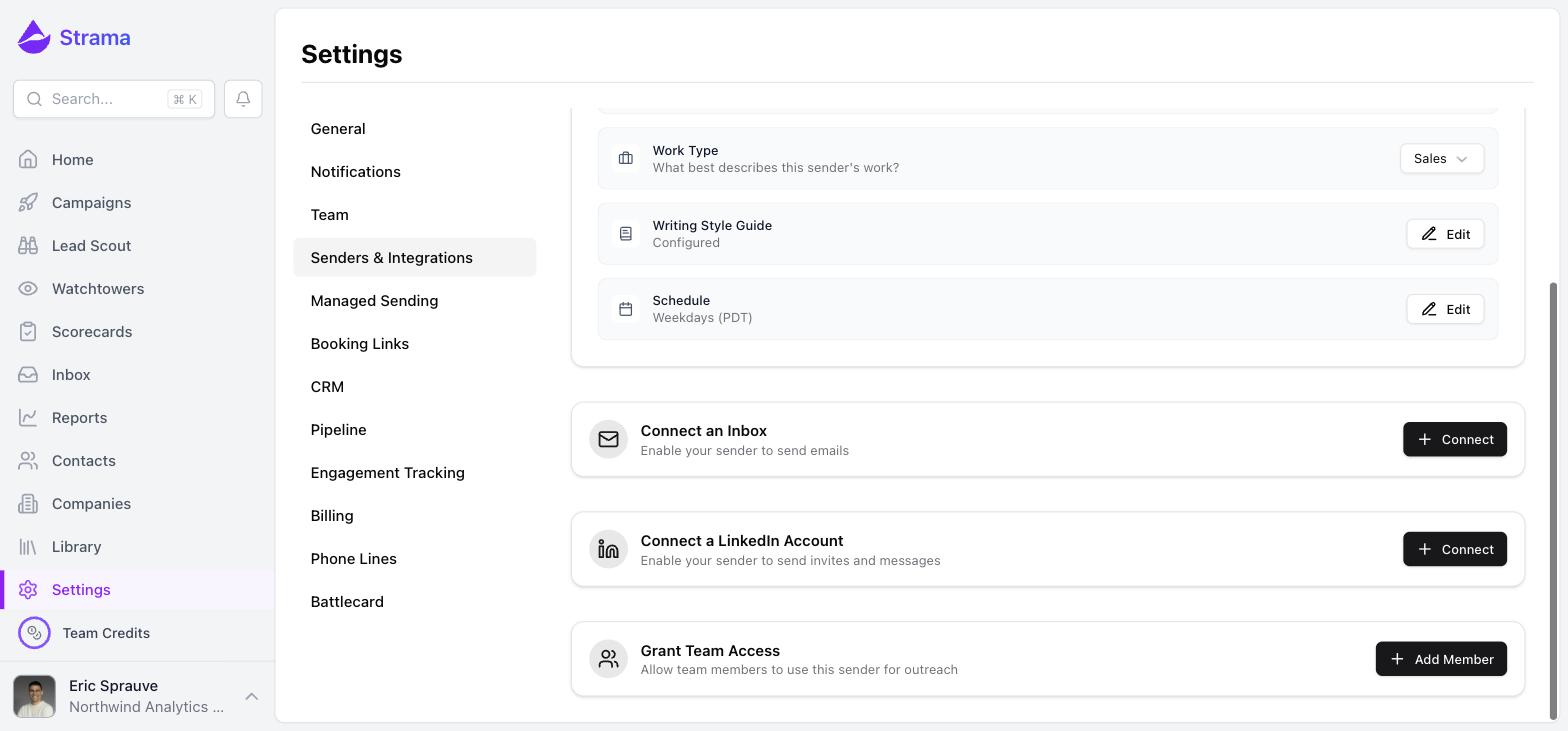
In Strama, every email goes out through a real mailbox. Reps connect their own Google or Microsoft inbox, or Strama provisions managed inboxes on lookalike .com domains, warms them over about a month, and monitors each one with a health score, cutting volume or pausing cold sending when health drops. Sends are spread through the working day in the sender’s timezone (connecting your email inbox).
Follow-up runs on the same rules this article recommends. Email and LinkedIn run as independent tracks that never reference each other, and when a prospect replies, the sequence stops and the conversation lands in one Inbox, so nobody gets a follow-up after they answer (how sequences run).
Judge the system on pipeline, not reply rate alone. TCS Basys opened roughly $16M in qualified pipeline, with its first meeting in under 30 days (the TCS Basys story).
Better Replies Begin Before the Email Is Written
Higher B2B cold email reply rates do not come from one magic template or a larger sending volume. They come from a connected outbound discipline: accurate account selection, relevant hypotheses, authentic concise messaging, respectful persistence, coordinated channels, and reliable measurement. When SDR teams use automation to remove repetitive work, not to automate irrelevance, they can spend more time on the judgment that prospects actually notice. The result is a healthier pipeline built on conversations worth having.