Friday, October 16, 2026
Build a Lead Engine, Not a Bigger SDR Task List

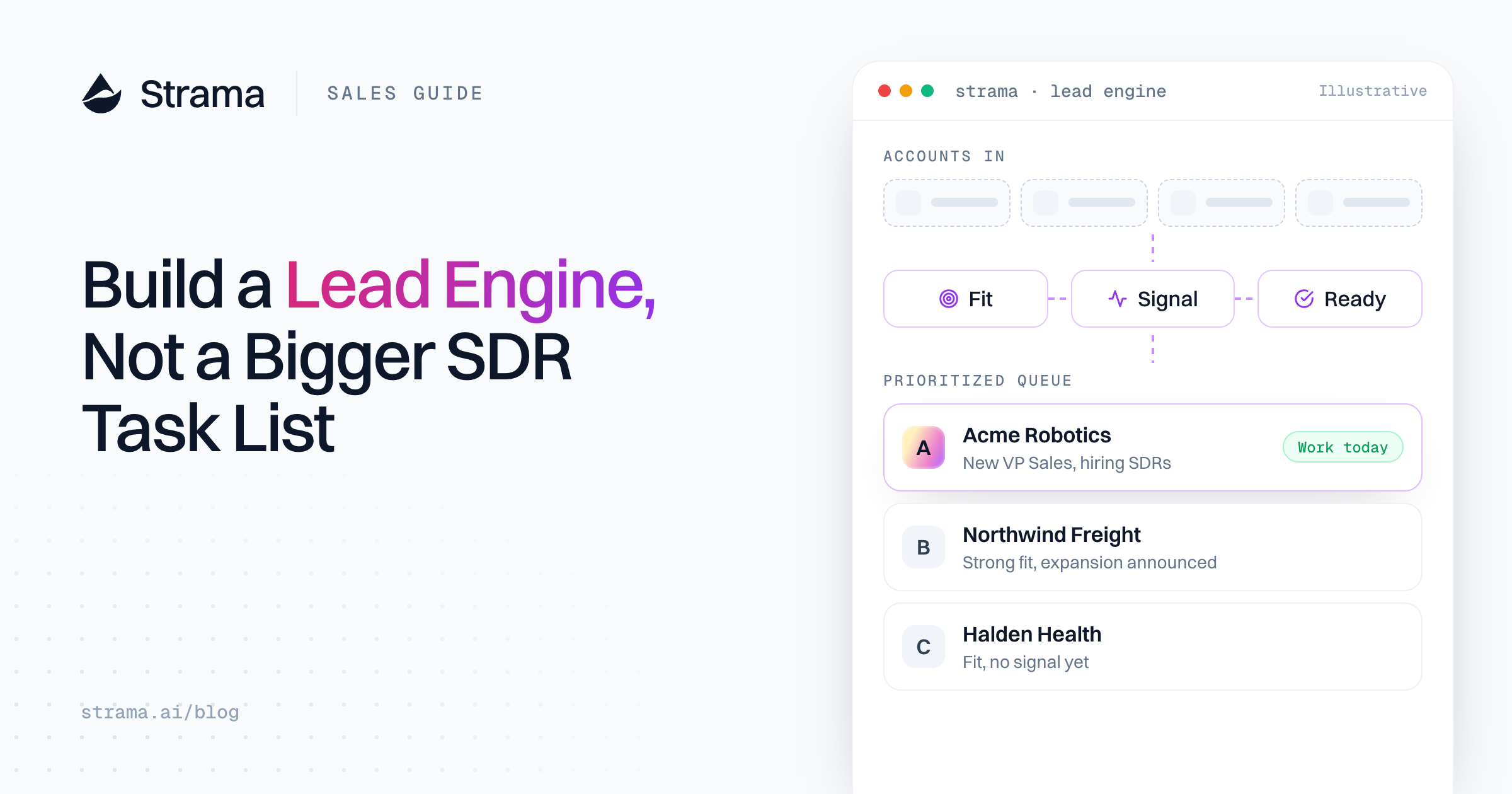
Why More Prospecting Activity Rarely Solves the Productivity Problem
How much of your SDR team’s week is spent deciding who to contact rather than having a meaningful conversation with the right buyer? Salesforce’s State of Sales research has reported that sales representatives spend only about 28% of their time actually selling. For many B2B teams, the rest goes to account research, list cleaning, CRM administration, and manual qualification.
Automating lead sourcing and qualification addresses that gap, but only when automation improves decision quality instead of just producing larger lists. The goal is a reliable system that identifies accounts with a credible fit, finds the relevant people within them, prioritizes the right moment to engage, and gives reps enough context to start useful conversations. Giving every SDR 5,000 more contacts does not get you there.
A productive lead engine combines clear qualification logic, trustworthy data, buying signals, and human review at the points where judgment matters most. Done well, it turns lead sourcing and qualification from an inconsistent rep-by-rep task into a repeatable operating process.
Start with a measurable definition of a qualified account
Automation can't fix vague targeting. Before selecting data sources or deploying AI sales outreach, define what “qualified” means in practice.
Build your ideal customer profile around attributes that can be verified consistently:
- Firmographic fit: industry, employee count, revenue range, geography, ownership model, and growth stage.
- Technographic fit: required technologies, complementary tools, or systems that indicate a need for what you sell.
- Commercial potential: estimated contract value, number of relevant business units, and expansion opportunity.
- Access to buying roles: whether the account has identifiable economic, technical, and operational stakeholders.
- Disqualifiers: existing contracts, prohibited industries, non-target regions, insufficient company size, or customer status.
- Signals of timing: hiring patterns, funding, leadership changes, product launches, technology changes, or relevant public initiatives.
The strongest qualification frameworks separate fit from intent. A large enterprise may fit your ideal customer profile but have no immediate reason to buy. And a company showing strong interest may be too small or unable to buy. Scoring them separately keeps SDRs from chasing noisy activity that will not create pipeline.
For example, an account score might assign 50% of its value to ICP fit, 30% to buying signals, and 20% to contactability. The weights should come from your historical conversion data, not assumptions made in a planning meeting.
Translate judgment into transparent scorecards
A scoring model turns your team’s best qualification instincts into a consistent workflow. Start simple. A model with five to eight criteria is more likely to be adopted and audited than one with 40 opaque variables.
A practical account score could include:
| Qualification factor | Example indicator | Why it matters |
|---|---|---|
| Company fit | 500–5,000 employees in target vertical | Reflects the ICP |
| Technology fit | Uses a complementary platform | Indicates a credible use case |
| Department maturity | Dedicated operations or transformation team | Suggests ownership and budget potential |
| Trigger event | Recent expansion, hiring, or change initiative | Creates a reason to engage now |
| Reachability | Relevant decision-makers identified | Determines whether an SDR can act |
Set clear thresholds for action. For instance:
- High-priority accounts: enter an SDR sequence immediately, with tailored research.
- Developing accounts: monitor for new signals or enroll in lighter-touch nurture.
- Low-fit accounts: suppress or recycle rather than consuming rep capacity.
Custom scorecards help most when an SDR manager needs to keep strategic nuance at scale. Strama’s Scorecards, for example, grade each company and contact from A to F against criteria the team writes in plain language, so that account prioritization does not depend on each representative interpreting the ICP differently. For a deeper view of contextual qualification gaps, see how AI research can address the lead qualification crisis.
Automate research collection, not the final thinking
High-value accounts still need manual research, but it should not start with a blank browser tab. The most effective sales development automation gathers repeatable context before the SDR opens a record.
For each target account, automate the collection and normalization of information such as:
- company description and business model;
- headcount, growth, and location data;
- likely technologies and operating environment;
- recent news, hiring activity, and leadership changes;
- relevant initiatives, partnerships, or customer announcements;
- potential personas and their functions;
- CRM history, open opportunities, prior meetings, and existing relationships.
The system should then summarize what matters: Why is this account a fit? What signal suggests a conversation now? Which persona is most likely to care? That is a different outcome from a spreadsheet full of titles and email addresses.
A scout lead workflow should let SDRs search for a specific persona or company profile, inspect the reasoning behind the match, and begin working qualified records without exporting, deduplicating, and re-uploading CSV files. Strama’s Lead Scout covers the search-and-add part of this motion: it finds people who match a persona and adds them straight into a campaign or scorecard with no export, and the scorecard then shows the reasoning behind each grade. Strama’s advanced prospect research and qualification guidance illustrates why richer context should precede outreach.
Route leads according to value, timing, and ownership
A qualified lead that reaches the wrong rep (or arrives three weeks after a trigger event) still creates waste. Automation needs clear routing rules.
Route accounts by territory, segment, named-account ownership, language, industry specialization, current customer relationships, and score. Then set service-level expectations:
- High-scoring, high-intent accounts should receive first review within one business day.
- Named accounts should never be automatically assigned outside their account team.
- Inbound and outbound records should be deduplicated before assignment.
- Leads that lack a required data point should be placed in an enrichment queue, not sent directly to SDRs.
- Recycled leads should retain prior activity, objections, and disqualification reasons.
This governance matters because lead sourcing is not a one-time event. Accounts change. A previously poor-fit company may hire a new executive team, enter a target market, or adopt a relevant technology. Continuous signal monitoring lets teams revisit accounts when they become more likely to engage.
Use qualification context to create better outreach
Once automation has identified and ranked the right accounts, the next risk is generic messaging. High-quality personalized messaging should draw on verified, relevant context, not superficial facts such as a recent social post or a generic company award.
Give the SDR a short account brief with:
- The account’s likely business priority.
- The evidence supporting that hypothesis.
- The selected persona and why that role is relevant.
- A suggested value angle.
- Any prior account engagement or exclusions.
- One or two facts worth validating in conversation.
AI can turn this context into a first draft in the team’s established voice, but reps should keep control over claims, relevance, and final edits. That keeps the message authentic and removes the repetitive writing.
The same account narrative should inform multi-channel engagement. An email may introduce a hypothesis, a LinkedIn touch may reinforce a useful insight, and a phone call can test whether the issue is currently important. Do not repeat the same message across every channel; build a coherent sequence that advances the conversation.
Measure the quality of the machine, not just its volume
Lead volume is an activity metric, not a productivity metric. Evaluate the process at each stage:
- percentage of sourced accounts that meet ICP criteria;
- percentage of accounts with complete contact and context data;
- time from signal detection to first SDR action;
- meetings booked per qualified account;
- opportunity creation rate by score band;
- pipeline value and win rate by source and segment;
- disqualification reasons and false-positive rate;
- SDR time spent researching, writing, and speaking with prospects.
Review score performance monthly or quarterly. If “A-tier” accounts are not producing more conversations or opportunities than “B-tier” accounts, investigate the model. The issue may be inaccurate data, poorly weighted criteria, weak messaging, or a mismatch between the stated ICP and actual buying behavior.
The Operating Principles That Improve SDR Capacity
- Automate the repetitive collection, enrichment, scoring, and routing of account data, but keep SDR judgment for strategic accounts and final message review.
- Define fit, intent, and disqualification criteria before automating anything. An unclear ICP creates faster versions of the same waste.
- Use transparent account scorecards with a limited number of criteria so managers can audit why an account was prioritized.
- Prioritize timeliness. A relevant signal loses value when an SDR sees it after the buyer’s initiative has moved on.
- Give representatives an account brief, not a raw data dump. Context should explain why the account matters and what to test in the first interaction.
- Connect sourcing to outreach, calls, and CRM outcomes. Fragmented tools often recreate manual handoffs that automation was meant to remove.
- Optimize for qualified meetings, opportunities, and pipeline, not contacts added or emails sent.
Common Questions From Sales Development Leaders
What should I automate first: sourcing or qualification?
Start with the most repetitive, rules-based part of your current process. For many teams, that is initial account discovery and enrichment. Once you have a reliable supply of target accounts, automate qualification through scorecards and routing rules. Automating outreach before improving lead quality usually increases activity without improving conversion.
How do I avoid filling the CRM with low-quality leads?
Set hard inclusion and exclusion rules before records can enter the CRM or SDR queue. Require minimum fields, deduplicate against existing accounts, and assign a threshold score for active outreach. Keep a separate monitored pool for accounts that are promising but not ready, rather than treating every discovered company as a sales-ready lead.
Can AI qualify accounts accurately without human oversight?
AI can speed up research, spot patterns, summarize public context, and apply your defined criteria consistently. Don’t treat it as an unquestionable source of truth. Human oversight remains important for strategic accounts, ambiguous data, sensitive industries, and any qualification decision that affects territory ownership or customer experience.
Which buying signals are most useful for outbound prospecting?
The most useful signals are those that connect directly to a business problem you can solve. Examples include relevant hiring, expansion into new markets, leadership appointments, technology adoption, funding, regulatory changes, and stated strategic initiatives. A signal is only valuable when it changes the account’s likely need, urgency, or ability to buy.
How can SDR managers prove that automation is working?
Set a baseline before rollout. Track research time per account, sourcing-to-meeting conversion, opportunity creation by score tier, and pipeline generated per SDR. Compare results by cohort after the new workflow is in place. Also measure adoption: a sophisticated model cannot improve performance if reps bypass it.
Does lead automation replace personalized outreach?
No. It makes real personalization easier to do. By removing list-building and repetitive research tasks, automation gives SDRs time to validate the account narrative, tailor the message, respond thoughtfully, and prepare for calls. For practical implementation ideas across the workflow, Strama’s product tutorials provide useful starting points.
Put the Workflow Into Practice This Quarter
Start with a 30-day pilot for one segment, territory, or vertical rather than redesigning your entire outbound motion at once.
- Audit the current funnel. Identify where leads are lost: poor targeting, slow research, inconsistent scoring, routing delays, or weak follow-up.
- Document the ICP. Define the five to eight attributes that best predict a qualified opportunity, along with clear disqualifiers.
- Build initial score bands. Create high-, medium-, and low-priority tiers, then agree on the action each tier receives.
- Automate the handoffs. Connect account discovery, scoring, contact identification, sequencing, and CRM updates so SDRs do not have to move data between tools.
- Create an SDR review checklist. Before launch, require reps to validate the account’s relevance, contact role, evidence, and message angle.
- Review results weekly. Inspect conversion by score tier and document the reasons behind rejected or successful accounts.
- Refine monthly. Adjust weights, exclusions, and signal definitions based on opportunity outcomes, not vanity metrics.
A connected workflow matters most when teams need to move from research to personalized messaging, LinkedIn follow-ups, and calls without losing context. Explore Strama’s sales development platform to see how connected sourcing, scoring, outreach, and calling can reduce those operational gaps. As you scale, check that the vendor and process meet your team’s data-handling requirements; review Strama’s security information alongside your internal governance standards.
How Lead Sourcing and Qualification Work in Strama
In Strama, Lead Scout handles the sourcing side. It finds people who match a persona in the Strama Lead DB or through your own Sales Navigator seat, can build the filters from a plain-English description, and adds the leads straight into a campaign or scorecard with no export. Adding acts only on the rows you loaded and selected, so load the full audience before you select it.
Qualification runs on scorecards. Strama researches each company and contact, checks every criterion you wrote in plain language, and grades the lead from A to F, with the cited research report on the Intelligence tab. When the research cannot confirm a criterion, it counts as a fail, so write criteria the researcher can observe (how scorecards work).
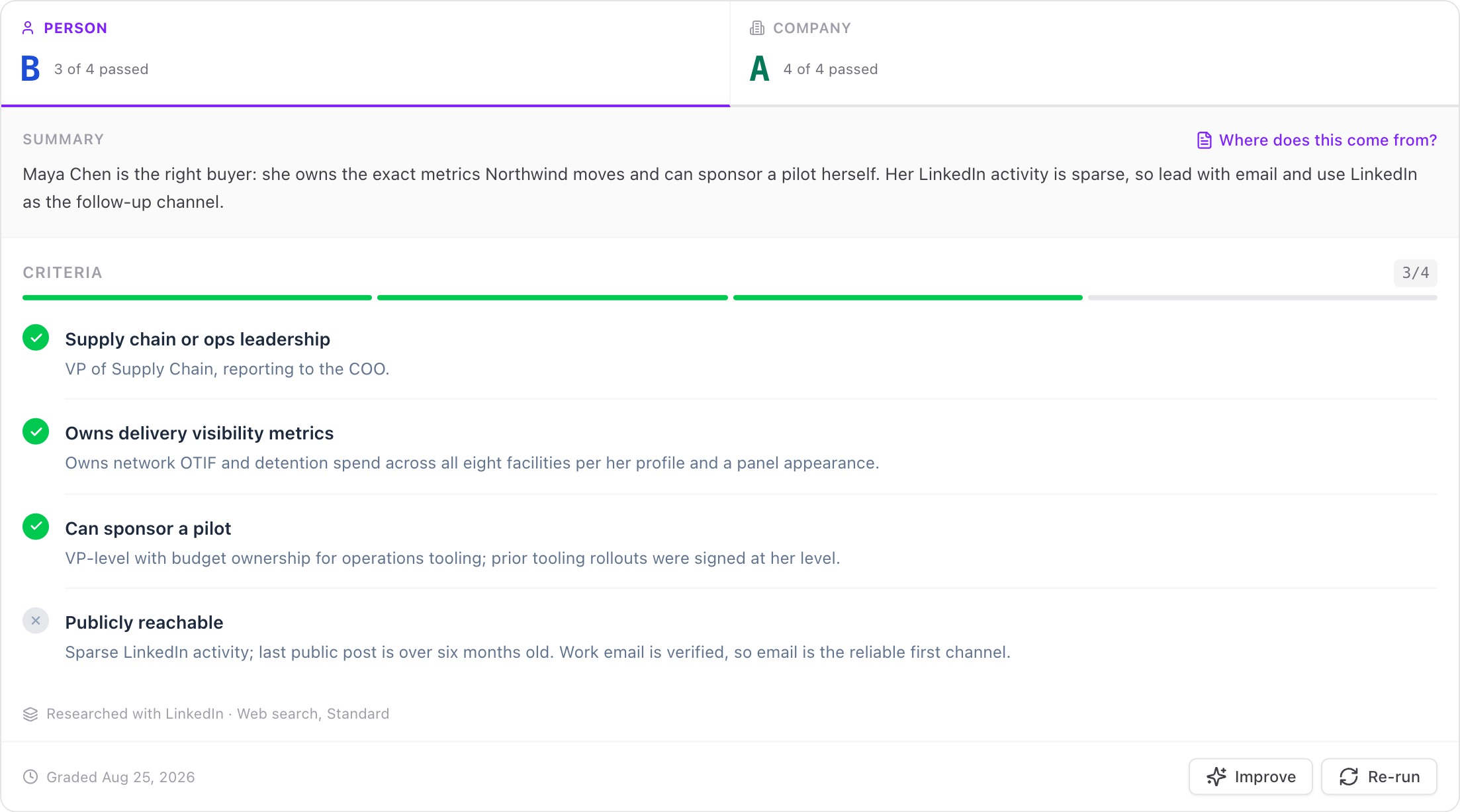
That same research is what sequence generation writes from, and every sequence stays a draft until a rep starts it. Judge the setup on pipeline. Speck Design grew pipeline about 50% in its first month on Strama (the Speck Design story).
Better Inputs Create Better Sales Conversations
SDR productivity comes from a system that puts the right accounts in front of reps, with the right evidence, at the right time. Asking them to work faster does not get you there. When lead sourcing and qualification are automated around clear fit criteria, real buying signals, and accountable measurement, SDRs spend less time managing data and more time creating informed conversations. That is the foundation of sustainable sales pipeline optimization.