Friday, October 2, 2026
How to Automate Lead Sourcing and Qualification for a More Productive SDR Team

The Productivity Problem Is Not a Lack of Leads
What if your SDR team does not have a productivity problem at all, but a prioritization problem created by too much manual prospecting? When representatives spend hours exporting lists, checking firmographic details, researching accounts, and deciding which contacts deserve attention, the work that should create pipeline gets pushed aside: starting relevant conversations.
Automating lead sourcing and qualification is not about flooding a sales team with more names. It is about building a reliable system that identifies accounts matching your ideal customer profile (ICP), evaluates them against consistent criteria, adds timely context, and routes the best opportunities into a thoughtful outreach sequence. Done well, sales development automation reduces administrative effort while making personalized messaging more practical at scale.
For SDR leaders, the goal is simple: give reps a smaller, higher-confidence set of accounts they can act on every day. That requires clear definitions, connected workflows, quality controls, and feedback from outcomes, not merely another database.
What an Effective Automated Workflow Delivers
- Automate repetitive research and list-building tasks, but keep human judgment for nuanced account decisions and high-value opportunities.
- Start with a documented ICP and explicit disqualification rules; automation cannot correct vague targeting.
- Use a weighted account score to combine firmographic fit, intent or buying signals, technology fit, and engagement rather than relying on one data point.
- Route qualified accounts directly into a rep-ready workflow with verified contacts, relevant context, suggested messaging angles, and clear ownership.
- Measure productivity through quality-adjusted outcomes: qualified meetings, opportunities created, conversion rates, and SDR hours saved, not lead volume alone.
- Audit data quality, scoring accuracy, deliverability, and compliance regularly. A fast workflow built on poor data simply accelerates wasted outreach.
- Treat lead sourcing and qualification as a closed loop: sales outcomes should continuously refine sourcing filters, scorecard weights, and messaging.
Common Questions From SDR Leaders
What should I automate first: lead sourcing or lead qualification?
Automate lead sourcing first when reps are struggling to build a consistent pipeline of accounts that meet basic ICP requirements. Begin by defining the industries, company sizes, geographies, business models, roles, and exclusion criteria that matter. A sourcing tool can then surface accounts and contacts without the CSV exports and tab-switching that consume SDR time.
However, sourcing without qualification creates a larger backlog. The most productive implementation connects both stages: source candidate accounts, score them against fit criteria, enrich the winning accounts with relevant context, and send only qualified records to outreach. Strama’s Lead Scout workflow reflects this principle by keeping the move from search to active lead work in one environment.
How do account scoring models improve SDR productivity?
A scoring model gives every account a consistent evaluation, reducing the time each SDR spends deciding where to begin. It also makes prioritization explainable. Instead of telling a rep that an account is “high priority,” the model can show that it fits the target segment, has the right operational profile, and displays a relevant trigger.
A practical scorecard uses criteria such as:
- Firmographic fit: industry, employee count, revenue band, location, and growth stage.
- Customer-pattern fit: traits shared by successful customers, such as business model, team structure, or technical environment.
- Buying readiness: hiring activity, funding events, leadership changes, expansion, relevant content engagement, or other valid signals.
- Contact accessibility: availability of the right personas and usable contact channels.
- Disqualifiers: existing customer status, unsupported geography, competitor category, or a company size outside the sales motion.
Assign weights based on evidence. If your closed-won analysis shows industry is more predictive than employee count, industry should contribute more to the score. Review results monthly or quarterly; a static scorecard eventually becomes disconnected from the market.
Will automation make outreach feel generic?
It will if it automates sending before it automates understanding. Generic outreach comes from weak inputs: incomplete account context, irrelevant targeting, and templates that never adapt to the recipient.
The better sequence is qualification first, personalization second. Once the system knows why an account matches the ICP and what signal makes outreach timely, it can generate a useful first draft around that evidence. SDRs should still review messages for strategic accounts, sensitive industries, and any claim that requires validation. A team voice framework is also essential: consistent personalized messaging should sound like your organization, not like a collection of disconnected AI prompts.
Which metrics prove that lead sourcing automation is working?
Track metrics across the entire funnel, not just activity. Useful measures include:
- Time from target-account identification to first outreach
- SDR research time per account
- Percentage of sourced accounts that meet qualification standards
- Percentage of high-scoring accounts accepted by SDRs
- Positive reply rate and meeting-booked rate by score band
- Sales-accepted opportunity rate from SDR-generated meetings
- Pipeline created per SDR hour
- Bounce rate, unsubscribe rate, and spam complaints for outbound email
Compare these metrics before and after implementation using the same target segments. For example, if research time falls but meeting quality declines, the scoring model is likely too broad or its data needs review. Higher activity counts are not a win if they do not improve sales pipeline optimization.
Can AI replace SDR research entirely?
No. AI is most valuable when it removes low-value repetition: gathering public information, structuring account data, identifying common fit signals, drafting first-pass research summaries, and preparing outreach suggestions. SDRs remain responsible for judgment, positioning, and live conversations.
A strong operating model uses AI sales outreach to make reps better prepared, not absent. Let automation handle the first 80 percent of repeatable work, then concentrate human attention on the decisions where context, commercial judgment, and relationship skills matter most.
Build the System Before You Scale the Volume
1. Define a usable ICP and a clear “not a fit” category
Turn the ICP from a slide into a set of operational rules. Specify required attributes, preferred attributes, and disqualifiers. For instance, a target may need to be in a defined vertical and size range, while a recent expansion event earns additional priority. Be equally explicit about who should not enter an SDR sequence.
Interview AEs, customer success leaders, and top-performing SDRs. Then compare their input with closed-won, closed-lost, and churned account data. The objective is not theoretical precision on day one; it is a repeatable starting point that can be improved.
2. Centralize sourcing instead of passing spreadsheets between tools
Fragmented workflows create duplicated records, inconsistent fields, and unclear ownership. Centralize lead sourcing and qualification so SDRs can search target personas or companies, inspect account context, and begin work without handling exports.
For deeper guidance on turning research into qualification decisions, review Strama’s discussion of advanced prospect research and qualification. The practical standard is that an SDR should be able to answer four questions quickly: Is this account a fit? Why now? Who should be contacted? What is the relevant opening angle?
3. Create score bands and action rules
Avoid treating a numerical score as an answer by itself. Define what each score band means operationally:
| Score band | SDR action |
|---|---|
| High fit and active signal | Assign immediately; begin tailored multi-channel outreach |
| High fit, limited signal | Enroll in a lighter-touch sequence; monitor for triggers |
| Moderate fit | Hold for targeted campaigns or additional enrichment |
| Low fit or disqualified | Suppress, recycle, or send to another motion if appropriate |
Customizable scorecards make the logic visible and auditable. They also prevent reps from cherry-picking only the easiest accounts. Strama’s perspective on the lead qualification crisis underscores why contextual research matters: basic data fields alone rarely reveal whether an account deserves immediate attention.
4. Connect qualification to multi-channel engagement
Once an account meets the threshold, automate the handoff into a sequenced process across email, LinkedIn, and phone. Multi-channel engagement should feel coordinated, not repetitive. A call can follow an email when a valid reason exists; a LinkedIn touch can reinforce familiarity rather than duplicate the same pitch.
Use the score and research summary to determine the motion. High-value accounts may merit a customized first email, timely LinkedIn follow-up, and a call task. Lower-priority accounts may enter a monitored nurture path. A built-in dialer and call transcription can further reduce context switching while preserving conversation insights for coaching and follow-up.
Before increasing sending volume, validate the underlying sending setup. Dedicated infrastructure, warmed inboxes, and reputation monitoring matter because even excellent targeting cannot produce replies from emails that never reach the inbox.
5. Give SDRs a review queue, not a black box
Automation should produce a daily action queue that tells each representative what to do next and why. Include the account score, qualifying evidence, disqualifiers checked, suggested contacts, recent signals, and recommended message angle.
Require a lightweight human review for accounts above a defined value threshold. Reps can correct inaccurate data, reject poor-fit records, and flag missing context. Those actions become essential feedback for improving the workflow. Product education should also be part of rollout; Strama’s product tutorials can help teams establish consistent habits around the platform.
6. Run a controlled pilot and tune from conversion data
Pilot the workflow with one segment, territory, or SDR pod for 30 days. Establish a baseline first: weekly research hours, sourced-account volume, qualified-account rate, reply rate, meetings booked, and opportunity conversion.
At the end of the pilot, ask:
- Which score bands created the most qualified meetings?
- Which attributes were present in accepted opportunities but missing from the model?
- Where did SDRs override automated recommendations?
- Did message quality improve when research context was available?
- Did deliverability remain healthy as activity increased?
Use the answers to adjust scoring weights, exclusions, and sequences. This disciplined approach is more reliable than deploying broad automation across every market at once. Teams evaluating operational fit can explore Strama’s pricing information alongside their expected workflow volume and adoption plan.
What This Looks Like in Strama
In Strama, sourcing and qualification sit in the same place. Lead Scout searches the Strama Lead DB or your own Sales Navigator seat. You can describe the audience in plain English and review the filters it builds before anything runs.
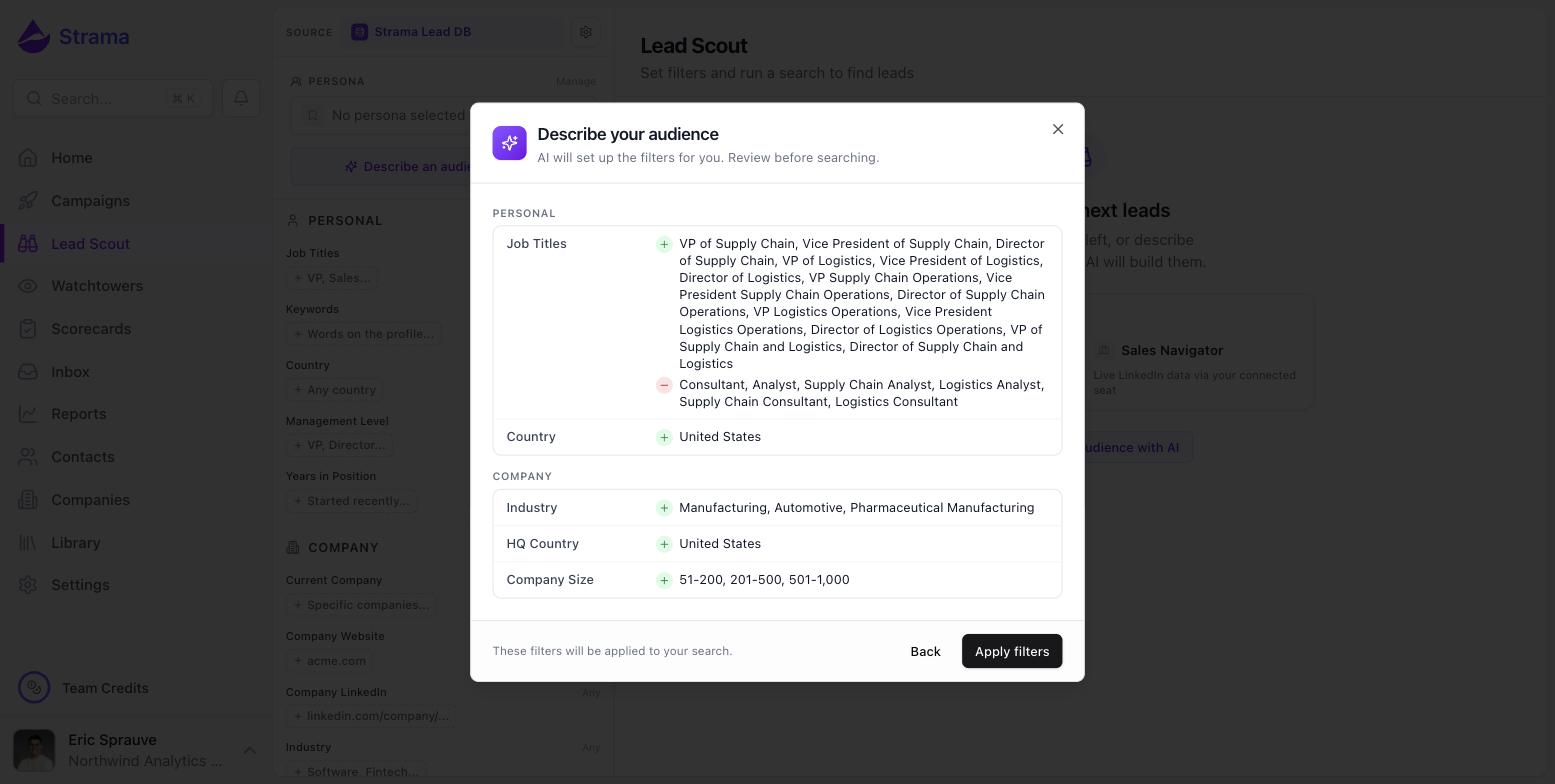
Leads you add go straight into a campaign or a scorecard, with no export step. The scorecard is the brief the research runs against: each company and contact is researched, graded from A to F, and saved with a cited report, so every row in the score band table above has evidence behind it. One rule saves new users a lot of confusion: adding acts on the leads you loaded and selected, so load the full audience before you select it (how scorecards work).
Speck Design grew pipeline about 50% in its first month on Strama (the Speck Design story).
Turn Research Time Into Selling Time
The misconception is that productive SDR teams simply need more leads. In reality, they need fewer manual decisions and better-informed next actions. Automated lead sourcing and qualification creates that foundation by identifying the right accounts, applying consistent fit criteria, surfacing timely context, and directing reps toward the outreach most likely to create a meaningful conversation.
The most effective programs do not remove people from the process. They remove spreadsheet work, fragmented research, and guesswork so SDRs can apply their expertise where it has the greatest commercial value. Build the rules, measure the outcomes, and refine the system continuously, and automation becomes a durable advantage rather than a faster way to send irrelevant messages.