Wednesday, July 22, 2026
What LinkedIn and a longer cadence actually do to reply rates


Is LinkedIn worth adding, and how many emails are really enough? Those are the two questions we hear constantly about outreach cadence. To answer them, we studied 11K+ Strama sequences started in the last six months spanning 100+ different industries.
Three numbers set the stage:
Finding 1: Roughly half of all replies come in on LinkedIn
For every replied multi-channel sequence, we know which touch earned the reply: the message the prospect was responding to when they wrote back. Tallying those up, LinkedIn touches earn 51.9% of all replies, edging out email. Those are conversations an email-only program structurally cannot capture.
Skipping LinkedIn isn't declining a marginal add-on. About half of all reply volume physically arrives on that channel. An email-only program simply never sees those conversations. Adding LinkedIn roughly doubles the surface where a prospect can say yes.
Finding 2: Replies keep arriving on later touches, and the per-touch rate doesn't fade
Because a reply stops the sequence, the touch it stopped on is the touch that earned it. Plotting the cumulative share of replies against touch number shows how much a short cadence forfeits: a sequence capped at two touches captures about 26% of the replies a full cadence eventually earns. The other 74% require touch three and beyond.
And the follow-ups don't wear out. The reply rate at each touch stays flat at roughly 1 to 2% all the way through touch ten. A tenth touch converts about as well as the first.
Stopping at one or two touches means walking away from roughly three-quarters of the replies the same list would produce over a full sequence. And because the per-touch rate never fades, the deeper touches aren't scraping the barrel: a touch-eight reply is about as likely as a touch-one reply.
Finding 3: Email depth alone front-loads; the sustained late value comes from the second channel
Isolating email-earned replies tells a more nuanced story than Finding 2. Per-email returns do diminish: the first three emails capture about 82% of all email-attributed replies, and emails four through six split the remaining 18%. So going from one email to three roughly doubles email reply capture; going deeper on email adds a thinner tail.
Put together: the reason the overall cadence (blue) keeps paying off deep into the sequence, while email alone (orange) flattens by the third email, is that the productive later touches are largely the LinkedIn steps interleaved between the emails. Depth and the second channel are the same lever, not two. If you run email-only, three emails clearly beat one or two, but you still leave the LinkedIn half from Finding 1 on the table.
Finding 4: Replies keep coming through the whole cadence; they don't turn into unsubscribes
A common worry is that messaging someone more just invites an unsubscribe. The data shows the opposite: opt-outs are most likely on the very first touch and fall from there, while replies keep landing at every touch through 8+.
At every touch, a prospect is far more likely to reply than to opt out, and the opt-out rate drops the deeper you go (from about 0.9% on touch one to about 0.3% by touch five) while replies hold steady. Persistence doesn't annoy people into leaving; formal opt-outs stay near 3.3% overall, well under the 8.65% reply rate. The "email them too much and they unsubscribe" instinct is simply backwards.
The warm replies concentrate early: 90% of interested replies arrive within the first five touches. But the tail keeps working, not backfiring.
The practical read: run at least five touches. That's where 90% of interested replies land, with the single biggest block on touches 3 and 4. Stopping at one or two touches to "avoid being annoying" mostly just forfeits replies you would have earned.
One more quality signal, this time by channel, and it reinforces Finding 1: LinkedIn's replies skew a little warmer than email's, not just more numerous.
And the later touches stay warmest on LinkedIn. Late email replies drift toward "not interested" (about 26% interested past touch two, down from 52% early), while LinkedIn holds near 41% interested deep into the sequence. The second channel is where the later touches keep earning warm replies, not just replies. (Directional: the early-LinkedIn slice is a smaller sample.)
One benchmark, 100+ industries
A fair question about any benchmark: whose outreach is this? The teams behind these sequences sell into markets as different as B2B software, cybersecurity, financial services, staffing, industrial building controls, medical device design, and retail. The companies they reached span 100+ distinct industries (LinkedIn's taxonomy). Software leads, as you'd expect from modern outbound, but the long tail is long.
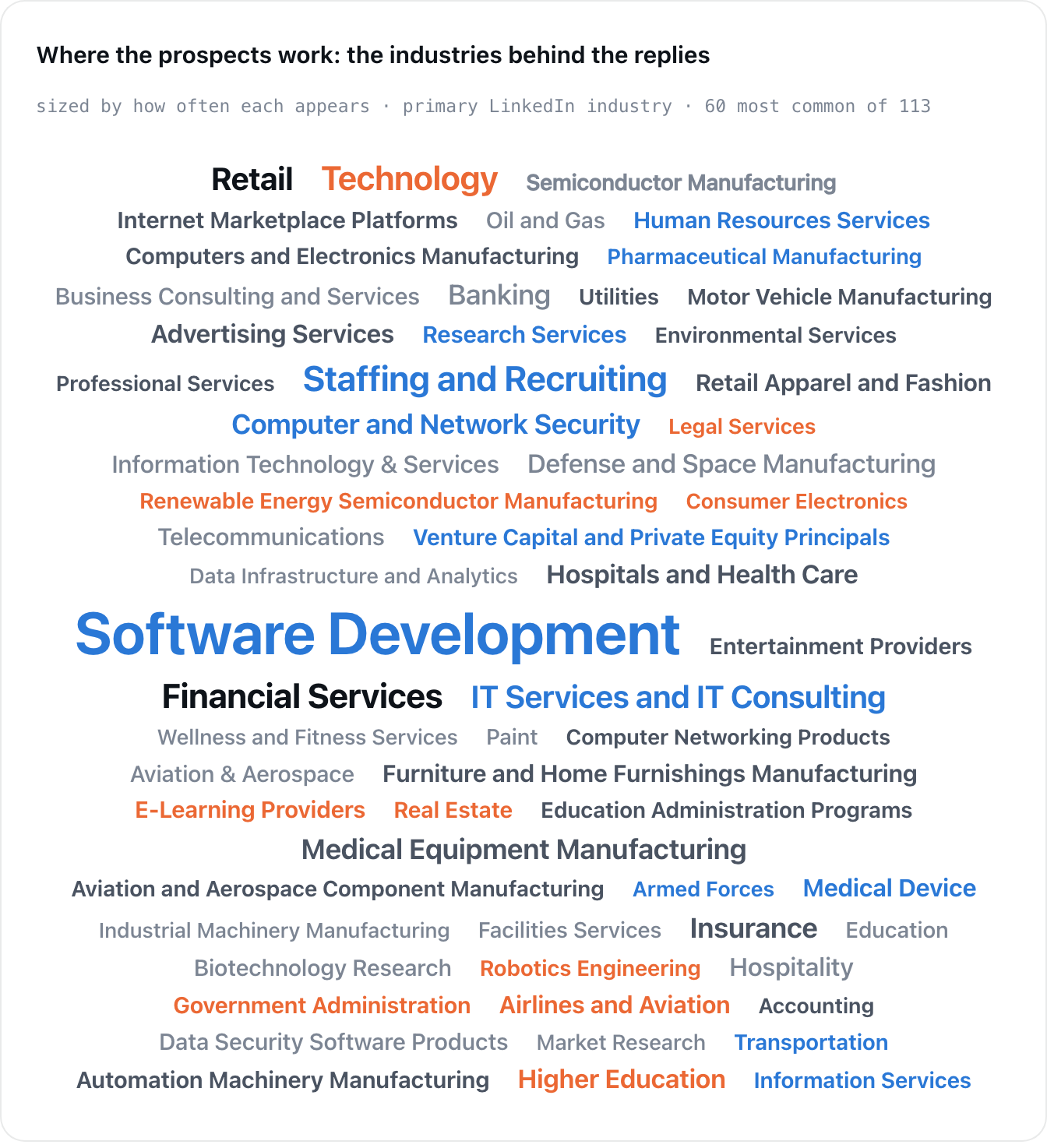
This isn't a SaaS-only benchmark. Every finding above is averaged across banks, insurers, recruiters, retailers, hospitals, medtech makers, defense and aviation firms, and universities, alongside the software companies you'd expect. If your market isn't software, this data already includes buyers like yours.
How we measured this
- The data. The 11,299 sequences that started across all Strama teams in the trailing six months and had at least 21 days to run, long enough for later touches and slower replies to land. (About 2,800 more recent sequences were set aside as too new to judge fairly.)
- Reply, interested, and not. A reply is a genuine response from the prospect. Interested means they signalled real interest; not interested is a decline or brush-off. Opt-outs and unsubscribes (3.3%) are tracked separately and not counted as replies at all.
- Which touch earned it. Because a reply pauses the sequence, each reply can be attributed to the exact message the prospect was responding to. That attribution is available for 96.6% of replies.
- Whose outreach it is. The sequences come from teams selling into a wide range of markets: AI and B2B software, cybersecurity, financial technology, recruiting and HR tech, contact-center software, industrial building controls, product design services, and retail services among them. No single vertical's playbook drives the shape of the findings.
- Prospect industries. Each prospect's industry is read from their company's LinkedIn profile (primary industry label), available for 68% of the cohort. The industry cloud above draws from that subset.
- What this is. A view of how outreach actually performs across many teams, industries, and offers. Real usage, not a lab study. Individual results vary with list quality, targeting, and message craft.
Aggregated across all Strama teams, six-month window ending July 21, 2026.