Thursday, May 28, 2026
From 5% to 45%: How Switchboard Hiring rebuilt outbound

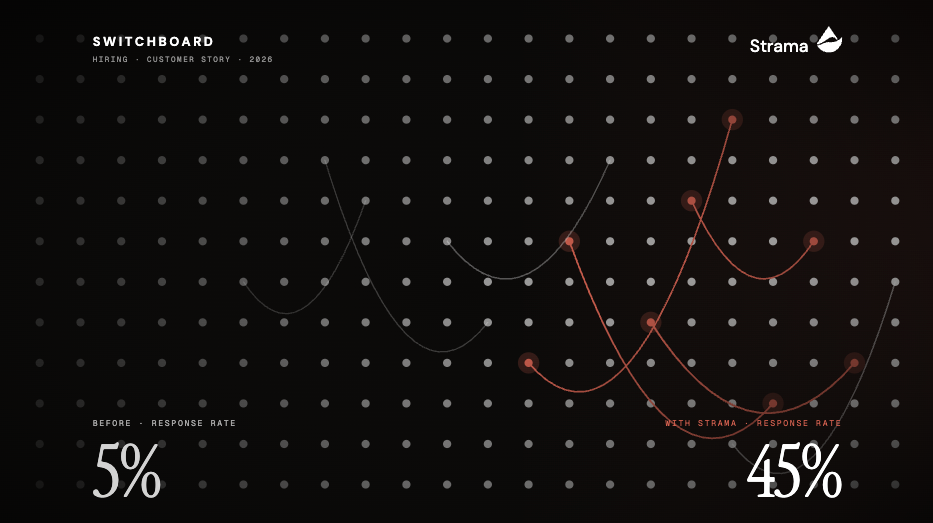
"We wouldn't be doing outreach if Strama didn't exist." — Adam Snyder, Co-founder, Switchboard Hiring
A new outbound channel at Switchboard Hiring cut placement time by 40%. Switchboard Hiring went from 40 manual outreaches a month to 200+ a month with 45% response rates. For a two-person recruiting firm built on speed, that shift turned their inbound-only recruiting model into an inbound-and-outbound engine they are now scaling.
The business they couldn't grow
Switchboard Hiring is a boutique Denver-area staffing firm founded to help companies fill roles across functions like software engineering, accounting, sales, and leadership, with a model built around high-quality placements at a reasonable flat fee.
That flat-fee model is the point. Instead of charging the typical 25–30% of a candidate’s salary, Switchboard charges a predictable fee clients can actually plan around. But the economics only work if they can place candidates fast and at high quality, which made their outreach problem an existential one.
Before Strama, outreach barely existed at Switchboard. Adam and Sylvia were sending roughly ten outreaches per week, between the two of them, and getting about a 5% response rate. Every message was hand-crafted, because automated outreach had never proven it could rise above the noise candidates were already getting.
So Switchboard ran an inbound-only business. They'd post a job and, in Adam's words, "wait and pray" for applicants. That worked fine for high-traffic roles like software engineer or engineering manager. It didn't work for the harder, more specialized searches, the ones their clients most needed help with, so they often had to turn those roles down. Outreach felt, as Adam put it, "expensive and hard."
What they tried before Strama
Switchboard didn't arrive at Strama on the first try. They evaluated the major players in recruiting outreach first:
- Ashby: LinkedIn messaging was a manual placeholder stage; sending a message took 5–6 clicks.
- Pin.com: Email-based; LinkedIn was an off-platform manual step.
- Gem and SourceWhale: Demoed both. Neither delivered the LinkedIn-native experience or the level of message customization Adam needed.
Adam's read on all of them was the same: "None of them have the same LinkedIn capability. And none of them have truly curated messaging." So Switchboard stayed manual. And manual stayed slow.
What changed
Every tool Adam tried before Strama solved the volume problem by replacing his messages with a templated cadence. Strama solved it the other way, keeping the messages authentic to Adam while taking the typing off his plate, through two levers he controls.
The first is voice. Strama learns it from samples of Adam's real writing, the phrases he reaches for, the sentence structures, the tone he takes when opening to someone he's never met. All of that gets encoded into a style guide he can review and refine, so every message Strama drafts comes out sounding like him.
The second is judgment. Adam can inject his own experience into each campaign, so the messages reflect what he'd actually think to mention. On a recent commercial lender search, he wrote into the campaign: "If a candidate works or used to work at First Bank, reference the shared connection. I worked there for 21 years." Strama carried that context into each message, so Adam’s judgment showed up where candidates could actually feel it.
The result is messaging that isn't generated but authored, and candidates can tell. Several candidates have written back to apologize for not responding sooner and thank Adam for the effort. They believe a human wrote it because, structurally, Adam did. Several candidates have even written back apologizing for the delay and thanking him for the effort he'd put in. "Which tells me it's working really well."
Results
Response rate 9x'd, from 5% to 45%. And it's not just any response: about 90% of replies are positive. Most common replies are: "Tell me more," "I'd like to connect." Adam: "That's kind of unheard of."
Outreach volume 5x'd, from 10 per week to over 50. Same two-person team. The bottleneck wasn't ambition; it was that personalization, before Strama, didn't scale.
Average placement time cut by ~40%. Outbound gave Switchboard a way to source for the exact requirements of each role, rather than building around whichever inbound candidates happened to apply. The result is a stronger fit from the first shortlist, with clients now calling it out directly: “Oh wow, this guy’s background is perfect.”
"Our business model has completely changed because of Strama. Outreach doesn't feel expensive and hard anymore." — Adam Snyder, Co-founder, Switchboard Hiring
Why it matters for recruiting firms
The recruiting industry's outreach playbook is mostly volume without personalization: a junior recruiter hammering a list, 100 calls a day, identical templates. It produces low response rates and burned-out recruiters. The alternative most firms default to, fully manual hand-crafted messaging, caps how much business a firm can actually take on.
Switchboard found a third option. Strama lets a two-person team run outreach at a scale and quality that would have required a much larger headcount to produce manually. For a flat-fee firm whose unit economics depend on speed, that's the difference between turning roles down and saying yes.
Three lessons for other recruiting firms
1. Persistence outperforms instinct. Adam used to believe that one or two perfect messages was the polite ceiling, that anything more felt like harassment. With Strama, he's watched candidates engage positively after the tenth message in a sequence. "Two weeks later, they're like, actually, I'm really interested. Tell me more." If you're capping sequence length at two or three touches because more feels disrespectful, you're probably leaving placements on the table.
2. Deliverability is the dirty foundational work nobody talks about. Adam didn't know why his outreach emails were getting zero traction. They were quietly going to spam, and his previous tools were happy to let him send 150 a day from his personal inbox without ever mentioning it. "No one gave me an education on that," he said. "It's the sexy UI and the marketing stuff that looks great. But to actually make this successful does take some education." If response rates aren't moving on a new tool, deliverability is the first place to look, before the templates, before the targeting, before anything else.
3. The hardest roles can become your fastest placements. Specialty searches are the ones most recruiting firms either avoid or drag on for months. The candidate pool is small, manual outreach is slow, and the math rarely works on a contingent basis. With precision outbound at scale, that dynamic inverts. Switchboard's hard-to-fill executive roles, the ones they used to decline, are now among their faster placements. Precision outreach beats wide-net inbound for specialized roles, because you can target the exact 50 people who actually fit and message them all in your own voice. Hard candidate searches stop being a tax and start being a competitive moat against other recruiting firms.