Tuesday, April 7, 2026
AI for Sales Prospecting: How Signal-Based Monitoring Helps Teams Find and Create Demand

Last year, we published The Intent Signal Trap, arguing that most intent data makes you late to the deal, not early. That thesis still holds. But the other side of the coin deserves attention: what happens when you combine proactive demand creation with real-time signal monitoring?
The answer is signal-based prospecting, a workflow where sales teams detect and act on buying signals as they happen, rather than waiting for a third-party vendor to tell them about last week's website visits. Strama's Watchtower feature was built for exactly this purpose, and the early results from teams using it reveal a fundamentally different approach to AI for sales prospecting.
The Timing Problem in Sales Prospecting
Why Most Outreach Is "Timing-Blind"
A VP of Sales at a B2B technology company put it bluntly during a recent product review: without intent signals, outreach is "timing-blind." Even well-researched, personalized messaging falls flat when it arrives at the wrong moment in a buyer's evaluation cycle.
This is the central tension most sales teams face. They invest in better messaging, better targeting, and better sales prospecting tools, but timing remains a coin flip.
The traditional answer has been to purchase intent data from providers like Bombora (bundled into platforms like ZoomInfo at roughly $12K per year) or to pay for LinkedIn Sales Navigator at approximately $8K per year for a five-seat team. These tools promise to solve the timing problem, but as we argued in the Intent Signal Trap, they often surface signals that are already stale.
What sales teams actually need is a way to detect signals in real time and act on them immediately, before the window closes.
The Gap Between Engagement and Action
During a discovery call, a head of marketing at a cybersecurity compliance company described a problem familiar to any team with an active LinkedIn presence: their CEO's posts generate significant engagement—comments, likes, shares—from exactly the kind of people they want to sell to. But the team has no system to convert that engagement into pipeline.
Even when the marketing lead could see the engagement and wanted to bring an activation plan to leadership, there was no scalable way to do it.
As she explained, "They get a lot of engagement on LinkedIn, but they can't always activate every single one."
This gap between visible engagement and actionable pipeline is one of the most common missed opportunities in B2B sales. The signals are there. The problem is that most teams lack the infrastructure to capture them at scale and route them into personalized outreach.
What Signal-Based Prospecting Actually Looks Like
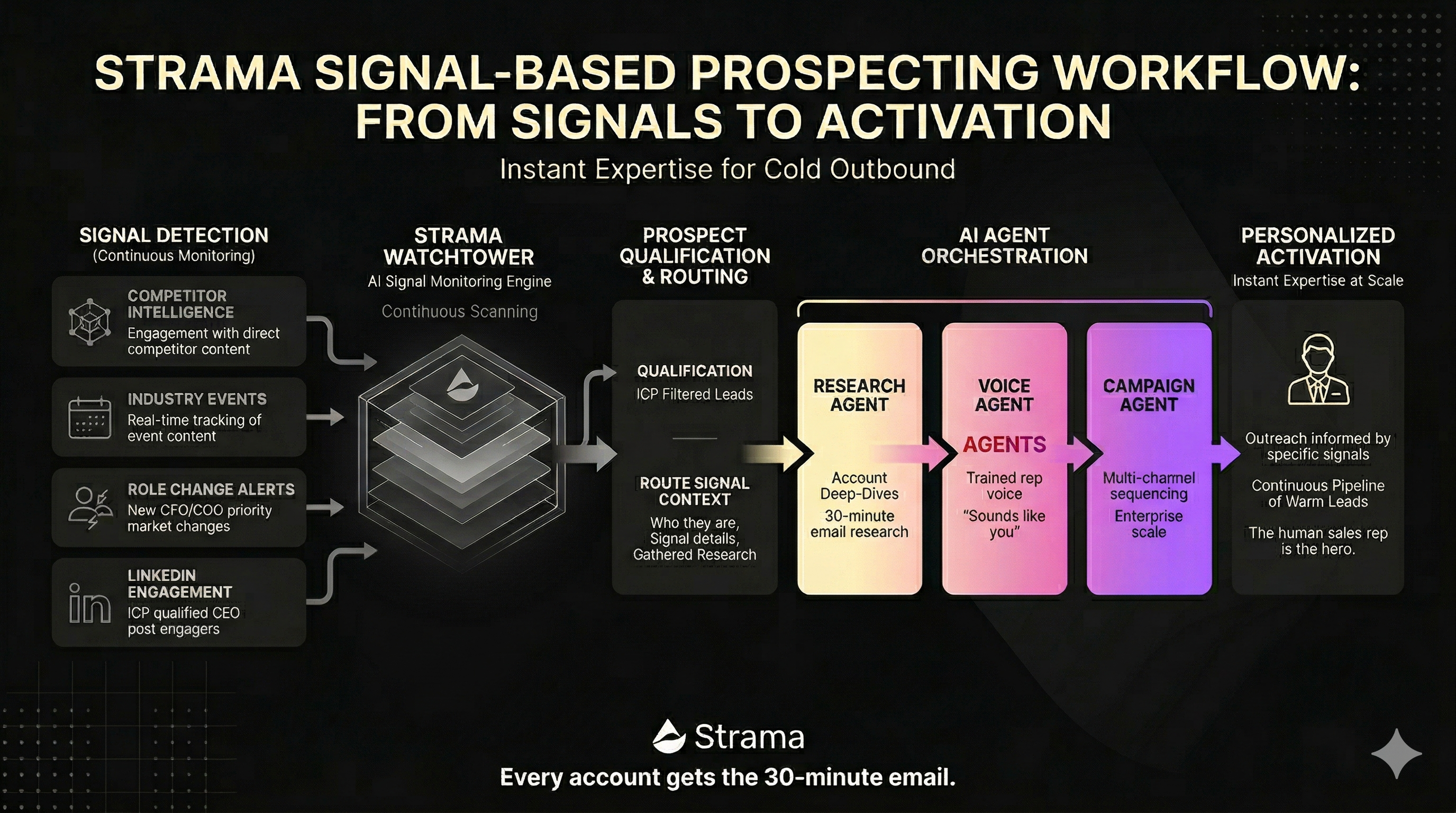
Watchtower is Strama's signal monitoring engine. It continuously scans for specific types of activity and surfaces the results as actionable leads that can flow directly into outreach campaigns.
Here are four signal types that early users have configured, each addressing a different prospecting need.
1. Monitoring Industry Events in Real Time
An SDR team at a contact center AI company set up a Watchtower to track engagement around CCW (Customer Contact Week), a major industry conference. The Watchtower monitored LinkedIn activity from people interacting with CCW-related content, filtered by geography and role, and surfaced prospects who were actively engaged with the event.
The results validated the approach during the initial configuration. As the Watchtower surfaced its first batch of prospects, a team member recognized one of the companies: a major financial institution that had come inbound through their website that same day.
The Watchtower had independently identified the same account based on conference engagement signals, confirming that the signal detection was surfacing companies exhibiting real buying behavior.
The SDR leader's reaction to the broader potential: "That gets me so excited, guys, because the list could be endless."
2. Competitor Intelligence That Creates Openings
The same team configured a second Watchtower to monitor engagement with a direct competitor's LinkedIn content. The logic is straightforward: people who engage with a competitor's posts are evaluating options in the category. They are, by definition, in-market.
This type of competitor intelligence Watchtower transforms passive social listening into an active AI prospecting tool. Rather than waiting for a third-party provider to aggregate intent scores weeks after the fact, the team sees who is engaging with competitor content today and can reach out with a differentiated message while the prospect is still comparing options.
3. Role Change Alerts for Timely Outreach
New executives, particularly CFOs and COOs, often trigger vendor re-evaluations. A new finance leader typically reviews existing contracts, reassesses budget allocations, and opens discussions with new providers within their first 90 days.
Watchtower can be configured to monitor role changes within specific title ranges, company sizes, and geographies.
During a product review, a VP of Sales at a B2B technology company and the Strama team configured a Watchtower specifically for CFO and COO changes at companies with 75 to 1,000 employees across the US and Canada. This type of signal is difficult to capture manually at scale but straightforward to automate.
4. Turning LinkedIn Engagement into Pipeline
For companies whose leadership maintains an active LinkedIn presence, Watchtower's post engagement monitoring directly addresses the activation gap described earlier.
The feature monitors engagement on posts from specified profiles (a CEO, a company page, or even an industry thought leader) and identifies which engagers match the team's ideal customer profile (ICP).
A BDR at the cybersecurity compliance company saw this feature in action and responded: "This is so cool. Oh my gosh." The reaction was tied to a specific capability: Watchtower can automatically add qualified engagers to an outreach campaign, eliminating the manual step of reviewing post engagement, cross-referencing profiles, and building prospect lists.
The auto-add-to-campaign feature transforms what was previously a manual, time-consuming process into a continuous pipeline of warm leads flowing directly into personalized sequences.
From Signals to Outreach: Closing the Loop
Signal detection alone is insufficient. The value of signal-based prospecting comes from connecting detection to personalized activation, replacing cold outreach with signal-informed messaging. This is where Watchtower differs from standalone intent data providers.
When a Watchtower surfaces a lead, that lead enters Strama's outreach engine with full context:
- Who they are
- What signal triggered the detection
- What research Strama's AI has gathered about their company and role
The outreach that follows is not a generic template triggered by a score; it is a personalized message informed by the specific signal that surfaced the prospect.
This closes the loop on the thesis from the Intent Signal Trap. You are not simply reacting to signals and hoping to catch up. You are creating the conditions that generate signals (through content, event participation, and market presence), then capturing the response with an AI sales agent that activates outreach in real time.
The goal is continuous coverage: something that is always doing that research in the background, so teams spend their time on the right prospects instead of searching for them.
Getting Started with Watchtower
For teams evaluating AI lead generation and signal-based prospecting, Watchtower configuration follows a simple progression:
- Start with competitor monitoring.
Set up Watchtowers on one or two direct competitors' LinkedIn profiles. This produces the highest-intent leads immediately.
- Add industry event tracking.
Identify the conferences and events your buyers attend, then monitor engagement around those events before, during, and after they occur.
- Configure role change alerts.
Define the titles, company sizes, and geographies that matter to your pipeline. New executives in these roles are natural conversation starters.
- Activate LinkedIn engagement.
Connect your leadership's LinkedIn profiles and begin routing engaged prospects directly into campaigns.
Each Watchtower runs continuously and can be configured to auto-add leads to campaigns, qualify them, or simply surface them for manual review. The goal is to replace the static, batch-oriented approach to prospecting with a continuous, signal-driven workflow.
Whether your priority is creating demand through proactive signal monitoring or responding faster when buyers show intent, Watchtower is designed to handle both motions simultaneously.
Sales teams interested in seeing it in action can schedule a walkthrough to explore which signal types fit their prospecting motion.