Thursday, October 1, 2026
AI-Driven Sales Outreach vs. Traditional Engagement Tools: What Changes for SDR Teams

The Shift From Sending More to Deciding Better
What would change if your SDR team spent less time operating outreach software and more time acting on the right opportunities at the right moment?
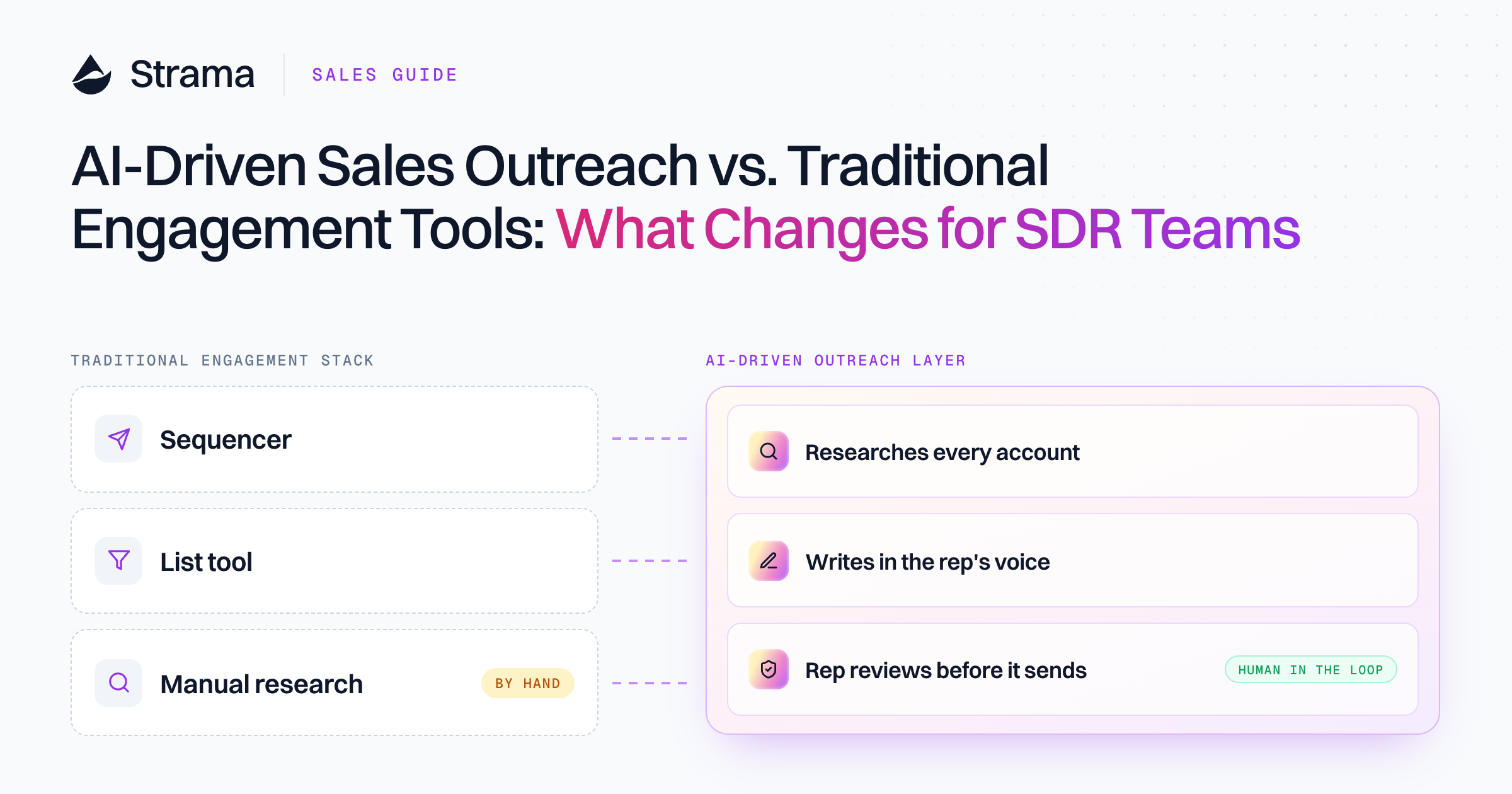
In the near future, the dividing line between high-performing outbound teams and everyone else will not be the size of their sequence library. It will be how effectively they turn changing account context into relevant conversations. Traditional sales engagement tools helped teams standardize activity: build lists, enroll contacts in cadences, and measure calls and emails. AI-driven sales outreach extends that model by helping teams decide who to contact, why now, what to say, and which channel deserves the next action.
AI-driven sales outreach is the use of artificial intelligence to source, qualify, prioritize, personalize, and coordinate prospect engagement using account data, behavioral signals, and sales context. Its purpose is not simply to automate message production; it is to improve the quality and timing of sales decisions at scale.
That distinction matters. A conventional engagement platform can ensure that 1,000 prospects receive a six-step sequence. An AI-enabled workflow can help determine whether those 1,000 prospects match the ICP, which 100 show meaningful buying signals, what each message should reference, and when a call or LinkedIn touch is more appropriate than another email.
For sales development leaders, the question is not whether automation belongs in the outbound motion. It already does. The question is whether automation is reducing administrative work while increasing relevance, or merely accelerating generic outreach.
What the Comparison Means in Practice
- Traditional sales engagement tools are primarily execution systems: they organize sequences, tasks, activity logging, and rep workflows.
- AI sales outreach combines execution with intelligence by supporting lead sourcing and qualification, account prioritization, personalized messaging, and next-best-action decisions.
- The greatest value comes from improving inputs before scaling activity. A highly automated sequence sent to poorly qualified accounts remains low-quality outreach.
- AI should work from verified data, explicit qualification criteria, and a defined brand voice. It should not operate as an unchecked message generator.
- Multi-channel engagement is more effective when each touch reflects a reason for contact, rather than repeating the same pitch across email, LinkedIn, and phone.
- Sales pipeline optimization depends on measuring downstream outcomes (qualified meetings, opportunities, pipeline, and conversion), not just opens, sends, or completed tasks.
- Teams should introduce AI in controlled workflows, review outputs regularly, and retain human judgment for strategic accounts, sensitive messages, and ambiguous signals.
Common Questions Sales Leaders Ask
What is the main difference between AI-driven sales outreach and a traditional sales engagement tool?
Traditional sales engagement tools focus on workflow execution. They help representatives send scheduled emails, complete call tasks, manage cadence steps, and track activity. AI-driven sales outreach adds intelligence before and during execution: identifying suitable accounts, scoring fit, monitoring signals, generating tailored messaging, and recommending channel or timing choices.
In other words, traditional tools help reps follow a process. AI-driven platforms can help improve the process’s inputs and decisions.
Does AI-driven outreach replace SDRs?
No. AI is most useful when it removes repetitive research, list handling, initial drafting, and administrative follow-up so SDRs can apply judgment where it matters most. Strong representatives still interpret complex account dynamics, run discovery conversations, handle objections, and build credibility with senior buyers.
The concern is valid, particularly when teams deploy generic automation without clear guardrails. A discussion on why AI sales tools can make outreach worse reflects a recurring practical issue: poor targeting and impersonal copy can damage trust faster at scale. AI should amplify disciplined selling, not substitute for it.
Is AI-generated personalized messaging actually personal?
It can be, but only when the system has useful context and the organization defines what “personal” means. Mentioning a job title, funding announcement, or generic company fact is not necessarily personalization. Relevant personalized messaging connects a specific account situation to a credible business hypothesis.
For example, “Congratulations on your recent funding” is often easy to automate but rarely creates urgency on its own. As Strama explains in why “congrats on your funding” emails do not work, and what does, the better approach is to connect an event to the operational changes or risks that may follow.
How should teams validate AI-generated leads and outreach?
Use a reviewable process. Define ICP and exclusion criteria, verify data quality, sample messages before launch, and inspect results by segment rather than trusting aggregate activity metrics. Teams should also create approval rules for regulated industries, executive accounts, and unfamiliar markets.
The practical debate around validating AI-generated leads and outreach before they damage trust emphasizes an important principle: AI prioritization is valuable only when the underlying signals and data are credible.
Can AI outreach improve deliverability?
It can support deliverability, but it cannot solve it alone. Better targeting, lower volume to irrelevant contacts, varied copy, and timely follow-up can reduce the patterns associated with indiscriminate sending. However, sending infrastructure, inbox health, domain reputation, authentication, and volume controls remain foundational. Teams should not mistake better copy generation for an email infrastructure strategy.
How to Evaluate and Introduce AI Into Your Outbound Motion
The most useful comparison is not “AI versus traditional tools.” It is “which parts of the outbound workflow need better decisions, and which simply need reliable execution?”
Compare the operating models side by side
| Capability | Traditional sales engagement tools | AI-driven sales outreach | Practical implication |
|---|---|---|---|
| Lead list creation | Usually relies on manual research, imports, and static databases | Can support automated discovery, enrichment, and ongoing prioritization | Less time spent exporting, cleaning, and routing lists |
| Qualification | Often handled through manual rep review or basic filters | Can assess accounts against custom fit criteria and signals | Reps can focus attention on higher-potential accounts |
| Messaging | Uses templates, snippets, and merge fields | Produces contextual drafts informed by account and persona data | Greater potential for relevance, with human review still required |
| Cadence management | Automates predefined steps and tasks | Adjusts recommendations based on context, engagement, or signals | Outreach can become more responsive rather than strictly sequential |
| Channel coordination | Supports email, calls, and social tasks | Helps determine when and why to use each channel | Multi-channel engagement becomes more coherent |
| Reporting | Tracks activities and campaign-level engagement | Can connect signals, targeting logic, and outcomes | Managers can diagnose why pipeline performance changes |
| Rep role | Executes high volumes of predefined activity | Applies judgment to prioritized, context-rich opportunities | More capacity for research, calls, and deal-oriented work |
Start with the highest-friction workflow
Do not begin by asking AI to automate every SDR responsibility. Start where the team loses the most time or quality. For many organizations, that is list building. Reps may spend hours moving between data sources, spreadsheets, enrichment tools, and engagement platforms before a sequence ever begins.
A workflow such as moving from a campaign idea to outreach without the list-building bottleneck illustrates the operational opportunity: reduce handoffs between identifying a market hypothesis and putting qualified prospects into action.
At Strama, Lead Scout is designed around this practical need: finding relevant personas or companies and working those leads in the same environment rather than relying on repeated CSV exports. The objective is not activity for its own sake; it is to shorten the path from market insight to a well-qualified conversation.
Make qualification criteria explicit
AI cannot reliably prioritize accounts if the organization has not defined what a good account looks like. Build a scorecard that includes:
- Firmographic requirements, such as industry, employee range, geography, and business model
- Technographic or operational indicators relevant to the offering
- Buying triggers, including hiring patterns, expansion, leadership changes, or technology changes
- Disqualifiers, such as contract restrictions, customer overlap, market exclusions, or poor-fit use cases
- Persona-level criteria, including seniority, function, and likely ownership of the problem
Strama’s Scorecards approach reflects a principle that applies regardless of platform: qualification logic should be visible, adjustable, and tied to the team’s actual win patterns. The more transparent the criteria, the easier it is to audit AI recommendations and improve them over time.
Treat signals as prompts for a hypothesis, not a reason to spam
A buying signal is evidence that something may have changed at an account. It is not permission to send a generic message about that change.
For example, a leadership hire may indicate a new initiative, a revised operating model, or no immediate buying relevance at all. The SDR’s job is to translate the signal into a thoughtful hypothesis: What problem could this event make more urgent? Why might this stakeholder care? What proof would make outreach credible?
Teams looking to operationalize this approach can learn from signal-based monitoring for AI sales prospecting. The important discipline is connecting signals to account relevance, rather than treating every public event as a trigger for a template.
Preserve a recognizable human voice
Personalization fails when it sounds technically customized but emotionally generic. Establish messaging rules before introducing AI-generated drafts:
- Define the team’s voice: direct, consultative, concise, technical, or executive-level.
- Specify claims that require proof or approval.
- Build examples of strong and weak outreach for common personas.
- Require the first line to earn attention through a relevant observation, not a superficial fact.
- Review language for accuracy, repetition, and unsupported assumptions.
A Style Guide can help AI produce messages aligned with the team’s established voice, but it should be trained on effective examples, not simply on every historical email. Teams should also remember that being human remains a sales advantage. Clear language, honest uncertainty, and a useful point of view frequently outperform elaborate automation.
Measure outcomes that reveal quality
Activity metrics still matter operationally, but they are insufficient for evaluating sales development automation. Track results at each stage:
- Coverage: percentage of target accounts with verified contacts and clear qualification status
- Relevance: positive reply rate and qualified reply rate by segment, persona, and message angle
- Conversion: meetings held, sales-accepted opportunities, and pipeline created
- Efficiency: research time per qualified account, touches required per meeting, and rep capacity
- Quality control: unsubscribe rate, spam complaints, data error rate, and message rejection reasons
- Revenue alignment: opportunity conversion and pipeline progression from AI-assisted versus conventional outreach
Review these measures by cohort. If an AI-supported motion raises reply volume but lowers meeting quality, the targeting or qualification model needs adjustment. If it improves meetings but creates deliverability problems, investigate sending practices and infrastructure before expanding volume.
Build a phased rollout
A practical rollout can follow four stages:
- Baseline: Document current conversion rates, rep time allocation, list-source quality, and deliverability health.
- Pilot: Select one segment, one offer, and a limited number of SDRs. Keep a comparable traditional workflow as a control where possible.
- Review: Inspect lead accuracy, message quality, replies, meetings, and rep feedback weekly. Correct poor inputs quickly.
- Scale: Expand only after the workflow consistently produces qualified outcomes and the team understands its exceptions.
This approach prevents the common error of treating AI as an all-or-nothing platform decision. The best implementation is usually a sequence of measurable workflow improvements.
How Strama Handles the Hand-Off From Research to Sequence
The table above describes a category. Here is the mechanic in Strama. Every lead gets its own sequence, written in one pass from the research on that person, your content library and your style guide. Email and LinkedIn run as separate tracks, so a pending connection invite never holds up an email, and the copy on each channel is written as if the prospect saw only that channel.
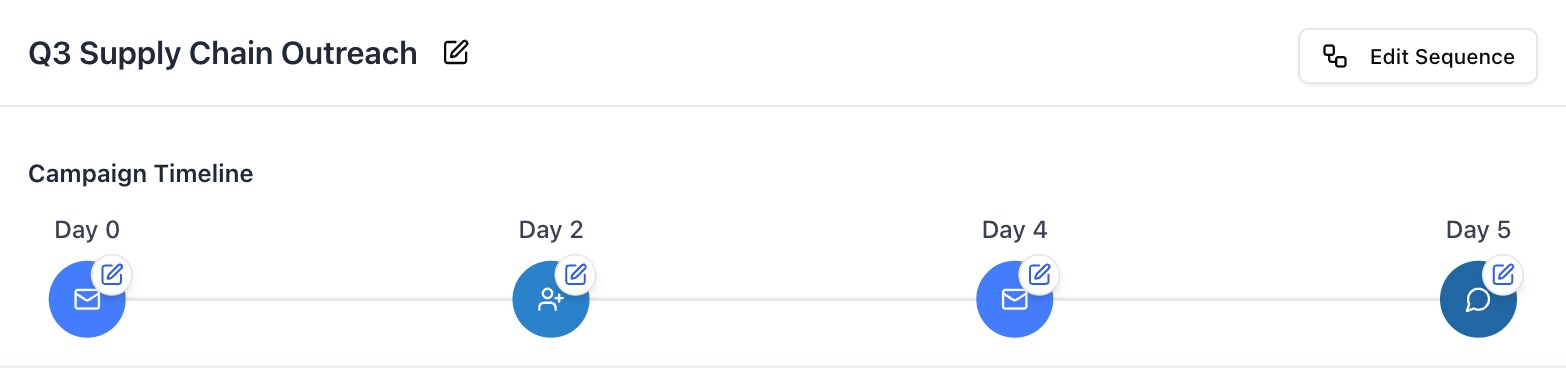
Nothing sends until a rep starts the sequence, which puts the human review this article argues for in front of every message (how sequences run).
TCS Basys used this motion to open roughly $16M in qualified pipeline, with its first meeting in under 30 days (the TCS Basys story).
Better Outreach Begins Before the First Email
Traditional sales engagement tools remain valuable because outbound teams need dependable sequencing, task management, and activity visibility. But AI-driven sales outreach changes the center of gravity from sending at scale to deciding with context. It can strengthen lead sourcing and qualification, make personalized messaging more relevant, coordinate multi-channel engagement, and support sales pipeline optimization, provided the team supplies clear criteria, reliable data, sound infrastructure, and human oversight.
The winning model is not autonomous outreach at maximum volume. It is a disciplined SDR workflow in which AI handles the repetitive work, surfaces the strongest reasons to engage, and gives salespeople more time to create conversations that deserve a reply.