Wednesday, October 21, 2026
Choosing an AI Outreach Platform That Still Sounds Like Your Sales Team

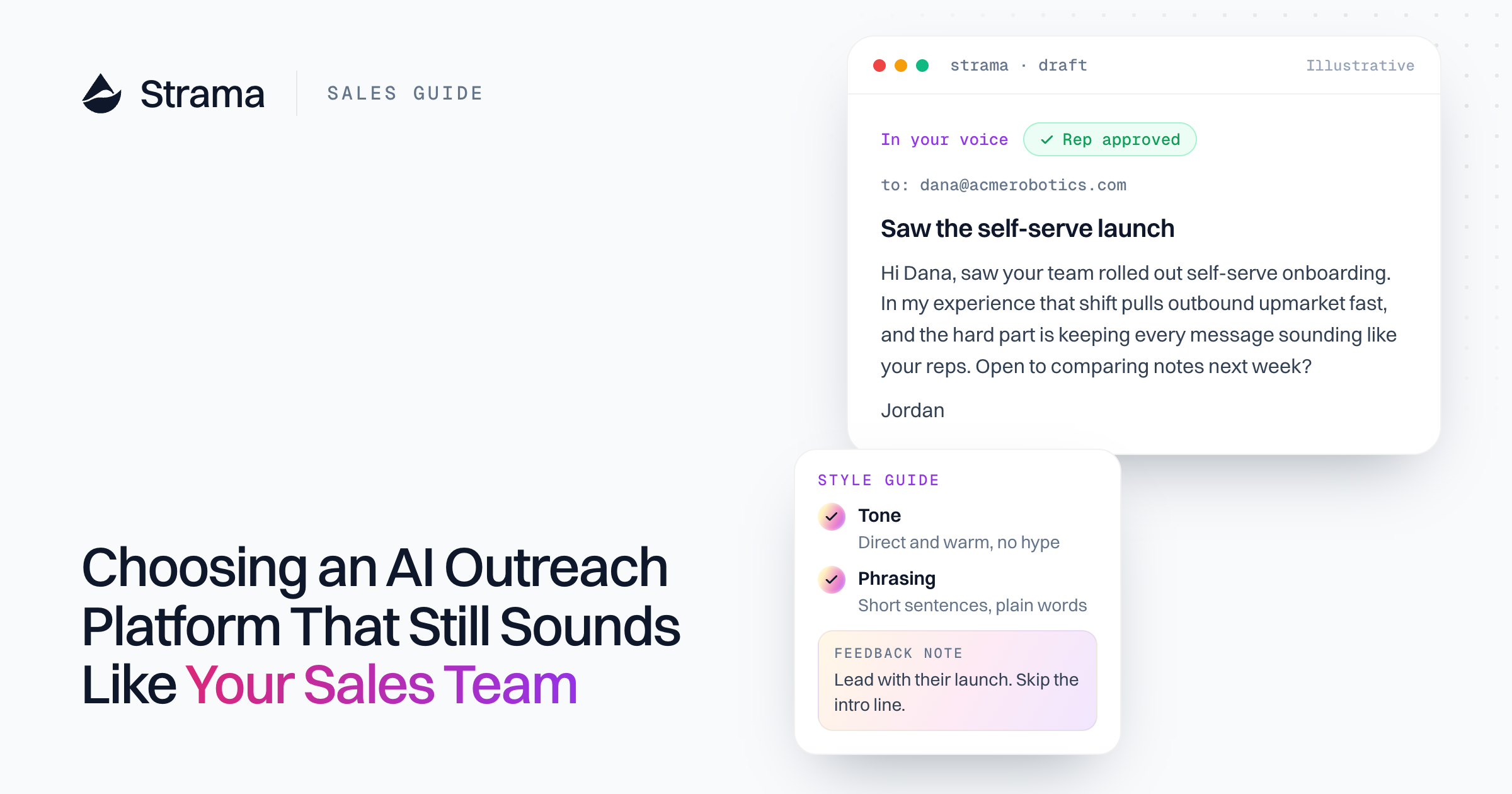
The Platform Decision Behind Every “Personalized” Message
What happens when your SDR team sends 2,000 “personalized” messages a week, and buyers can tell in five seconds that no one actually understood their business?
That is the central risk in AI-assisted outbound. B2B sales teams need a system that identifies the right accounts, recognizes why now may be the right time to engage, and helps reps communicate a credible reason for reaching out across email, LinkedIn, and phone. Another tool that produces more activity will not do that.
The best AI platforms for automating personalized sales outreach in B2B are not interchangeable. Some excel at sequencing and rep coaching. Some are strongest for contact data and prospecting. Others connect research, qualification, content generation, and multi-channel execution into one SDR workflow. The right choice depends on where your outbound process is breaking down.
Start with the workflow, not the AI label
Consider a familiar scenario: a sales development manager sees low reply rates and assumes messaging is the problem. The team buys an AI writing add-on. Reps now generate emails faster, but they still pull lists from one system, research accounts in browser tabs, check buying signals elsewhere, and paste notes into a sequencing tool. The bottleneck has moved, not disappeared.
A useful platform should support the full chain:
- Find accounts and contacts that match the ICP.
- Qualify them against clearly defined fit criteria.
- Gather usable context, including role, company priorities, and timely signals.
- Generate personalized outbound messaging in the team’s actual voice.
- Coordinate email, LinkedIn, and phone touches.
- Capture outcomes and improve the process.
For leaders asking, “how can sales teams personalize outbound without manual research?”, the answer is to automate the collection and organization of relevant context before drafting begins, not just to let AI write first drafts. That is the difference between volume at scale and relevance at scale.
The main platform categories to evaluate
Integrated AI outbound platforms are designed to manage large portions of the SDR process in one environment. Strama, for example, combines lead sourcing, account scoring, AI-generated messaging, multi-channel outreach, a dialer, and sending infrastructure. This model suits teams that want to reduce handoffs between single-purpose tools and give SDRs one place to work.
Its AI prospecting approach is most relevant when list creation, research, and outreach prep eat up a large share of rep time. Lead Scout finds people who match a persona and adds them straight into a campaign or scorecard without the export-and-CSV routine, while Scorecards grade each company and contact from A to F against your own account-fit criteria.
Sales engagement platforms such as Outreach and Salesloft are established choices for teams centered on structured sequences, task management, coaching, and sales engagement analytics. They can be a strong fit when a mature operating model is already in place and the priority is orchestrating rep activity, manager visibility, and CRM-connected execution. Look at how their AI uses account context, not just how fast it generates copy.
Prospecting and sales intelligence platforms such as Apollo, ZoomInfo, and Cognism are often evaluated for contact discovery, data enrichment, and list building. Their value depends on data coverage and accuracy in the markets you sell into. For many teams, these tools solve the “who should we contact?” question but still require a separate system for outreach execution and personalized messaging.
Revenue platforms with CRM-native workflows such as HubSpot and Salesforce ecosystems can work well for teams that prioritize a unified customer record and already have strong CRM adoption. They are especially useful when outreach must connect closely to marketing activity, lead lifecycle stages, and reporting. The trade-off can be configuration complexity or a reliance on additional tools for specialized prospecting and engagement needs.
Signal and account-intelligence platforms such as 6sense and Demandbase focus on identifying account activity and intent. They can add real value to account-based motions, but a signal is only useful if it triggers a well-timed, well-researched action. Teams should plan how intent data becomes a specific SDR workflow rather than another dashboard to monitor.
What separates genuine personalization from mail merge
Personalized outbound messaging should make a defensible connection between a buyer’s situation and a relevant reason to have a conversation. Mentioning a company name, industry, or recent funding event is not enough.
A highly personalized outbound statement example might look like this:
“Your team’s expansion into enterprise accounts changes the sales-development challenge: reps need to preserve account context across more stakeholders without extending research time. I noticed you are hiring across sales and revenue operations, which may make that trade-off especially immediate.”
It works because it combines a visible business change, a plausible operational implication, and a reason the sender’s point of view may matter. Length has nothing to do with it.
The best platforms make that level of relevance repeatable by assembling account context before content generation. Systems for organizing sales context help prevent the common failure mode of asking an AI model to write from incomplete or scattered inputs.
Voice is equally important. An outreach tool that doesn't sound like AI wrote it should learn from approved examples, respect message constraints, and allow a human to review claims before sending. AI should reduce blank-page work; it should not invent familiarity or pretend a rep conducted research they did not do.
Capabilities that should make the shortlist
When comparing platforms, score each one against how your team actually works:
- Data-to-action continuity: Can a rep source, qualify, research, and contact an account without constant exports and tab switching?
- Custom account scoring: Can your team define fit based on the buying attributes that matter, not a generic lead score?
- Signal monitoring: Does the platform surface changes that provide a legitimate reason to contact an account? Signal-based monitoring is most valuable when it changes prioritization or messaging.
- Voice control and approvals: Can managers set examples, guardrails, and review workflows so AI-written drafts reflect the team’s standards?
- Multi-channel orchestration: Does the platform coordinate email, LinkedIn, and calls in a coherent sequence, rather than treating channels as disconnected activity streams?
- Calling workflow: Are recordings and transcripts accessible for coaching, follow-up, and account context?
- Deliverability controls: Does the vendor provide dedicated sending infrastructure, inbox warming, and reputation monitoring? Poor deliverability can make a strong strategy look like it failed. This is often the hidden infrastructure issue behind weak outreach.
- CRM and governance: Can the system sync the right data while respecting consent, security, retention, and regional privacy obligations?
LinkedIn deserves a practical note. The LinkedIn connection request personalized note character limit in 2026 is 300 characters. That limitation favors one clear observation and a low-friction reason to connect, not a compressed sales pitch. A platform should help reps adapt the same account insight to the conventions of each channel.
A Practical Shortlist for Sales Development Leaders
- The best AI outreach platform is the one that resolves your largest workflow constraint: prospecting, account qualification, messaging, engagement execution, or data fragmentation.
- Evaluate personalization by the quality of its inputs. Relevant account context and current buying signals matter more than fluent AI-generated language.
- Integrated platforms are often the strongest option for SDR teams that want to stop switching among sourcing, scoring, messaging, and engagement tools.
- Sales engagement platforms can be effective for sequence management and coaching, while prospecting databases and intent tools can strengthen targeting. They may require additional systems to form a complete workflow.
- A highly personalized outbound statement should connect a specific business observation to a credible operational implication. Avoid superficial personalization and unsupported assumptions.
- Deliverability, sender reputation, CRM governance, and manager review are purchasing requirements, not technical details to defer until after rollout.
- AI should preserve human judgment. Buyers respond to messages that show relevance, restraint, and a real understanding of their role. As explored in why being human still matters in sales, automation and credibility must reinforce one another.
Questions Buyers Ask Before Selecting an AI Outreach Platform
Is there one best AI sales outreach platform for every B2B team?
No. A company with reliable data and an established sales engagement process may prioritize sequencing, coaching, and analytics. A team losing hours to list building and qualification may benefit more from an integrated workflow that starts with sourcing and scoring. Find the current bottleneck, then judge platforms against it.
What is the best way to eliminate manual prospect research for sales development reps?
Automate the repetitive collection of account and contact information, then use custom qualification criteria to focus attention on the highest-potential accounts. Reps should still apply judgment to strategic accounts and validate sensitive claims, but they should not spend most of their day copying basic facts between systems.
Can AI-generated outreach remain compliant and trustworthy?
It can, if teams use clear controls. Set rules for approved data sources, prohibited claims, regulated industries, opt-out handling, and human review. Do not use AI to imply a relationship, meeting, or research activity that did not occur. Compliance also requires attention to applicable privacy and electronic communications laws in each target market.
Where do leading sales tools often fall short in user experience?
Many platforms solve one stage of the workflow well but force reps to move between disconnected tools for research, personalization, calling, sequencing, and CRM updates. The result is duplicated data, inconsistent context, and lower adoption. A good user experience reduces administrative switching while keeping the rep in control of meaningful decisions.
Should SDRs approve every AI-generated message?
For high-value accounts, sensitive segments, new campaigns, and early implementation, yes. For well-tested messages targeting lower-risk segments, teams may automate more aggressively with clear guardrails. The appropriate level of review depends on the cost of a poor message, not on whether automation is available.
Put the Evaluation Into Practice
Start with a two-week outbound workflow audit. Ask SDRs to track the time spent sourcing leads, enriching data, researching accounts, writing messages, launching sequences, completing LinkedIn tasks, dialing, and updating the CRM. The results will show whether your next investment should go to data, orchestration, personalization, or infrastructure.
Then run a controlled pilot with one segment and a defined baseline. Measure:
- Qualified accounts worked per rep
- Time from account selection to first touch
- Positive reply rate and meeting conversion rate
- Bounce rate and deliverability health
- Calls completed and follow-up speed
- SDR adoption and time saved per week
Use the same ICP, offer, and period for the comparison. A platform that increases send volume but reduces positive replies is not improving outbound efficiency.
For teams seeking an end-to-end option, assess how Strama’s Lead Scout, Scorecards, Style Guide, multi-channel outreach capabilities, built-in dialer, and sending infrastructure fit the process you documented. The objective is to remove repetitive work so SDRs can spend more time on account judgment, conversations, and thoughtful follow-through, not to automate every interaction.
How Strama Keeps Drafts in Each Rep’s Voice
In Strama, voice is trained on the drafts themselves. A rep selects the text that reads wrong in a drafted message, clicks Give Feedback, and says what is off in plain language. Strama turns each note into a proposed style guide rule, and the rep chooses to add it to the guide, apply it to this sequence only, or skip it. Rules saved to the guide shape every sequence generated for that sender from then on.
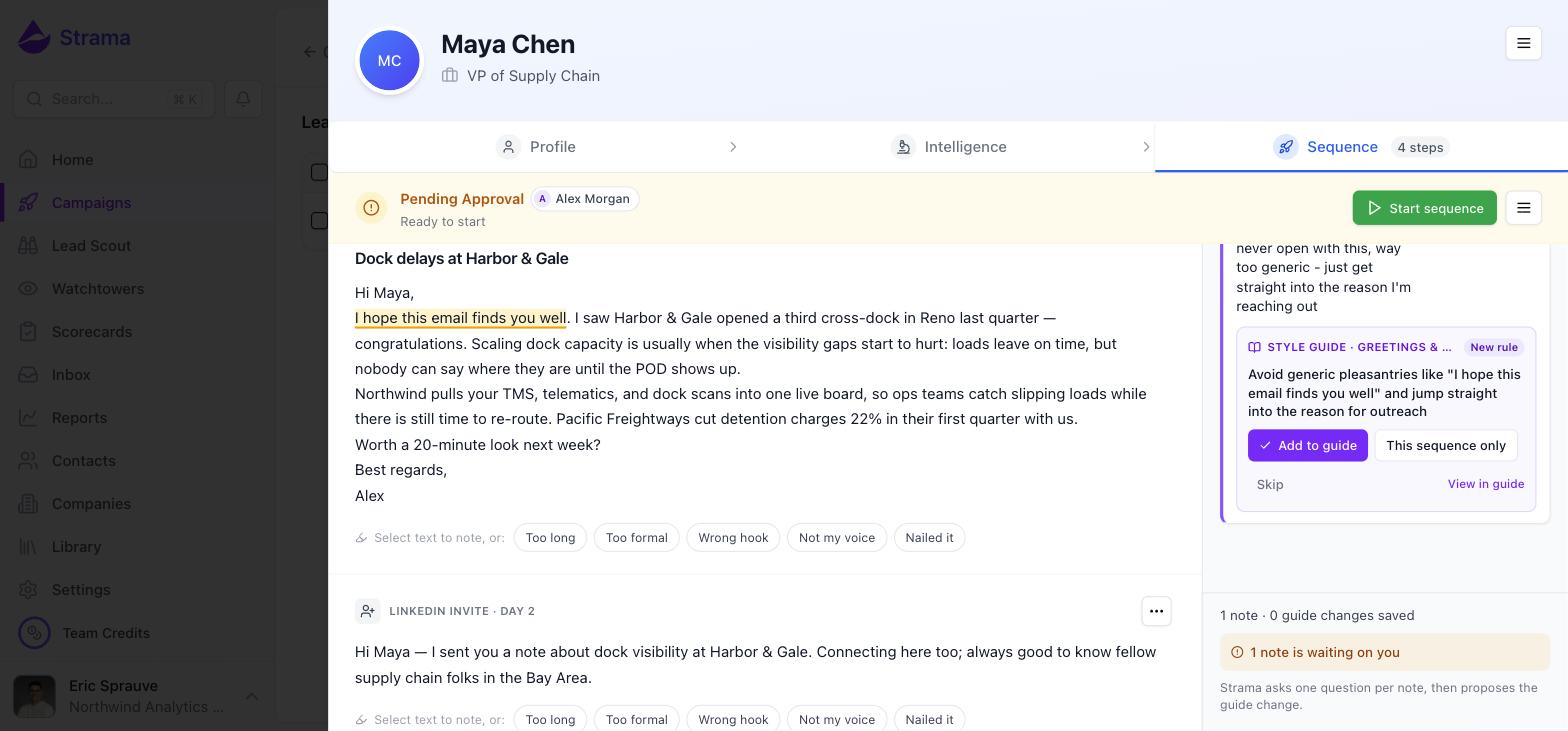
The style guide is per sender, so one rep’s rules never bleed into a teammate’s messages. Every sequence also stays a draft until a rep starts it, which is the review step the shortlist above asks for (making the AI sound like you).
Judge it on pipeline, not on how polished the copy looks. Speck Design grew pipeline about 50% in its first month on Strama (the Speck Design story).
Choose Better Context, Not Just Faster Copy
The strongest AI platforms for B2B sales outreach do more than write acceptable emails at speed. They help teams select the right accounts, understand what makes outreach relevant now, preserve a recognizable sales voice, and execute consistently across channels.
For sales development leaders, the standard is simple: choose technology that gives reps better context and fewer administrative steps while maintaining human accountability. When AI supports that discipline, personalized outreach becomes scalable without becoming impersonal.