Friday, October 9, 2026
The B2B Cold Email Reply-Rate Playbook: Better Targeting, Relevance, and Follow-Through

Why More Emails Rarely Solve a Reply Problem
What if your cold-email reply rate is not primarily a copywriting problem, but a signal that your targeting, timing, and follow-up process are misaligned?
Over the next year, B2B outbound teams will be judged more on the quality of conversations created per account than on the number of emails sent. As inbox providers raise deliverability standards and buyers become more selective, high-volume generic outreach will become even less reliable. The teams that earn replies will combine sharp account selection, credible personalization, disciplined sequences, and fast learning loops.
A reply to a cold email is a small but real commitment. It means the recipient recognized enough relevance, trust, or urgency to spend time responding. Improving that takes a system that makes each message timely, specific, easy to answer, and consistently delivered to the inbox. A clever subject line is not enough.
The Reply-Rate Levers That Matter Most
- Prioritize account fit before message volume. A relevant message sent to the wrong company is still irrelevant. Use firmographic, technographic, trigger, and buying-context data to narrow the audience.
- Personalize around a business hypothesis, not a superficial fact. Mentioning a funding round, job title, or recent post is not enough unless it connects to a plausible business priority. Learn why “congrats on your funding” emails often fail and what to use instead.
- Make the first email easy to process and easier to answer. Lead with a concise observation, connect it to a relevant outcome, and end with a low-friction question.
- Use multi-channel engagement to create familiarity, not to overwhelm prospects. Coordinate email, LinkedIn, and phone outreach around one consistent point of view.
- Protect deliverability as carefully as messaging quality. Poor domain reputation, weak authentication, and excessive sending volume can suppress reply rates before a prospect ever sees the email.
- Measure positive replies by segment and experiment. Overall reply rate can hide major differences across industries, personas, account tiers, and messaging angles.
Start with the accounts most likely to care
The most effective way to increase reply rates is to reduce the number of people who have no reason to reply.
Lead sourcing and qualification should begin with a clear ideal customer profile. Define the characteristics that indicate both fit and potential need:
- Company size, industry, geography, and growth stage
- Technology stack or operational environment
- Hiring patterns and organizational changes
- Recent product launches, market expansion, or leadership changes
- Known pain indicators, such as inefficient sales processes or fragmented tools
- The likely economic buyer, champion, and end user
Then add a second layer: a reason to engage now. A target account can match your ICP and still be a poor prospect this quarter. Timing signals (new hiring, strategic initiatives, technology changes, or a relevant business event) help SDRs distinguish a theoretical fit from an active opportunity.
This is where a repeatable scoring model helps. Instead of asking reps to interpret dozens of account attributes by hand, set weighted criteria for fit, urgency, and access to the right stakeholder. Sales development automation should reduce research burden while preserving judgment for accounts that deserve deeper investigation.
Data quantity alone does not create relevance. Large contact databases may accelerate list building, but they can also produce generic outreach when they lack actionable context. As explored in why large contact databases still lead to generic emails, the differentiator is better account intelligence and a clearer messaging hypothesis, not more records.
Personalize the commercial insight, not the greeting
Prospects can quickly recognize empty personalization:
“I saw you are growing your team. Congratulations.”
The observation may be true, but it does not explain why the recipient should respond. Strong personalized messaging makes a relevant connection between a visible signal and a potential business consequence.
For example:
- Weak: “I noticed you are hiring SDRs.”
- Better: “Your open SDR roles suggest outbound coverage is expanding. Teams at that stage often find rep research time and inconsistent messaging become constraints before headcount can fully ramp.”
The second version does not claim certainty. It presents a reasonable hypothesis, identifies a recognizable problem, and gives the buyer a reason to consider whether it applies.
A practical personalization framework is:
- Signal: What changed or what is observable about the account?
- Implication: What challenge, opportunity, or operational pressure could follow?
- Proof point: Why is your perspective credible for this type of situation?
- Question: What simple question can the recipient answer without scheduling a meeting?
AI sales outreach can make this process scalable, but only if the inputs and quality controls are strong. A platform should use account context to generate a relevant draft while retaining your team’s language, positioning, and claims standards. Strama’s Style Guide approach illustrates an important principle: automation should reproduce a team’s authentic voice rather than flatten it into generic AI phrasing.
Write emails for scanning, not reading
Most cold emails compete with urgent work, internal messages, and dozens of other sales emails. The recipient should be able to understand the point within seconds.
A reliable structure is:
- Opening line: A relevant account-level observation or role-specific challenge
- Value statement: One outcome your approach can help improve
- Credibility: A concise example, customer pattern, or operational insight
- Call to action: A simple, direct question
For many first-touch emails, 75 to 125 words is enough. That is not a rigid rule; a more complex enterprise issue may require additional context. But every sentence should earn its place.
Avoid common reply-rate killers:
- Long company introductions
- Broad claims such as “revolutionary” or “best-in-class”
- Multiple requests in one email
- Overloaded personalization that feels invasive
- Feature lists with no business implication
- Calendar links as the only call to action
Instead of “Are you available for a 30-minute demo next week?” try an easier next step:
“Is reducing SDR research time a priority for your team this quarter?”
A response of “yes,” “not now,” or “we already use a tool” all creates information that can guide the next action.
Treat subject lines as a promise, not a trick
A subject line can improve opens, but it cannot make up for a weak message or poor audience selection. Use it to set an accurate expectation for the email:
Question about [company]’s outbound coverage[Company] and SDR research timeA thought on [specific initiative]
Keep the wording concrete and aligned with the body copy. Avoid deceptive “Re:” or “Fwd:” formats, excessive urgency, all caps, and vague clickbait. The goal is enough credibility for the recipient to keep reading, not just an open.
Build follow-up sequences around added value
Most qualified prospects will not respond to the first email. They may be busy, skeptical, not yet convinced, or they missed it. A thoughtful follow-up strategy gives them another reason to engage without repeating the same request.
A five-touch sequence might look like this:
- Email one: Account-specific hypothesis and a low-friction question
- Follow-up: Restate the issue more concisely and add a useful insight
- LinkedIn touch: View or connect with a short, non-promotional note
- Email three: Introduce a different proof point or stakeholder concern
- Phone call: Use a relevant reason for calling, then leave a brief voicemail only when appropriate
Space touches thoughtfully. For many B2B motions, a cadence over two to four weeks is more respectful and sustainable than daily follow-ups. Stop or pause when the account shows no fit, requests no contact, or signals that the timing is clearly wrong.
Multi-channel engagement works best when each interaction reinforces a coherent message. A LinkedIn note should not introduce an unrelated pitch; a call should not sound as though the representative has never contacted the prospect. For deeper guidance on sequencing, review these LinkedIn cadence and reply-rate considerations.
Protect inbox placement before optimizing copy
If emails land in spam or promotions folders, copy tests will produce misleading results. Deliverability is a reply-rate prerequisite.
At a minimum, sales leaders should make sure sending domains are properly authenticated with SPF, DKIM, and DMARC. Google and Yahoo have introduced stronger requirements for bulk senders, making authentication and complaint control essential operational practices rather than technical extras.
Other practical safeguards include:
- Use dedicated sending infrastructure rather than relying on one heavily used corporate inbox
- Ramp volume gradually on new domains and inboxes
- Keep list quality high and remove invalid addresses quickly
- Monitor bounce rates, spam complaints, inbox placement, and domain reputation
- Do not send the same copy at scale to poorly segmented lists
- Include a clear, functional way for recipients to opt out
Dedicated provisioning, warming, and reputation monitoring can reduce the administrative burden, but they do not justify poor targeting. Deliverability and relevance reinforce one another: better targeting produces fewer complaints, and stronger inbox placement gives relevant messages the chance to earn replies.
Measure the signals that lead to pipeline
Reply rate is useful, but it should not be the only metric. A vague “send details” response and a qualified conversation should not carry equal weight.
Track performance by audience, message, sender identity, and channel:
| Metric | What it indicates |
|---|---|
| Delivery rate | List quality and sending infrastructure health |
| Open rate | A directional signal, but increasingly imperfect due to privacy features |
| Total reply rate | Whether outreach is prompting any response |
| Positive reply rate | Whether the audience and message are creating interest |
| Meeting conversion rate | Whether positive replies become sales conversations |
| Opportunity conversion rate | Whether meetings are reaching the right buyers |
| Unsubscribe and complaint rate | Whether targeting, timing, or frequency needs correction |
Calculate positive reply rate as:
positive replies ÷ delivered emails × 100
Review results at the segment level. One message may perform well with VP-level sales leaders at growth-stage software companies and poorly with enterprise operations executives. Those differences show where your value proposition and account selection are strongest.
Use controlled tests. Change one meaningful variable at a time (such as the problem framing, call to action, or account trigger) while keeping the audience comparable. Avoid declaring a winner after a handful of sends. Look for enough volume to make decisions responsibly, then document what works in a reusable playbook.
Common Questions About Cold Email Replies
What is a good B2B cold email reply rate?
There is no universal benchmark because performance depends on list quality, market awareness, sender reputation, offer relevance, and how “reply” is defined. A better internal benchmark is your positive reply rate by segment. Improve against your own baseline while monitoring whether those replies convert into meetings and qualified pipeline.
Should SDRs use AI to write every cold email?
AI is most useful for speeding up research, drafting relevant first passes, and maintaining consistency across a large account list. SDRs should still review messages for accuracy, tone, unsupported assumptions, and strategic relevance. The best use of AI sales outreach is faster production of high-quality, controlled personalization, not hands-off volume.
How many follow-ups should a cold-email sequence include?
For a well-qualified account, three to five touches across email, LinkedIn, and phone is a reasonable starting point. The number should depend on the seniority of the buyer, sales cycle length, deal value, and engagement signals. Each follow-up should add a new angle or useful detail rather than saying “just checking in.”
Does calling prospects improve email reply rates?
It can. A call can create familiarity and give an SDR immediate market feedback, particularly when it follows a relevant email. The call should be connected to the same account hypothesis, not treated as a separate generic activity. Teams can improve coaching by reviewing recorded conversations and identifying which opening statements earn dialogue; see the principles behind a cold-call script that works.
Why are prospects opening emails but not replying?
An open without a reply often means the subject line succeeded but the body did not create enough relevance or trust. Review whether the message identifies a meaningful issue, supports it with credible context, and asks a question that is easy to answer. Also check whether the recipient is the right stakeholder.
Put a Reply-Rate Improvement System in Place
Start with a focused 30-day improvement cycle rather than rewriting every sequence at once.
- Audit your current baseline. Break down delivery, replies, positive replies, meetings, and objections by segment.
- Choose one priority audience. Define the account criteria, buyer roles, and timing signals that make that audience worth pursuing.
- Create two messaging hypotheses. Base each on a distinct business problem, not cosmetic copy differences.
- Build a coordinated cadence. Combine email with appropriate LinkedIn and phone activity, using one consistent narrative.
- Check deliverability weekly. Monitor bounces, complaints, domain health, and sending volume before judging copy performance.
- Review responses qualitatively. Categorize positive, negative, neutral, and objection-based replies to refine the next iteration.
For teams managing this at scale, an integrated workflow can make the process more manageable: source accounts, score fit, generate on-brand messages, sequence touches, and capture call intelligence in one operating rhythm. That is where sales pipeline optimization becomes practical rather than theoretical.
How Strama Approaches Reply Rates
Most of this playbook comes down to one standard: every message should say something true and current about the person reading it. In Strama, each contact is researched and graded against your scorecard before anything is written, and the sequence draws on that research, your content library and your style guide. Generated claims are checked against their sources before a rep sees the draft.
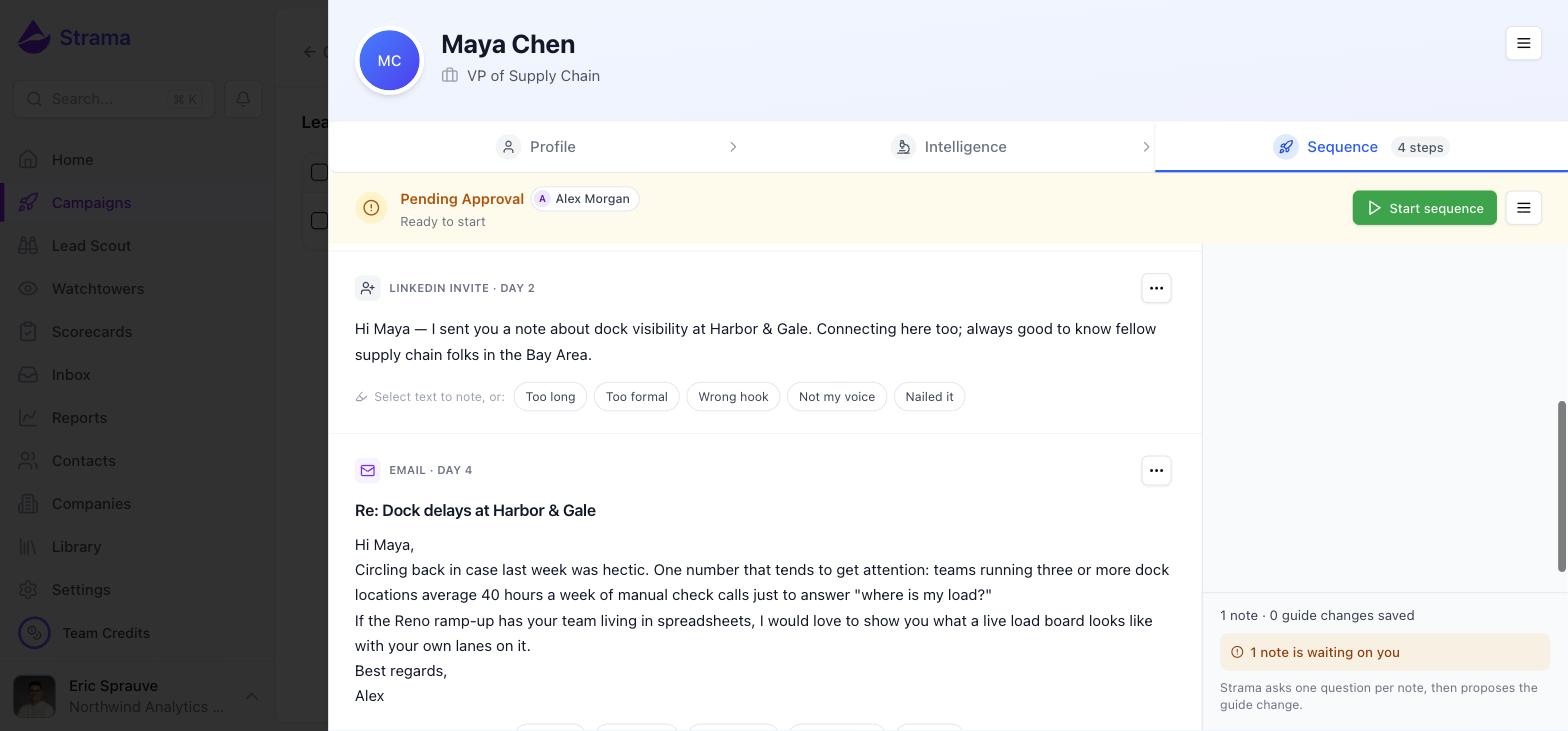
Two mechanics map to the sections above. Email and LinkedIn copy never reference each other, because many prospects read one channel and ignore the other. And when a prospect replies, the sequence stops and the conversation lands in one Inbox, so a follow-up never goes out after someone has already answered (how Strama works).
Speck Design grew pipeline about 50% in its first month on Strama (the Speck Design story).
Better Replies Begin Before the First Send
The most reliable way to raise cold-email reply rates is to earn attention rather than demand it. Select accounts with a credible reason to care, translate real signals into relevant hypotheses, write concise messages that invite an easy response, and follow up across channels with discipline. Then measure what creates qualified conversations, not just activity.
When targeting, personalized messaging, deliverability, and sales development automation operate as one system, SDR teams spend less time chasing responses and more time starting the right conversations.