Monday, October 12, 2026
A Practical Guide to Sales Platforms That Unite Email, LinkedIn, and Phone

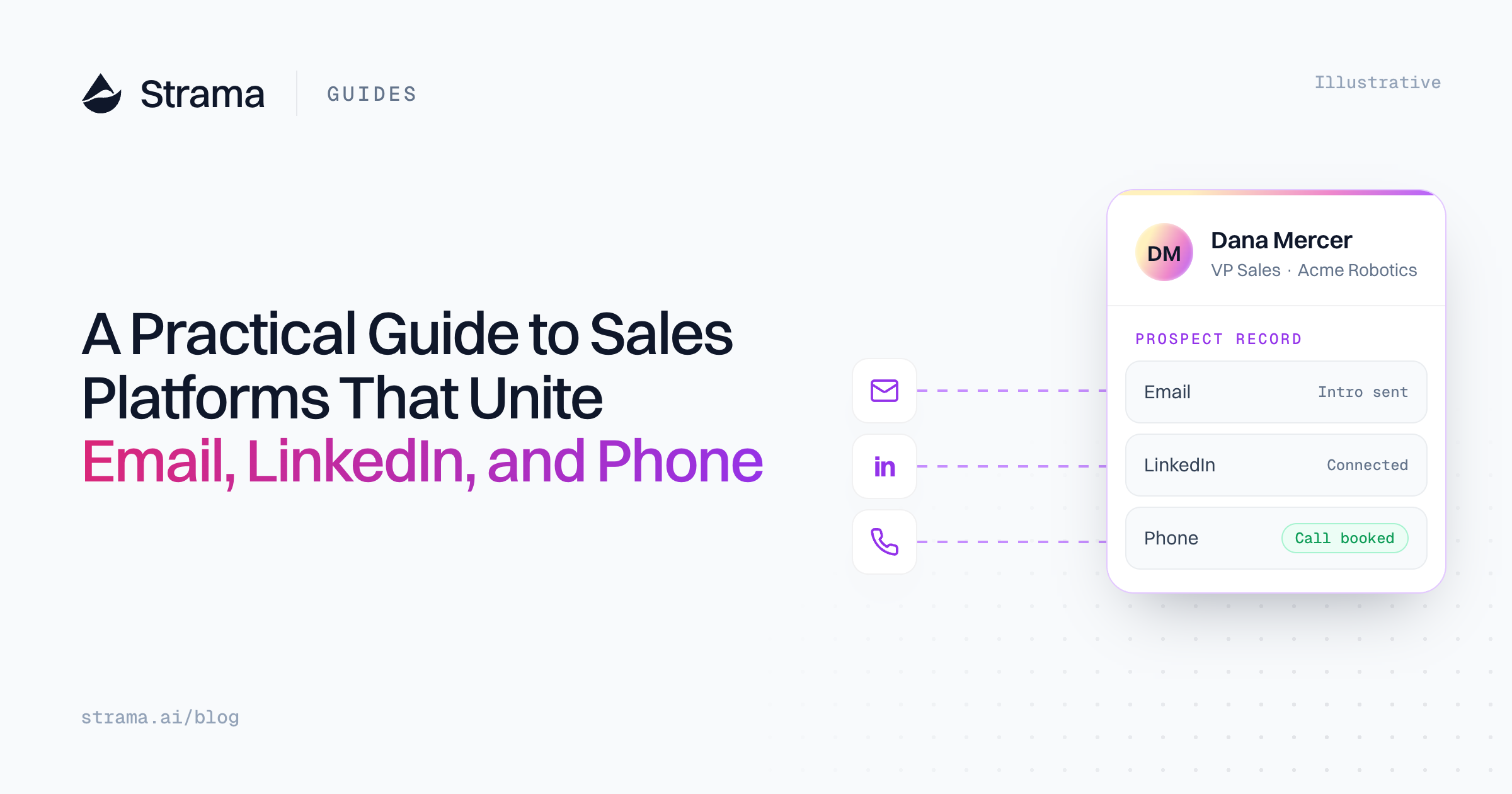
The “All-in-One” Claim Needs Closer Scrutiny
What does “integrated outreach” actually mean if your SDRs still have to switch tabs, manually create LinkedIn tasks, and copy call notes into a CRM?
Many sales platforms claim to support email, LinkedIn, and phone. But the depth of that support varies widely. One tool may let reps place calls and send email while only reminding them to visit LinkedIn. Another may automate parts of LinkedIn engagement but leave lead sourcing, qualification, or call documentation disconnected. For sales development leaders, those differences determine whether a platform reduces administrative work or simply centralizes it.
An integrated multi-channel outreach platform should help teams coordinate activity across channels, preserve the context of every interaction, and guide SDRs toward the next best action. It should also support responsible outreach practices: platform policies, consent requirements, deliverability safeguards, and human review where judgment matters.
What “integrated” should mean for an SDR team
At a minimum, a platform should bring these capabilities into one workable sequence:
- Email: Personalized email steps, reply handling, activity tracking, and deliverability controls.
- LinkedIn: Connection requests, profile views, messages, or at least LinkedIn tasks that fit logically within a cadence.
- Phone: Click-to-call or a built-in dialer, call outcome logging, recordings or transcriptions where permitted, and follow-up actions.
- Shared prospect context: A single record that shows prior emails, LinkedIn touches, calls, qualification data, and next steps.
- Sequence orchestration: Rules that prevent redundant touches (for example, pausing an email sequence after a prospect replies on LinkedIn).
- Reporting: Channel-level and sequence-level performance data, including meetings created and opportunities influenced rather than only activity volume.
Adding more channels does not automatically improve results. Multi-channel engagement works when each touch gives a distinct reason to respond. Three disconnected activities are just noise delivered through different channels.
Platform categories worth evaluating
Several categories of sales technology can support email, LinkedIn, and phone outreach, although their approaches differ.
Sales engagement platforms such as Outreach and Salesloft typically provide strong email cadence management, dialer functionality, coaching features, and CRM integration. LinkedIn is commonly handled through manual or semi-guided tasks within a sequence, rather than unrestricted automated messaging. This model can fit enterprise teams that prioritize governance, forecasting, and sales execution discipline.
Prospecting and engagement platforms such as Apollo combine contact data, sequencing, email, and calling capabilities. They can be useful when teams want prospect discovery and execution in a shared environment. Buyers should check data coverage in their target market, dialer availability by region, and whether LinkedIn actions are native, task-based, or dependent on an extension.
Sales automation platforms such as Reply.io and similar tools often emphasize multi-channel sequences that combine email, LinkedIn activity, and calls. Their suitability depends on how well the platform handles personalization, workflow controls, inbox health, and CRM synchronization at the team’s operating scale.
CRM-centered suites such as HubSpot Sales Hub can combine email tracking, calling, sales sequences, and LinkedIn Sales Navigator integration. This route may work well for teams committed to a single CRM ecosystem. Teams should still check whether the LinkedIn workflow is embedded in rep execution or primarily an adjacent integration.
AI-native SDR workflow platforms are designed to connect the work that happens before outreach (finding accounts, scoring fit, identifying signals, and assembling context) with the outreach itself. Strama falls into this category, bringing lead sourcing, account scoring, AI-generated personalized messaging, email, LinkedIn, and phone activity together. Rather than treating sequencing as the starting point, this approach addresses the upstream work that often prevents personalization from scaling.
For example, teams that need to turn a broad territory into an actionable account list can benefit from eliminating the spreadsheet handoff described in this look at the list-building bottleneck. The right platform is the one that removes the most consequential workflow gaps, which is not always the one with the longest feature list.
How leading options differ in practice
When comparing platforms, assess the operating model rather than accepting a generic “multichannel” label.
| Platform type | Phone | Best fit | Key question to ask | ||
|---|---|---|---|---|---|
| Sales engagement platform | Mature sequencing and analytics | Often task-led | Strong dialing and coaching | Structured enterprise sales teams | Are LinkedIn actions automated, guided, or manual? |
| Prospecting plus engagement platform | Sequencing tied to contact data | Usually extension or task support | Often built in | Teams seeking data and execution together | Is data quality reliable for our ICP and regions? |
| CRM-centered suite | Native CRM activity history | Integration-led | Native or integrated calling | CRM-first organizations | Can reps run the whole workflow without leaving the CRM? |
| AI-native SDR workflow platform | AI-assisted, personalized sequences | Connected sequence actions | Built-in or connected calling | Teams scaling tailored outbound | Does it connect sourcing, qualification, context, and execution? |
Look closely at a platform’s LinkedIn approach. LinkedIn policies and product capabilities can limit automation, so responsible tools often use tasks, reminders, browser-assisted workflows, or approved integrations rather than fully automated direct messaging. That is not necessarily a weakness. A well-timed, rep-reviewed LinkedIn message can be more credible than volume-driven automation.
The practical goal is sequence continuity: an SDR should see that a prospect opened an email, engaged with a LinkedIn touch, or spoke briefly on the phone, and know what to do next. Strama’s multi-channel sequence approach reflects that principle by running email and LinkedIn as independent tracks inside one sequence that stops when the prospect replies, rather than treating each channel as a separate campaign.
The capabilities that matter beyond channel coverage
Channel support is table stakes. The real buying criteria are the systems around it.
Lead sourcing and qualification. If reps receive poorly matched leads, better sequences only make poor outreach faster. Look for custom account scoring criteria that reflect your actual ideal customer profile: company size, geography, technology stack, growth signals, hiring patterns, or other relevant attributes. Effective AI for sales prospecting should improve prioritization, not just generate a larger list.
Personalized messaging at scale. Personalization should draw on meaningful context, such as an initiative, role-specific challenge, trigger event, or account priority. It should not rely on superficial merge fields. A messaging system also needs to preserve your team’s tone so outreach does not sound generic or artificially polished. A clear team style guide can help AI turn account context into messages that still sound like the people sending them.
Call intelligence. A built-in dialer is more useful when calls are recorded and transcribed in accordance with applicable laws and company policies. Transcripts help managers coach, let SDRs reference objections accurately, and create a usable record for the account executive who inherits the opportunity.
Sending infrastructure. Email remains vulnerable to deliverability problems. Dedicated domains and inboxes, automated warming, and reputation monitoring are operational requirements, not technical extras, when scaling outbound. A polished sequence cannot perform if it reaches spam folders, a problem explored in the infrastructure issues that undermine outreach.
Buying signals. Timely outreach can outperform higher-volume outreach. A prospect who has recently changed roles, raised funding, expanded a team, or shown another relevant signal may deserve a different sequence and faster follow-up. Signal-based monitoring makes sales pipeline optimization more deliberate by directing attention toward accounts with a reason to engage now.
What a Strong Multi-Channel Stack Delivers
- Platforms including Outreach, Salesloft, Apollo, Reply.io, HubSpot Sales Hub, and AI-native SDR workflow tools can support combinations of email, LinkedIn, and phone, but the degree of integration differs a lot.
- “LinkedIn support” often means sequence tasks or guided workflows, not unrestricted automated messages. Confirm the exact workflow and ensure it aligns with LinkedIn policies.
- The best sales development automation connects prospecting, account qualification, personalized messaging, outreach execution, and reporting in one operating flow.
- Evaluate email deliverability infrastructure and call documentation alongside sequence features; both have a direct effect on whether activity becomes pipeline.
- Use channel orchestration to add context, not volume. A phone call, LinkedIn touch, and email should each have a clear purpose in the buyer journey.
- Prioritize platforms that show reps a complete account history and suppress unnecessary follow-ups after a meaningful response.
Questions Sales Leaders Ask Before Choosing a Platform
Which platform is best for email, LinkedIn, and phone outreach?
There is no universal best option. Outreach and Salesloft are commonly considered by larger companies that need mature sales engagement controls and enterprise integrations. Apollo may suit teams that want prospect data and engagement capabilities together. HubSpot Sales Hub can be a practical choice for CRM-centric teams. Platforms such as Strama are relevant when the requirement extends beyond sequencing to include AI sales outreach, lead sourcing and qualification, account scoring, personalized messaging, and coordinated execution across channels.
The best choice depends on your CRM, target-market data needs, compliance requirements, sales motion, and the amount of manual workflow your SDRs currently manage.
Can a platform automate LinkedIn messages safely?
Teams should be cautious with the word “automate.” LinkedIn’s policies, account restrictions, and product capabilities affect what tools can do and what is appropriate. Many platforms support LinkedIn through tasks, prompts, browser-assisted actions, or approved integrations rather than fully autonomous messaging.
A safer approach is to automate preparation and workflow coordination: surface the right profile, suggest a relevant message, create the follow-up task, and log the interaction. Keep the SDR responsible for reviewing and sending communications when needed.
Should SDRs use the same message on email, LinkedIn, and phone?
No. The core insight can remain consistent, but the execution should adapt to the channel. An email can provide more detail and a resource. A LinkedIn note should be concise and contextual. A phone call should open with a clear reason for calling and invite a conversation rather than recite an email.
Good multi-channel engagement creates recognition without repetition. If every touch uses identical copy, the sequence feels automated even when the underlying research is strong.
What metrics prove that multi-channel outreach is working?
Track both leading and outcome metrics. Leading indicators include positive reply rate, call connection rate, LinkedIn acceptance rate, task completion, and deliverability. Outcome metrics should include qualified meetings booked, meeting-to-opportunity conversion, pipeline created, pipeline conversion, and revenue contribution.
Review results by persona, industry, account tier, sequence, and channel mix. Do not assume a channel caused success just because it appeared in a sequence; compare conversion patterns across consistent segments.
How many touches should a multi-channel sequence include?
The answer depends on deal size, buyer seniority, market saturation, and message relevance. Start with a modest sequence that gives each interaction a purpose (often several touches over a few weeks), then test cadence length and channel order. Avoid treating a lack of response as permission to increase frequency indefinitely.
Use negative signals, unsubscribes, direct replies, and account-level activity to stop or adjust sequences quickly. Quality control matters more than hitting a predetermined activity quota.
Build a Better Evaluation Process
Before scheduling demos, map your current SDR workflow from account selection through handoff to an account executive. Count the systems, manual exports, repetitive tasks, and points where prospect context disappears. That exercise will clarify whether you need a sequencing tool, a data provider, a dialer, or a connected platform that covers the whole SDR workflow.
Then run a structured pilot:
- Define one target segment. Choose a clear ICP slice with enough accounts to produce meaningful results.
- Set qualification rules. Establish the account attributes and buying signals that determine priority.
- Build two or three channel-aware sequences. Give every email, LinkedIn interaction, and call a distinct role.
- Create message guardrails. Define tone, approved claims, personalization standards, and escalation rules.
- Measure business outcomes. Compare qualified meetings and pipeline progression, not just open rates or tasks completed.
- Audit rep experience. Ask SDRs how many tabs, exports, and manual updates remain after implementation.
For teams exploring an integrated model, Strama’s Lead Scout can reduce the friction between identifying a persona and beginning outreach, while Scorecards can apply custom fit criteria before SDR time is spent. Its Style Guide learns from the feedback reps leave on drafted messages, so email and LinkedIn copy keeps the team’s voice, and sequences can include call steps alongside a built-in dialer that records and transcribes calls.
The most useful pilot question is simple: did the platform give reps more time for relevant conversations, or did it just help them perform more activity?
How Multi-Channel Sequences Work in Strama
In Strama, every lead in a campaign gets one sequence, and email and LinkedIn run in it as independent tracks. The default is five emails and two LinkedIn messages over 21 days, with the connection invite added automatically, and you can add call steps and profile visits. A pending invite never holds up the emails, and the two channels never reference each other, because a lot of prospects only read one of them.
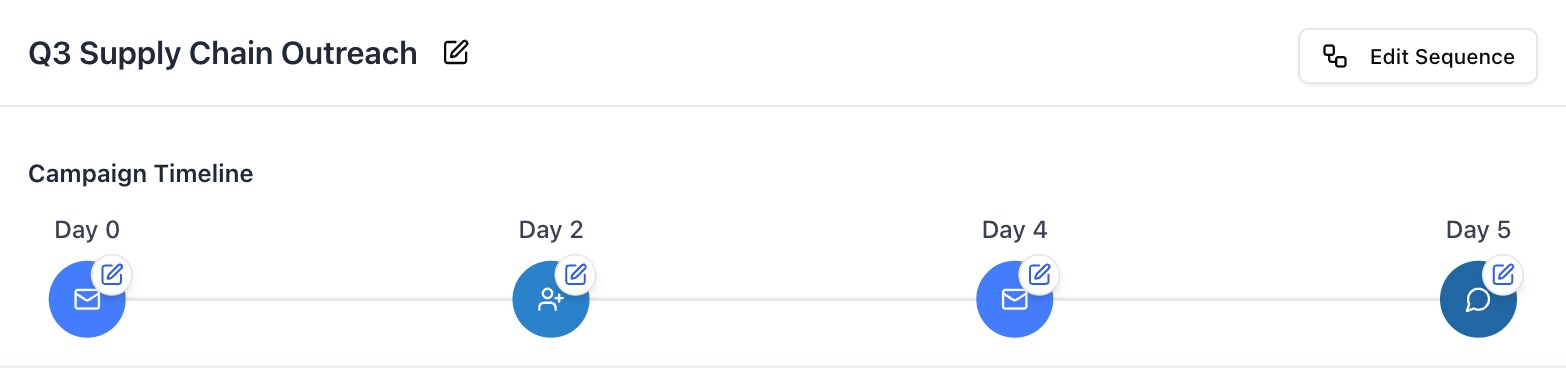
When a prospect replies, the sequence stops and the reply lands in one Inbox, so nobody gets a follow-up after they already answered. Every sequence is a draft until a rep starts it, which is the review step the pilot above calls for (how sequences run).
Judge it on pipeline, not activity. TCS Basys opened roughly $16M in qualified pipeline, with its first meeting in under 30 days (the TCS Basys story).
Integration Is a Workflow Outcome, Not a Feature Checkbox
A platform that supports email, LinkedIn, and phone can improve outbound performance, but only when those channels operate as one informed conversation. The strongest platforms connect account selection, qualification, personalization, timing, calls, and follow-up without forcing SDRs to reconstruct context at every step. Evaluate the actual rep workflow, the quality of account intelligence, the limits of LinkedIn execution, and the deliverability foundation behind email. When those elements work together, multi-channel outreach becomes a disciplined system for creating pipeline rather than a larger collection of sales tasks.