Monday, October 5, 2026
The Best AI Platforms for Personalized B2B Sales Outreach: A Practical Buyer’s Guide

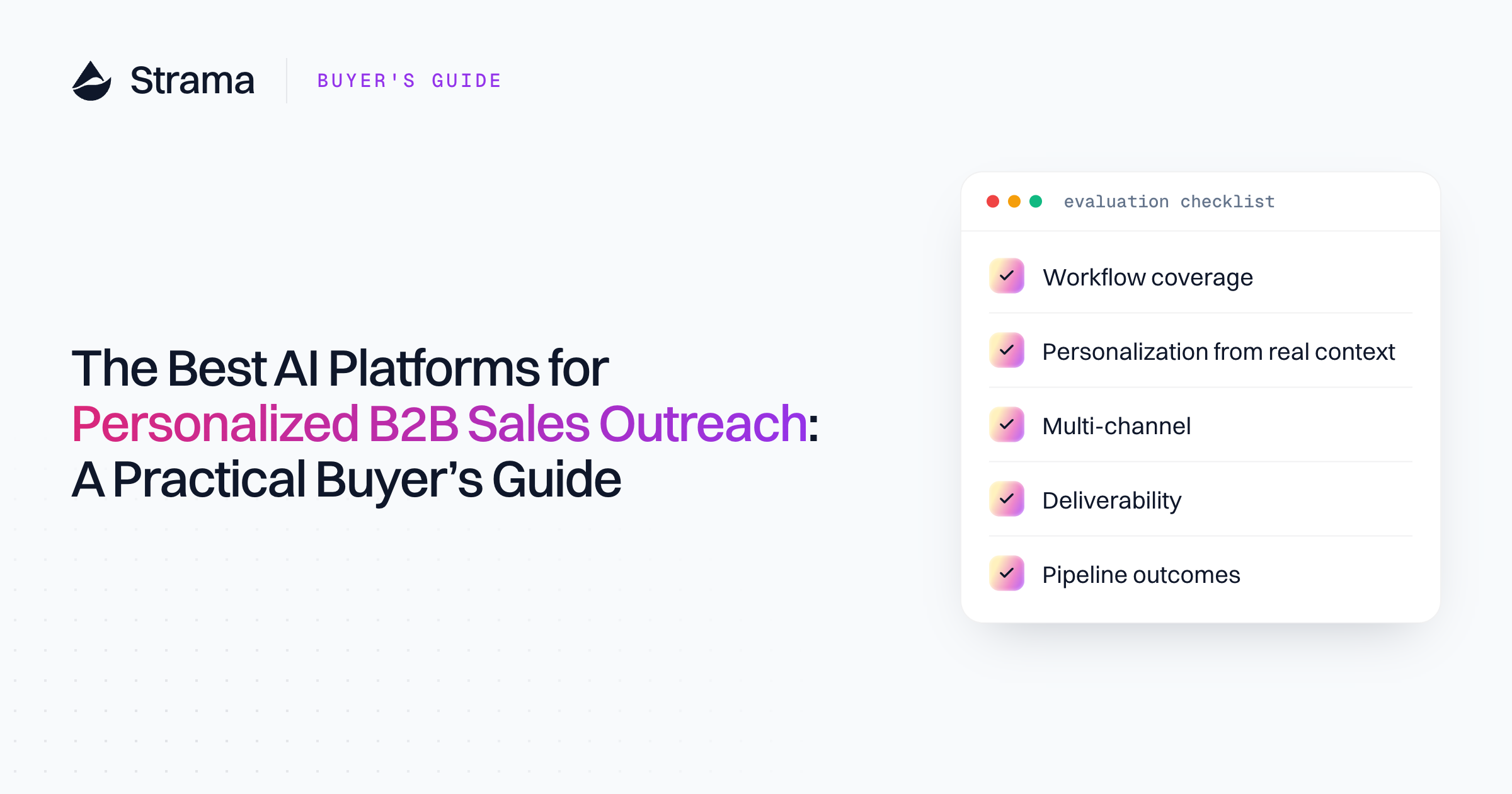
The Best Platform Is Not the One That Sends the Most Messages
What if the AI outreach platform your team calls “efficient” is quietly making your outbound less effective? Volume has become an easy proxy for progress, but B2B buyers do not reward automated activity: they reward relevance. The best AI platforms for personalized sales outreach do more than generate email copy. They help SDR teams identify the right accounts, recognize meaningful buying signals, preserve a credible human voice, coordinate follow-up across channels, and protect deliverability.
That matters in a crowded market. Many tools solve one narrow problem: sequencing, contact data, email writing, or call recording. A stronger sales development automation platform connects those steps into a workflow that turns account context into timely, personalized action.
For mid-market and enterprise sales teams, the useful question goes past “Which AI tool can write outreach?” to “Which platform enables our team to create more qualified conversations without sacrificing judgment, brand credibility, or operational control?”
What a High-Performing AI Outreach Stack Must Deliver
- Prioritize workflow coverage over isolated AI features. The most capable platforms connect lead sourcing and qualification, messaging, sequencing, calling, and performance feedback rather than requiring SDRs to manage a patchwork of tabs and exports.
- Treat personalization as evidence, not token insertion. Effective personalized messaging reflects account priorities, role-specific pain points, relevant triggers, and a clear reason to engage now, not just a first name and company reference.
- Evaluate data and timing before copy generation. Even excellent AI-written outreach will fail when the account is a poor fit, the contact is wrong, or the timing is irrelevant.
- Choose channels based on buyer behavior. Email remains essential, but multi-channel engagement can combine email, LinkedIn, and phone in a coordinated, non-repetitive sequence.
- Protect sender reputation as a core buying criterion. Dedicated sending infrastructure, inbox warming, monitoring, and sensible sending controls are as important as the message itself.
- Measure business outcomes, not output volume. Track positive replies, meetings held, qualified opportunities, conversion by segment, and pipeline contribution, not only emails sent or open rates.
- Keep humans accountable for strategy. AI can speed up research and execution, but SDR leaders still need clear ICP rules, approved messaging principles, review processes, and escalation paths.
Questions Buyers Ask Before Choosing an AI Outreach Platform
What types of AI platforms are available for B2B sales outreach?
Most platforms fall into four overlapping categories:
- Sales engagement platforms organize sequences, tasks, email steps, calls, and activity reporting. They are often strongest when a team already has reliable account and contact data.
- AI writing assistants help representatives draft subject lines, emails, call scripts, and follow-ups. They can improve speed, but typically do not solve targeting or execution workflow problems on their own.
- Prospecting and intent-data tools help teams find contacts, enrich records, and identify possible buying signals. Their value depends on data quality and the team’s ability to act on insights quickly.
- Integrated AI SDR platforms combine prospecting, qualification, personalized messaging, multi-channel sequencing, and infrastructure in one operating environment.
The first three can work well in an established stack. Teams trying to scale outbound with fewer handoffs often do better with an integrated approach. The hard part is moving from a potentially relevant account to a well-timed, well-executed conversation, more than writing the email. That is why solving the list-building bottleneck has outsized impact on SDR productivity.
What should a team look for in personalized messaging capabilities?
A platform should produce messages from meaningful context, not generic templates with variables. During an evaluation, ask vendors to show how their AI uses:
- Account attributes, such as industry, size, growth stage, geography, and technology environment
- Contact role, seniority, and likely responsibilities
- Public company developments and relevant business events
- Previously recorded account notes and sales interactions
- Your approved positioning, claims, proof points, and brand voice
- Rules that prevent unsupported assumptions or over-personalization
The last point matters most. A message that claims intimate knowledge of a buyer based on shallow web research can feel invasive or inaccurate. Better AI sales outreach uses context to form a relevant hypothesis, then gives the buyer an easy way to confirm or reject it.
Voice consistency should also be testable. For example, Strama’s Style Guide learns from the feedback reps leave on drafted messages, so AI-generated outreach reflects each sender’s own writing style rather than defaulting to a polished but interchangeable “AI voice.” This matters because being recognizably human still matters in sales, particularly for complex B2B purchases where trust develops over several interactions.
Which capabilities matter most beyond AI email writing?
The strongest platforms support the full SDR motion. Prioritize these capabilities:
- Lead sourcing and qualification: Search for relevant personas and companies, apply fit criteria, and keep representatives working from one current record set. Strama Lead Scout and Scorecards reflect this model: find prospects that match a persona, then grade each company and contact against your own fit criteria before outreach begins.
- Signal monitoring: Track changes that may make an account more likely to engage, then route those signals into a timely action. Signal-based outreach is more useful when the trigger changes the message or prioritization decision, not when it simply adds another alert. See this explanation of signal-based monitoring for sales prospecting.
- Multi-channel engagement: Coordinate email, LinkedIn, and phone activity around a single account strategy. Each touch should add a distinct reason to respond instead of repeating the same pitch.
- Calling support: A built-in dialer, call recording, and transcription reduce administrative burden and create usable context for future outreach.
- Governance and reporting: Managers need visibility into account scoring, message quality, engagement patterns, rep activity, and conversion performance.
A narrow writing tool may still be a sensible first purchase for a small team. But if reps spend a lot of time switching among prospecting databases, spreadsheets, email tools, social tools, and dialers, a broader workflow platform will usually create more durable gains.
How should we compare AI platforms in a real pilot?
Run a controlled pilot rather than relying on a polished product demo. Choose one or two segments with enough prospect volume, define the target persona, and establish a baseline from the previous 30 to 60 days.
Evaluate each platform on five dimensions:
- Time to first campaign: Measure how long it takes to identify accounts, verify contacts, approve copy, and launch.
- Personalization quality: Have sales managers review a random sample of messages for accuracy, relevance, voice, and unsupported claims.
- Deliverability and engagement: Monitor bounces, spam complaints, reply rates, positive-reply rates, and meeting conversion. Open rates are less and less reliable because privacy features can inflate them.
- Rep adoption: Track time spent per qualified account, manual research burden, task completion, and whether reps continue using the process after the novelty period.
- Pipeline quality: Compare meetings held, sales-accepted opportunities, and opportunity conversion, not just booked meetings.
Use a minimum sample large enough to avoid overreacting to a few replies. For many teams, that means testing across several hundred contacts per comparable segment, while respecting sending limits and account-level targeting rules. Keep variables controlled: do not change the ICP, offer, messaging, channel mix, and rep assignment all at once.
Is a multi-channel approach always better than email alone?
No. More channels are not automatically more relevant. Multi-channel engagement works when it is coordinated around the buyer’s likely preferences and the value of the opportunity.
For a high-value account, an SDR may use a concise email, a thoughtful LinkedIn interaction, and a well-prepared call attempt over a defined period. For a lower-priority or broad market segment, email may be the most practical primary channel. The goal is enough helpful, consistent exposure to earn attention without creating fatigue, not the maximum number of touches.
Platforms that centralize these actions make coordination easier. Strama’s multi-channel outreach capabilities combine email, LinkedIn follow-ups, and phone outreach, while the built-in dialer records and transcribes calls, so reps keep a record of what the buyer actually said.
Why does sending infrastructure belong in an AI outreach evaluation?
Because a highly personalized message has no commercial value if it lands in spam or never arrives. Deliverability is influenced by domain reputation, inbox health, sending patterns, authentication, list quality, bounce rates, and recipient engagement.
Ask every vendor whether they provide dedicated domains and inboxes, warming processes, ongoing reputation monitoring, and controls for safe send volumes. Also ask what your team (not the vendor) must configure and maintain. The hidden infrastructure behind sales outreach performance often determines whether an otherwise strong campaign reaches its intended audience.
AI should improve relevance and prioritization, but it should never be used as an excuse to send indiscriminately. Good infrastructure and disciplined targeting are inseparable.
A Sensible Path to Selecting and Deploying Your Platform
Start by documenting the existing outbound workflow from target-account selection to meeting handoff. Identify where representatives lose time, where data becomes stale, and where personalization quality declines. This exercise often shows that the real constraint is fragmented process design, not rep effort.
Then take the following steps:
- Define the ideal customer profile and disqualifiers. Establish firmographic, technographic, geographic, and business criteria. Include explicit reasons an account should not be contacted.
- Create a scoring model. Assign priority based on fit and signals rather than contact volume. Review the model with sales and marketing leaders before automating it.
- Build messaging guardrails. Provide approved value propositions, customer evidence, prohibited claims, preferred tone, and escalation guidance. AI performs better when the strategy is clear.
- Design channel-specific plays. Determine when email, LinkedIn, and phone add value for each persona and account tier. Avoid copying the same message across every channel.
- Pilot against measurable outcomes. Compare qualified meetings and opportunity progression alongside engagement metrics.
- Review messages and calls regularly. Use transcripts, manager feedback, and conversion data to improve prompts, style guidance, qualification logic, and sequencing.
Teams considering a unified workflow can explore how AI for sales prospecting connects target selection with outreach execution. The goal is simple: give SDRs more time to think, listen, and engage while automation handles repeatable research, preparation, and follow-up tasks.
Where Strama Fits in This Evaluation
If you put Strama through the pilot above, here is what you would be testing. A scorecard holds your fit criteria in plain language. Strama researches each company and contact against live sources, grades them from A to F, and saves the full research report with citations, so a manager reviewing a message can open the source behind any claim in it.
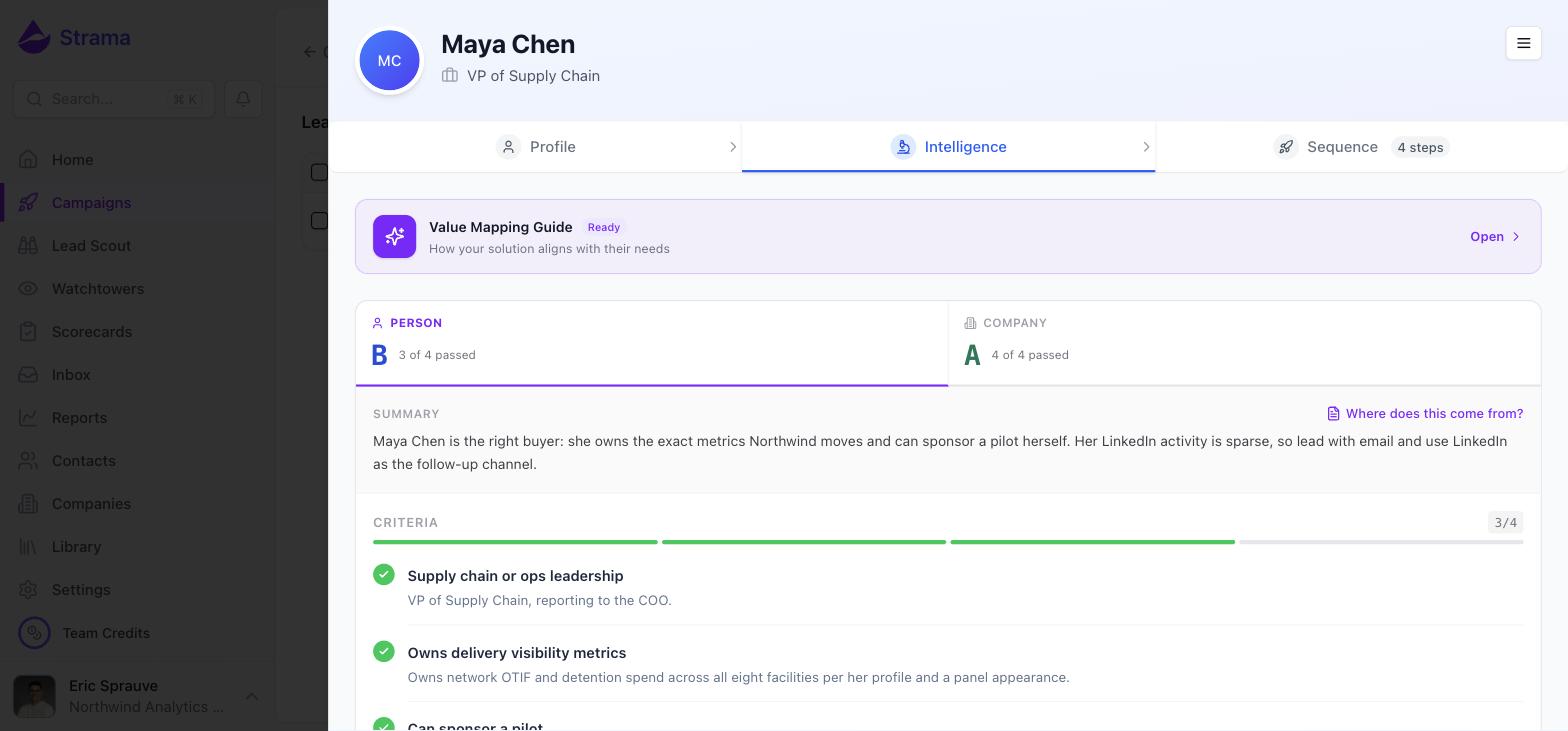
Generation then draws on that research, your content library and your style guide, and every sequence lands as a draft. Nothing sends until a rep starts it, which is the review step the governance criteria above ask for (how Strama works, end to end).
Judge any platform you pilot, Strama included, on pipeline rather than activity. TCS Basys opened roughly $16M in qualified pipeline, with its first meeting in under 30 days (the TCS Basys story).
Choose Relevance Over Automation Theater
The best AI platform for automating personalized B2B sales outreach helps your team consistently identify worthwhile accounts, act on credible context, communicate in an authentic voice, reach buyers through appropriate channels, and measure whether activity produces qualified pipeline. That may not be the platform with the most generative features or the largest claimed contact database.
For sales development leaders, that means evaluating AI as an operating system for better outbound decisions, not as a machine for producing more messages. When lead sourcing, qualification, personalization, multi-channel engagement, and deliverability work together, sales pipeline optimization becomes a repeatable process rather than a volume contest.